p.37 抽出テキスト
time-sensitive NCS. Once the P2Y12 inhibitor has been discontinued, surgery should be performed while the patient is still on aspirin. Indications for long-term DAPT have recently emerged. Long-term DAPT (beyond 1 year) with clopidogrel, prasugrel, or ticagrelor in addition to aspirin should be considered in patients with high ischaemic risk, and may be considered in patients with moderate ischaemic risk, both in the absence of increased risk of major or lifethreatening bleeding.98 When NCS is required, discontinuation of P2Y12 inhibitors is recommended for 3–7 days (depending on the P2Y12 inhibitor) for these additional indications for DAPT.

5.3.1.3 De-escalation of antiplatelet effect

The management of antiplatelet therapy in patients who have undergone recent PCI and are scheduled for NCS should be discussed by the surgeon and cardiologist, so that the balance between the risk of life-threatening surgical bleeding on antiplatelet therapy—best understood by the surgeon—and the risk of life-threatening stent thrombosis due to premature DAPT discontinuation—best understood by the cardiologist—can be considered (Figure 5 and Figure 6). An increased risk of MACE as a consequence of (major) bleeding also needs to be taken into consideration when balancing risk. When time-sensitive surgery cannot be postponed and be performed with the recommended DAPT on board, de-escalation or shortening of DAPT is recommended. This may encompass either a switch from the more potent P2Y12 inhibitors prasugrel or ticagrelor to clopidogrel, or cessation of aspirin and use of prasugrel or ticagrelor monotherapy. If neither of these options is deemed to be sufficient, premature discontinuation of the P2Y12 inhibitor may be considered. If discontinuation is required, ticagrelor needs to be withheld for 3–5 days, clopidogrel for 5 days, and prasugrel for 7 days prior to surgery.262–264 Whenever possible, in patients with an indication for DAPT, surgery should be performed without discontinuation of aspirin. Aspirin might be discontinued as a last measure only with very high bleeding risk and a comparably low ischaemic risk. However, such surgical procedures should be performed in hospitals where 24/7 catheterization laboratories are available so as to treat patients immediately in case of peri-operative ischaemic events. Although generally not recommended, bridging with i.v. compounds (eptifibatide/tirofiban or cangrelor) might be applicable in rare cases when DAPT cannot be interrupted before NCS (e.g. in patients with very high risk of stent thrombosis, history of recurrent MI, recent PCI) (see Figure 5 and Figure 7).282 For patients receiving antiplatelet therapy, who have excessive or life-threatening peri-operative bleeding, transfusion of platelets is recommended as a bail-out strategy. However, ticagrelor and its active metabolite may also inhibit aggregation of transfused platelets. Experimental data indicate that administration of albumin binds ticagrelor and reduces its inhibitory effect on platelet aggregation.283 A monoclonal antibody fragment (PB2452) for neutralizing ticagrelor is in development but is not yet clinically available.284

5.3.1.4 Platelet function guided peri-operative management of

antiplatelet therapy Platelet function testing has several theoretical advantages in the peri-operative setting, including: (i) the identification of patients on antiplatelet therapy who are at increased risk of surgery-related bleeding; (ii) individualized timing of elective surgery after antiplatelet therapy cessation; and (iii) guiding therapy in bleeding complications.285–287 However, neither the optimal assay nor a universal cutoff value associated with bleeding has been defined and validated in patients undergoing NCS.

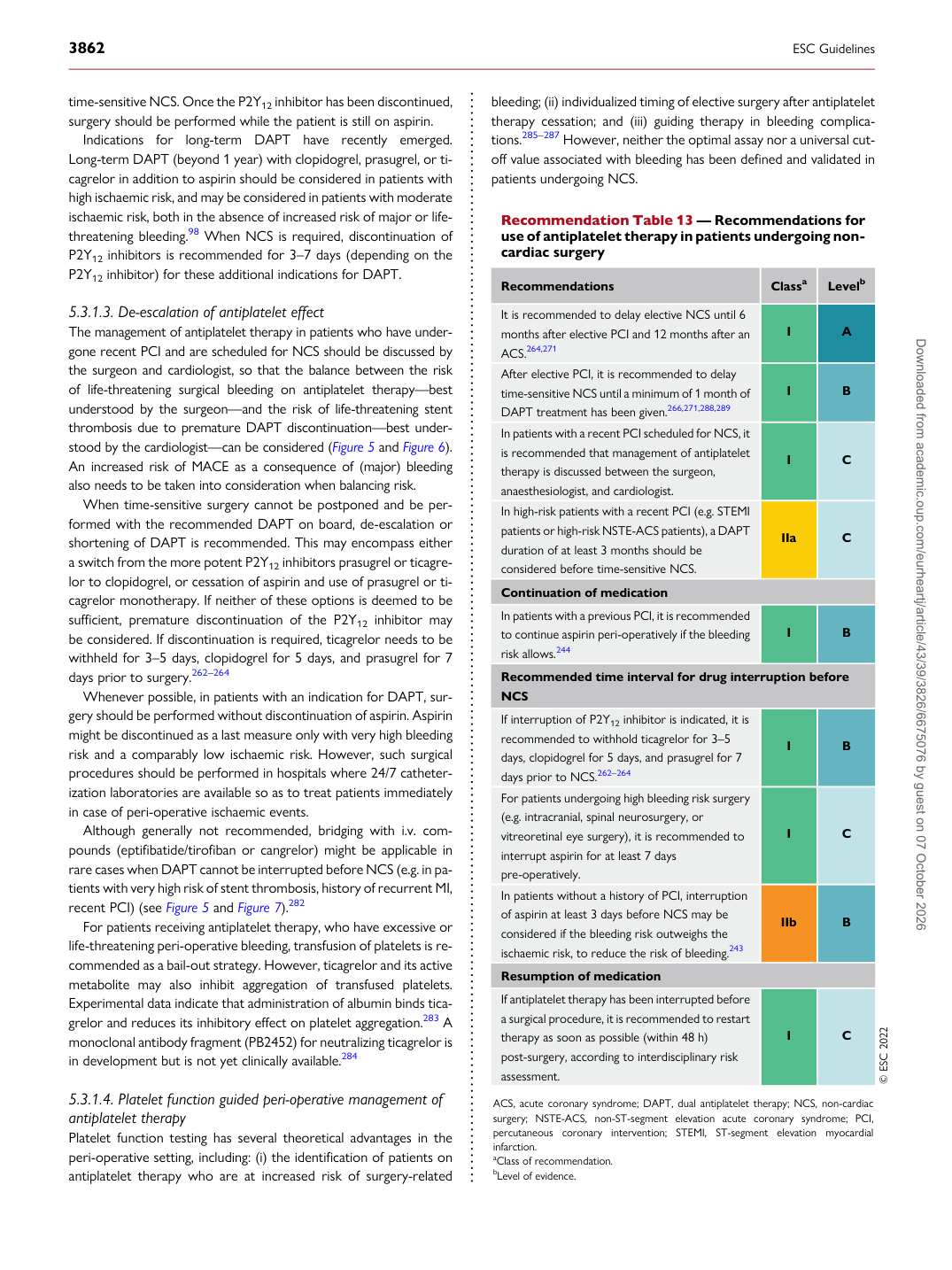
Recommendation Table 13 — Recommendations for use of antiplatelet therapy in patients undergoing noncardiac surgery

Recommendations Classa Levelb

It is recommended to delay elective NCS until 6 months after elective PCI and 12 months after an ACS.264,271 I A After elective PCI, it is recommended to delay time-sensitive NCS until a minimum of 1 month of DAPT treatment has been given.266,271,288,289 I B In patients with a recent PCI scheduled for NCS, it is recommended that management of antiplatelet therapy is discussed between the surgeon, anaesthesiologist, and cardiologist. I C In high-risk patients with a recent PCI (e.g. STEMI patients or high-risk NSTE-ACS patients), a DAPT duration of at least 3 months should be considered before time-sensitive NCS. IIa C Continuation of medication In patients with a previous PCI, it is recommended to continue aspirin peri-operatively if the bleeding risk allows.244 I B Recommended time interval for drug interruption before NCS If interruption of P2Y12 inhibitor is indicated, it is recommended to withhold ticagrelor for 3–5 days, clopidogrel for 5 days, and prasugrel for 7 days prior to NCS.262–264 I B For patients undergoing high bleeding risk surgery (e.g. intracranial, spinal neurosurgery, or vitreoretinal eye surgery), it is recommended to interrupt aspirin for at least 7 days pre-operatively. I C In patients without a history of PCI, interruption of aspirin at least 3 days before NCS may be considered if the bleeding risk outweighs the ischaemic risk, to reduce the risk of bleeding.243 IIb B Resumption of medication If antiplatelet therapy has been interrupted before a surgical procedure, it is recommended to restart therapy as soon as possible (within 48 h) post-surgery, according to interdisciplinary risk assessment. I C © ESC 2022

ACS, acute coronary syndrome; DAPT, dual antiplatelet therapy; NCS, non-cardiac surgery; NSTE-ACS, non-ST-segment elevation acute coronary syndrome; PCI, percutaneous coronary intervention; STEMI, ST-segment elevation myocardial infarction. aClass of recommendation. bLevel of evidence. Downloaded from academic.oup.com/eurheartj/article/43/39/3826/6675076 by guest on 07 October 2026