p.36 抽出テキスト
The proportion of risk attributable to underlying CVD or stent implantation remains uncertain.254 Risk factors for MACE after NCS are: time from PCI to surgery, with the highest risk in the first month; primary PCI for ST-segment elevation myocardial infarction (STEMI); dual antiplatelet therapy (DAPT) interruptions/discontinuation; and lesion characteristics, including ostial and distal lesions.252,257–259 Urgency of surgery is a further risk factor. The ESC/ESA classification of NCS is a validated tool with which to predict the impact of the type of surgery on MACE.16 A meta-analysis of observational data indicated that discontinuation of clopidogrel for at least 5 days reduced the risk of reoperation for major bleeding by 50%, without increasing the risk of MACE or death.260 Other observational data indicate an increase in MACE with brief DAPT interruptions.261 However, these nonrandomized data may have been biased by the type and urgency of surgery.260 Of note, the prognosis of stent thrombosis appears to be worse than for de novo coronary occlusion (and depends on the site of stent deployment), and premature interruption of DAPT in patients with recent coronary stent implantation is the strongest predictor for stent thrombosis.

The preferred management of patients on DAPT due to PCI is to delay elective NCS until completion of the full course of DAPT (6 months after elective PCI and 12 months after ACS).98,146 However, several recent trials have indicated that shortening DAPT duration to 1–3 months after implantation of modern DES is associated with acceptable rates of MACE and stent thrombosis in low- and moderate-risk patients. Based on these newer data, it is recommended to delay time-sensitive NCS until a minimum of 1 month of DAPT treatment has been effectuated. In high-risk CV patients, for example due to an ACS, a DAPT duration of at least 3 months should be considered before time-sensitive NCS. See Figure 5 for the recommended duration of DAPT before

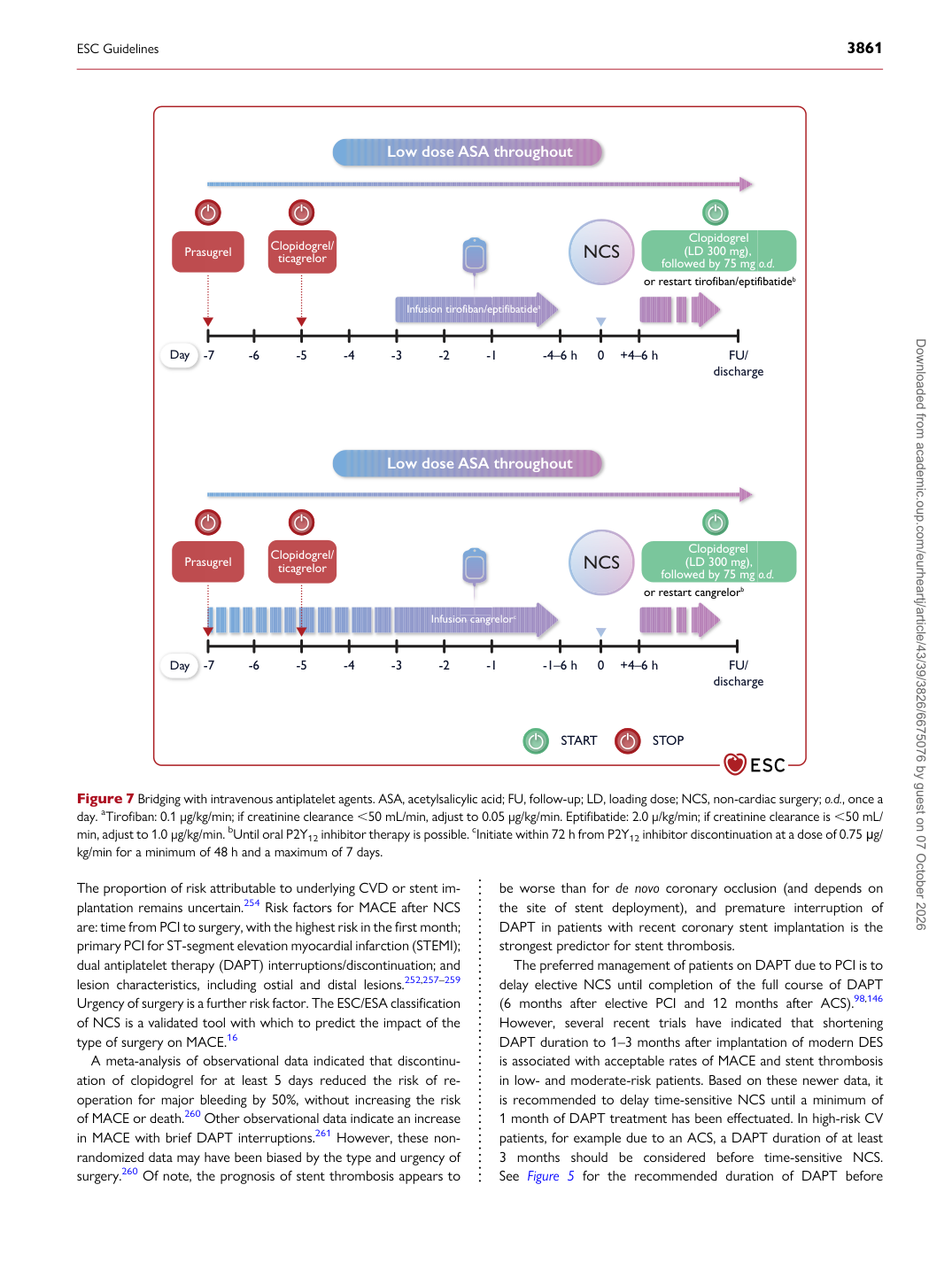
Clopidogrel (LD 300 mg), followed by 75 mg o.d.

Infusion tirofiban/eptifibatidea or restart tirofiban/eptifibatideb

ofiban/e ofiban/e

Infusion cangrelorc or restart cangrelorb

on cang r

on cang r NCS

Prasugrel Clopidogrel/

ticagrelor

Clopidogrel (LD 300 mg), followed by 75 mg o.d.

STOP START

Prasugrel Clopidogrel/

ticagrelor NCS

Day Low dose ASA throughout

-7 -6 -5 -4 -3 -2 -1 -4–6 h 0 FU/ discharge +4–6 h

Day -7 -6 -5 -4 -3 -2 -1 -1–6 h 0 FU/ discharge +4–6 h

Low dose ASA throughout

Figure 7 Bridging with intravenous antiplatelet agents. ASA, acetylsalicylic acid; FU, follow-up; LD, loading dose; NCS, non-cardiac surgery; o.d., once a day. aTirofiban: 0.1 μg/kg/min; if creatinine clearance ,50 mL/min, adjust to 0.05 μg/kg/min. Eptifibatide: 2.0 μ/kg/min; if creatinine clearance is ,50 mL/ min, adjust to 1.0 μg/kg/min. bUntil oral P2Y12 inhibitor therapy is possible. cInitiate within 72 h from P2Y12 inhibitor discontinuation at a dose of 0.75 μg/ kg/min for a minimum of 48 h and a maximum of 7 days.

ESC Guidelines                                                                                                                                                                                     3861

Downloaded from academic.oup.com/eurheartj/article/43/39/3826/6675076 by guest on 07 October 2026