p.35 抽出テキスト
the management of acute coronary syndromes in patients presenting without persistent ST-segment elevation;98 therefore, periprocedural management of clopidogrel-based single antiplatelet therapy (SAPT) is required. Consensus has been reached that a short interruption of P2Y12 inhibitor monotherapy is recommended in patients at high risk of bleeding. Patients treated with P2Y12 inhibitor monotherapy as part of a deescalation strategy after PCI/ACS, or due to a recent stroke, PAD, or aspirin intolerance, might require peri-operative management of this monotherapy.248–250 A careful interdisciplinary evaluation of perioperative bleeding vs. ischaemic risk is warranted in these situations, and individual decisions based on the peri-operative bleeding and ischaemic risk (e.g. surgery under P2Y12 monotherapy, switching to aspirin, short interruption, or bridging in the peri-operative phase) may be applicable, although evidence for these different regimens is missing. It should be recognized that the effects of ticagrelor or clopidogrel monotherapy on haemostasis are considerably less than when they are combined with aspirin.

5.3.1.2 Dual antiplatelet therapy

P2Y12 inhibitors in addition to aspirin are recommended for patients after PCI.98,146 The frequency of major NCS in the first year after PCI is ≏4%; most frequently orthopaedic, abdominal, and vascular surgery.251 Other observational data report cumulative incidences of NCS after PCI for 30 days, 6 months, and 1 year of 1%, 5%, and 9%, respectively.252 Observational studies have reported a substantial rate of MACE— including cardiac death, MI, and stent thrombosis—ranging between 2–8%251,253,254 in PCI patients undergoing NCS, with a more than two-fold increased risk compared with non-stented patients.255,256

N

P2Y12 inhibitor interruption after PCI before elective non-cardiac surgerya

ACS at index PCI or other high ischaemic risk featuresb

Time from DAPT

initiation Y

1 month

3 months

6 months

12 months Class IIIc

Class IIad

Class Ie Class IIIf

Class IIbg

Class IIah

Class Ii

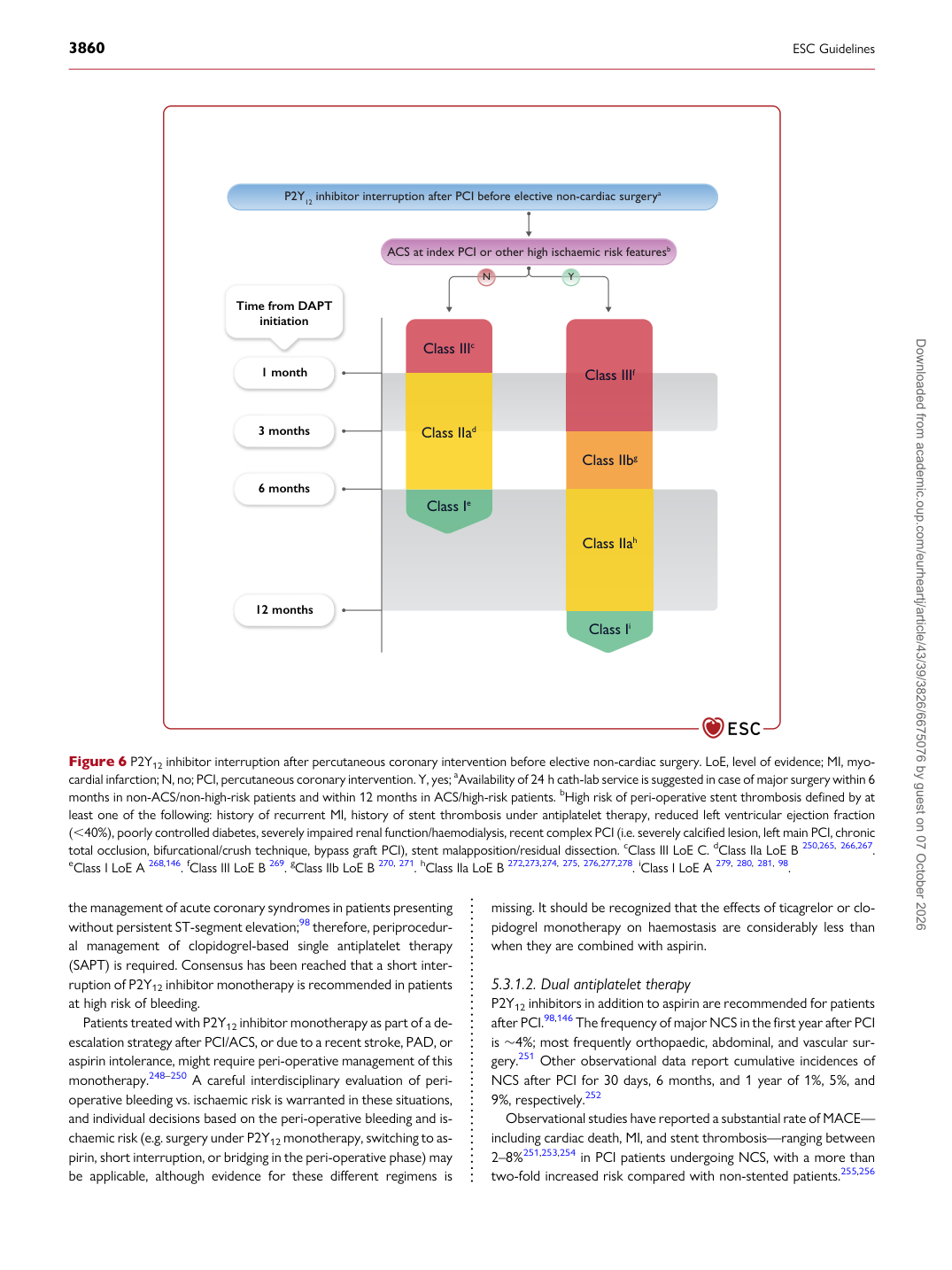
Figure 6 P2Y12 inhibitor interruption after percutaneous coronary intervention before elective non-cardiac surgery. LoE, level of evidence; MI, myocardial infarction; N, no; PCI, percutaneous coronary intervention. Y, yes; aAvailability of 24 h cath-lab service is suggested in case of major surgery within 6 months in non-ACS/non-high-risk patients and within 12 months in ACS/high-risk patients. bHigh risk of peri-operative stent thrombosis defined by at least one of the following: history of recurrent MI, history of stent thrombosis under antiplatelet therapy, reduced left ventricular ejection fraction (,40%), poorly controlled diabetes, severely impaired renal function/haemodialysis, recent complex PCI (i.e. severely calcified lesion, left main PCI, chronic total occlusion, bifurcational/crush technique, bypass graft PCI), stent malapposition/residual dissection. cClass III LoE C. dClass IIa LoE B 250,265, 266,267. eClass I LoE A 268,146. fClass III LoE B 269. gClass IIb LoE B 270, 271. hClass IIa LoE B 272,273,274, 275, 276,277,278. iClass I LoE A 279, 280, 281, 98. Downloaded from academic.oup.com/eurheartj/article/43/39/3826/6675076 by guest on 07 October 2026