p.32 抽出テキスト
5.3 Peri-operative handling of

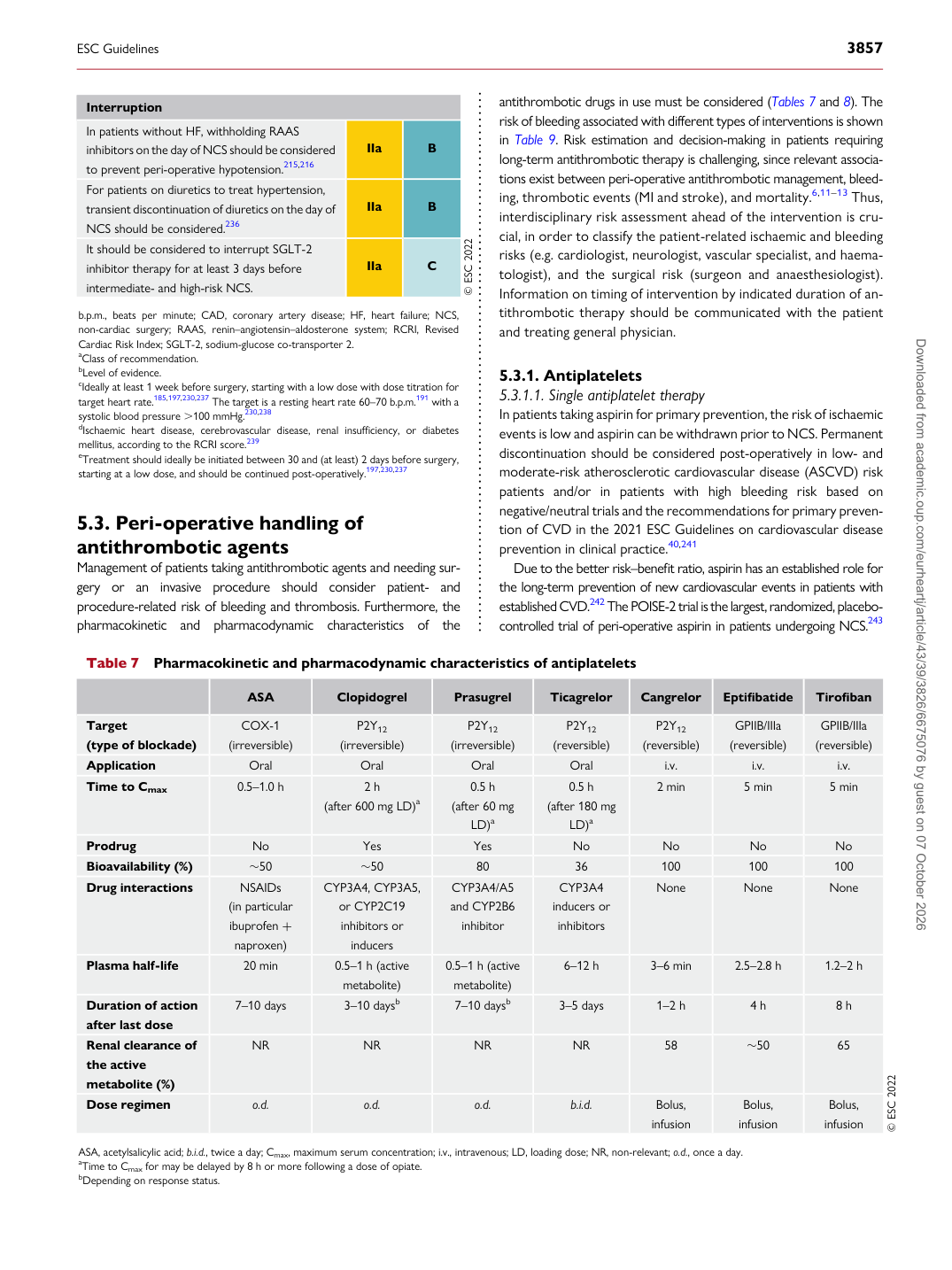
antithrombotic agents Management of patients taking antithrombotic agents and needing surgery or an invasive procedure should consider patient- and procedure-related risk of bleeding and thrombosis. Furthermore, the pharmacokinetic and pharmacodynamic characteristics of the antithrombotic drugs in use must be considered (Tables 7 and 8). The risk of bleeding associated with different types of interventions is shown in Table 9. Risk estimation and decision-making in patients requiring long-term antithrombotic therapy is challenging, since relevant associations exist between peri-operative antithrombotic management, bleeding, thrombotic events (MI and stroke), and mortality.6,11–13 Thus, interdisciplinary risk assessment ahead of the intervention is crucial, in order to classify the patient-related ischaemic and bleeding risks (e.g. cardiologist, neurologist, vascular specialist, and haematologist), and the surgical risk (surgeon and anaesthesiologist). Information on timing of intervention by indicated duration of antithrombotic therapy should be communicated with the patient and treating general physician.

5.3.1 Antiplatelets

5.3.1.1. Single antiplatelet therapy In patients taking aspirin for primary prevention, the risk of ischaemic events is low and aspirin can be withdrawn prior to NCS. Permanent discontinuation should be considered post-operatively in low- and moderate-risk atherosclerotic cardiovascular disease (ASCVD) risk patients and/or in patients with high bleeding risk based on negative/neutral trials and the recommendations for primary prevention of CVD in the 2021 ESC Guidelines on cardiovascular disease prevention in clinical practice.40,241 Due to the better risk–benefit ratio, aspirin has an established role for the long-term prevention of new cardiovascular events in patients with established CVD.242 The POISE-2 trial is the largest, randomized, placebocontrolled trial of peri-operative aspirin in patients undergoing NCS.243

Interruption In patients without HF, withholding RAAS inhibitors on the day of NCS should be considered to prevent peri-operative hypotension.215,216 IIa B For patients on diuretics to treat hypertension, transient discontinuation of diuretics on the day of NCS should be considered.236 IIa B It should be considered to interrupt SGLT-2 inhibitor therapy for at least 3 days before intermediate- and high-risk NCS. IIa C © ESC 2022

b.p.m., beats per minute; CAD, coronary artery disease; HF, heart failure; NCS, non-cardiac surgery; RAAS, renin–angiotensin–aldosterone system; RCRI, Revised Cardiac Risk Index; SGLT-2, sodium-glucose co-transporter 2. aClass of recommendation. bLevel of evidence. cIdeally at least 1 week before surgery, starting with a low dose with dose titration for target heart rate.185,197,230,237 The target is a resting heart rate 60–70 b.p.m.191 with a systolic blood pressure .100 mmHg.230,238 dIschaemic heart disease, cerebrovascular disease, renal insufficiency, or diabetes mellitus, according to the RCRI score.239 eTreatment should ideally be initiated between 30 and (at least) 2 days before surgery, starting at a low dose, and should be continued post-operatively.197,230,237

Table 7 Pharmacokinetic and pharmacodynamic characteristics of antiplatelets

ASA Clopidogrel Prasugrel Ticagrelor Cangrelor Eptifibatide Tirofiban

Target (type of blockade) COX-1

(irreversible) P2Y12 (irreversible) P2Y12 (irreversible) P2Y12 (reversible) P2Y12 (reversible) GPIIB/IIIa

(reversible) GPIIB/IIIa

(reversible)

Application Oral Oral Oral Oral i.v. i.v. i.v. Time to Cmax 0.5–1.0 h 2 h

(after 600 mg LD)a 0.5 h

(after 60 mg

LD)a 0.5 h

(after 180 mg

LD)a 2 min 5 min 5 min

Prodrug No Yes Yes No No No No Bioavailability (%) ≏50 ≏50 80 36 100 100 100 Drug interactions NSAIDs (in particular

ibuprofen + naproxen) CYP3A4, CYP3A5,

or CYP2C19 inhibitors or

inducers CYP3A4/A5 and CYP2B6

inhibitor CYP3A4 inducers or

inhibitors None None None

Plasma half-life 20 min 0.5–1 h (active

metabolite) 0.5–1 h (active

metabolite) 6–12 h 3–6 min 2.5–2.8 h 1.2–2 h

Duration of action after last dose 7–10 days 3–10 daysb 7–10 daysb 3–5 days 1–2 h 4 h 8 h Renal clearance of the active metabolite (%) NR NR NR NR 58 ≏50 65 Dose regimen o.d. o.d. o.d. b.i.d. Bolus,

infusion Bolus,

infusion Bolus,

infusion © ESC 2022

ASA, acetylsalicylic acid; b.i.d., twice a day; Cmax, maximum serum concentration; i.v., intravenous; LD, loading dose; NR, non-relevant; o.d., once a day. aTime to Cmax for may be delayed by 8 h or more following a dose of opiate. bDepending on response status.

ESC Guidelines                                                                                                                                                                                     3857

Downloaded from academic.oup.com/eurheartj/article/43/39/3826/6675076 by guest on 07 October 2026