p.31 抽出テキスト
aortic aneurysm surgery suggested that dihydropyridine use was independently associated with an increased incidence of peri-operative mortality.221 These observational data may be biased by the indications for the use of CCBs. In patients already on CCBs, particularly in those with vasospastic angina, it is recommended to continue CCBs during the peri-operative period, but withholding the dose on the day of surgery in order to avoid post-operative hypotension.

5.2.6 Alpha-2 receptor agonists

Alpha-2 receptor agonists reduce post-ganglionic noradrenaline output and might therefore reduce catecholamine surge during surgery. The European Mivazerol trial randomized 1897 patients with IHD who underwent intermediate- or high-risk NCS.222 Mivazerol did not decrease the incidence of death or MI in the whole population. However, it did decrease the incidence of death in a subpopulation of 904 patients undergoing vascular surgery.222 The international Peri-Operative ISchemic Evaluation 2 (POISE-2) trial randomized 10 010 patients undergoing NCS to clonidine or placebo.223 Clonidine did not reduce the rate of death or nonfatal MI in general or in patients undergoing vascular surgery (RR, 1.08; 95% Cl, 0.93–1.26; P = 0.29), but it did increase the risk of clinically important hypotension (RR, 1.32; 95% Cl, 1.24–1.40; P , 0.001) and non-fatal cardiac arrest (RR, 3.20; 95% Cl, 1.17– 8.73; P = 0.02).

5.2.7 Diuretics

Diuretics are frequently used in patients with hypertension or HF. In general, therapy for treatment of hypertension should be continued to the day of surgery and resumed orally when possible. However, the benefit for continuing diuretics as antihypertensive therapy is unclear, and alternative antihypertensive agents may be considered. In HF, the dosage of diuretics should be adjusted well in advance for an optimal fluid balance before surgery, and to avoid fluid retention or dehydration. The possibility of electrolyte disturbance should be considered in any patient receiving diuretics. Hypokalaemia is reported to occur in up to 36% of patients undergoing surgery (mostly NCS).224,225 Special attention should be given to patients prone to developing arrhythmias. Any electrolyte disturbance, especially hypokalemia and hypomagnesaemia, should be corrected in due time before surgery. Acute pre-operative repletion in asymptomatic patients may be associated with more risks than benefits; thus, minor asymptomatic electrolyte disturbances should not delay acute surgery. In the peri-operative period, volume status in patients with HF should be carefully monitored and optimized by loop diuretics or fluids. However, retrospective data suggest that intra-operative prescription of diuretics may increase the risk of acute kidney injury (AKI) after NCS.226

5.2.8 Ivabradine

Heart rate is an independent and modifiable risk factor for periprocedural MI (and maybe death) after NCS. Ivabradine is a negative chronotropic agent without associated hypotensive effect, and is therefore a possible alternative to beta-blockers. However, there are few studies about the value of ivabradine for high-risk patients undergoing NCS.227 The small (78 patients) PeRi-OperaTivE CardioproTection With Ivabradine in Non-cardiac Surgery (PROTECTIN) (NCT04436016) trial is ongoing.

5.2.9 Sodium–glucose co-transporter-2 inhibitors

The use of sodium–glucose co-transporter-2 (SGLT-2) inhibitors is increasing, due to proven CV benefits for patients with type-2 diabetes mellitus (DM) and a beneficial effect on outcomes for patients with HF and renal insufficiency. Euglycaemic diabetic ketoacidosis (EDKA) is a rare but serious complication. While the incidence was not significantly increased with SGLT-2 inhibitors in RCTs, several case reports indicate that EDKA may occasionally occur after (non-cardiac) surgery in patients on SGLT-2 inhibitors.228 A systematic review indicated that precipitating factors include diabetes medication changes, diet modifications, and intercurrent illnesses.229 The US Food and Drug Administration (FDA) recommends interrupting SGLT-2 inhibitor therapy for at least 3–4 days before scheduled surgery and to be vigilant for symptoms related to EDKA, prompting measurement of ketones.

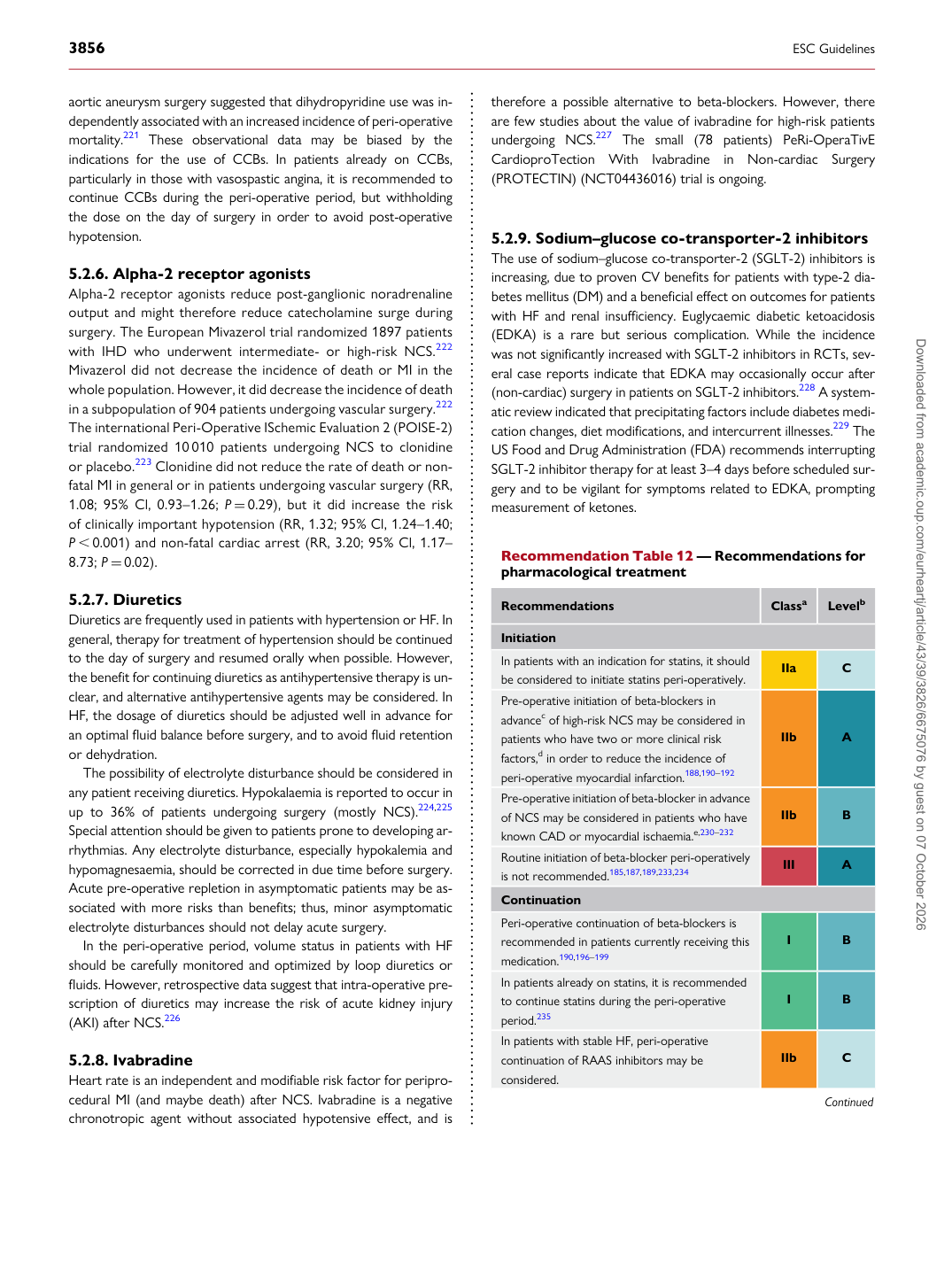
Recommendation Table 12 — Recommendations for pharmacological treatment

Recommendations Classa Levelb

Initiation In patients with an indication for statins, it should be considered to initiate statins peri-operatively. IIa C Pre-operative initiation of beta-blockers in advancec of high-risk NCS may be considered in patients who have two or more clinical risk factors,d in order to reduce the incidence of peri-operative myocardial infarction.188,190–192 IIb A Pre-operative initiation of beta-blocker in advance of NCS may be considered in patients who have known CAD or myocardial ischaemia.e,230–232 IIb B Routine initiation of beta-blocker peri-operatively is not recommended.185,187,189,233,234 III A Continuation Peri-operative continuation of beta-blockers is recommended in patients currently receiving this medication.190,196–199 I B In patients already on statins, it is recommended to continue statins during the peri-operative period.235 I B In patients with stable HF, peri-operative continuation of RAAS inhibitors may be considered. IIb C

Continued Downloaded from academic.oup.com/eurheartj/article/43/39/3826/6675076 by guest on 07 October 2026