p.3 抽出テキスト
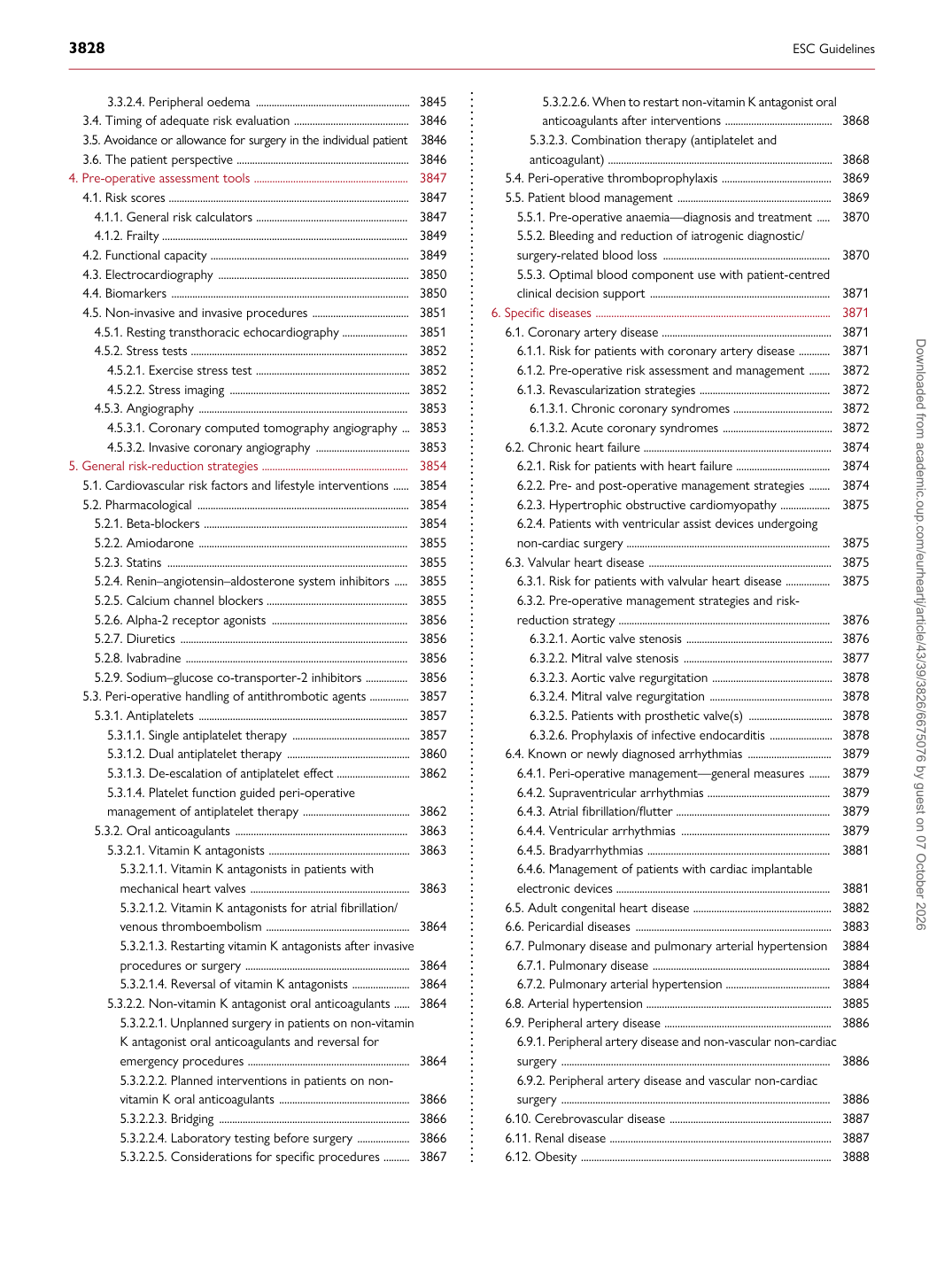
3.3.2.4. Peripheral oedema ........................................................... 3845 3.4. Timing of adequate risk evaluation ............................................ 3846 3.5. Avoidance or allowance for surgery in the individual patient 3846 3.6. The patient perspective .................................................................. 3846 4. Pre-operative assessment tools ........................................................... 3847 4.1. Risk scores ............................................................................................ 3847 4.1.1. General risk calculators .......................................................... 3847 4.1.2. Frailty .............................................................................................. 3849 4.2. Functional capacity ............................................................................ 3849 4.3. Electrocardiography ......................................................................... 3850 4.4. Biomarkers ........................................................................................... 3850 4.5. Non-invasive and invasive procedures ..................................... 3851 4.5.1. Resting transthoracic echocardiography ......................... 3851 4.5.2. Stress tests ................................................................................... 3852 4.5.2.1. Exercise stress test ........................................................... 3852 4.5.2.2. Stress imaging ..................................................................... 3852 4.5.3. Angiography ................................................................................ 3853 4.5.3.1. Coronary computed tomography angiography ... 3853 4.5.3.2. Invasive coronary angiography .................................... 3853 5. General risk-reduction strategies ........................................................ 3854 5.1. Cardiovascular risk factors and lifestyle interventions ...... 3854 5.2. Pharmacological ................................................................................. 3854 5.2.1. Beta-blockers .............................................................................. 3854 5.2.2. Amiodarone ................................................................................ 3855 5.2.3. Statins ............................................................................................ 3855 5.2.4. Renin–angiotensin–aldosterone system inhibitors ..... 3855 5.2.5. Calcium channel blockers ...................................................... 3855 5.2.6. Alpha-2 receptor agonists .................................................... 3856 5.2.7. Diuretics ....................................................................................... 3856 5.2.8. Ivabradine ..................................................................................... 3856 5.2.9. Sodium–glucose co-transporter-2 inhibitors ................ 3856 5.3. Peri-operative handling of antithrombotic agents ............... 3857 5.3.1. Antiplatelets ................................................................................ 3857 5.3.1.1. Single antiplatelet therapy ............................................. 3857 5.3.1.2. Dual antiplatelet therapy ............................................... 3860 5.3.1.3. De-escalation of antiplatelet effect ............................ 3862 5.3.1.4. Platelet function guided peri-operative management of antiplatelet therapy ......................................... 3862 5.3.2. Oral anticoagulants .................................................................. 3863 5.3.2.1. Vitamin K antagonists ...................................................... 3863 5.3.2.1.1. Vitamin K antagonists in patients with mechanical heart valves ............................................................. 3863 5.3.2.1.2. Vitamin K antagonists for atrial fibrillation/ venous thromboembolism ....................................................... 3864 5.3.2.1.3. Restarting vitamin K antagonists after invasive procedures or surgery ............................................................... 3864 5.3.2.1.4. Reversal of vitamin K antagonists ...................... 3864 5.3.2.2. Non-vitamin K antagonist oral anticoagulants ...... 3864 5.3.2.2.1. Unplanned surgery in patients on non-vitamin K antagonist oral anticoagulants and reversal for emergency procedures .............................................................. 3864 5.3.2.2.2. Planned interventions in patients on nonvitamin K oral anticoagulants .................................................. 3866 5.3.2.2.3. Bridging ......................................................................... 3866 5.3.2.2.4. Laboratory testing before surgery .................... 3866 5.3.2.2.5. Considerations for specific procedures .......... 3867 5.3.2.2.6. When to restart non-vitamin K antagonist oral anticoagulants after interventions ......................................... 3868 5.3.2.3. Combination therapy (antiplatelet and anticoagulant) ...................................................................................... 3868 5.4. Peri-operative thromboprophylaxis .......................................... 3869 5.5. Patient blood management ........................................................... 3869 5.5.1. Pre-operative anaemia—diagnosis and treatment ..... 3870 5.5.2. Bleeding and reduction of iatrogenic diagnostic/ surgery-related blood loss ................................................................ 3870 5.5.3. Optimal blood component use with patient-centred clinical decision support ..................................................................... 3871 6. Specific diseases .......................................................................................... 3871 6.1. Coronary artery disease ................................................................. 3871 6.1.1. Risk for patients with coronary artery disease ............ 3871 6.1.2. Pre-operative risk assessment and management ........ 3872 6.1.3. Revascularization strategies .................................................. 3872 6.1.3.1. Chronic coronary syndromes ...................................... 3872 6.1.3.2. Acute coronary syndromes .......................................... 3872 6.2. Chronic heart failure ........................................................................ 3874 6.2.1. Risk for patients with heart failure .................................... 3874 6.2.2. Pre- and post-operative management strategies ........ 3874 6.2.3. Hypertrophic obstructive cardiomyopathy ................... 3875 6.2.4. Patients with ventricular assist devices undergoing non-cardiac surgery .............................................................................. 3875 6.3. Valvular heart disease ...................................................................... 3875 6.3.1. Risk for patients with valvular heart disease ................. 3875 6.3.2. Pre-operative management strategies and riskreduction strategy ................................................................................. 3876 6.3.2.1. Aortic valve stenosis ........................................................ 3876 6.3.2.2. Mitral valve stenosis ......................................................... 3877 6.3.2.3. Aortic valve regurgitation .............................................. 3878 6.3.2.4. Mitral valve regurgitation ............................................... 3878 6.3.2.5. Patients with prosthetic valve(s) ................................ 3878 6.3.2.6. Prophylaxis of infective endocarditis ........................ 3878 6.4. Known or newly diagnosed arrhythmias ................................ 3879 6.4.1. Peri-operative management—general measures ........ 3879 6.4.2. Supraventricular arrhythmias ............................................... 3879 6.4.3. Atrial fibrillation/flutter ........................................................... 3879 6.4.4. Ventricular arrhythmias ......................................................... 3879 6.4.5. Bradyarrhythmias ...................................................................... 3881 6.4.6. Management of patients with cardiac implantable electronic devices .................................................................................. 3881 6.5. Adult congenital heart disease ..................................................... 3882 6.6. Pericardial diseases ........................................................................... 3883 6.7. Pulmonary disease and pulmonary arterial hypertension 3884 6.7.1. Pulmonary disease .................................................................... 3884 6.7.2. Pulmonary arterial hypertension ........................................ 3884 6.8. Arterial hypertension ....................................................................... 3885 6.9. Peripheral artery disease ................................................................ 3886 6.9.1. Peripheral artery disease and non-vascular non-cardiac surgery ....................................................................................................... 3886 6.9.2. Peripheral artery disease and vascular non-cardiac surgery ....................................................................................................... 3886 6.10. Cerebrovascular disease .............................................................. 3887 6.11. Renal disease ..................................................................................... 3887 6.12. Obesity ................................................................................................ 3888 Downloaded from academic.oup.com/eurheartj/article/43/39/3826/6675076 by guest on 07 October 2026