p.29 抽出テキスト
5 General risk-reduction

strategies

5.1 Cardiovascular risk factors and

lifestyle interventions Control of CV risk factors—including BP, dyslipidaemia, and diabetes —is important before NCS. For pre-operative management of BP and diabetes, see Sections 6.8 and 6.13, respectively. While lifestyle modifications before intervention reduce the risk of several peri-operative complications, the impact on CV complications has not been adequately explored. Of the lifestyle changes recommended before surgery, smoking cessation is the best documented in RCTs. Smoking has been associated with a higher rate of post-operative complications at 30 days.173,174 Reviews of RCTs have shown an effect of smoking cessation up to 6 months post-operatively, with a clear reduction in any post-operative complications by hazard ratio (HR) 0.42 (95% CI, 0.27–0.65), particularly wound infections (HR, 0.43; 95% CI, 0.21–0.85).173,175 Regarding timing of cessation, reviews of observational studies have shown consistent associations with better surgical outcome for cessation .4 weeks before surgery, with each additional week resulting in a further improvement of 19%.176–178 Pre-operative exercise programmes have only been tested in small RCTs, and recent reviews have shown a relative risk (RR) reduction in post-operative complications of 67% (RR, 0.33; 95% CI, 0.17– 0.61).179 Referral to a pre-operative exercise programme may be considered for patients scheduled for major or complex elective surgery.176,179,180 Weight reduction of obese patients immediately prior to surgery is not recommended. 5.2 Pharmacological

5.2.1. Beta-blockers Beta-blockers reduce myocardial oxygen consumption by reducing contractile force and heart rate. Beta-blockers are also effective antiarrhythmic agents. In addition, some beta-blockers such as metoprolol have an effect on acute inflammatory responses by inhibiting neutrophil hyperactivation in acute settings.184 These properties mean that beta-blockers have been some of the most frequently tested cardioprotective agents in patients undergoing NCS. Several RCTs have evaluated the effects of peri-operative beta-blockade on clinical end-points in patients with different risk profiles (see Supplementary data, Section 3.1.1.). Type, dosing and titration, timing of initiation, duration of beta-blocker therapy, type of surgery, and risk profile of subjects significantly differ between studies, making comparisons complex. The question about pre-surgery initiation of beta-blockers has been a matter of intense controversy (see Supplementary data, Section 3.1.1.1). The largest and latest trial on the topic, the Perioperative Ischemic Evaluation (POISE-1) trial, enrolled 8351 patients with or at risk of atherosclerotic disease, and not on beta-blockers before NCS. Patients were randomized to extended-release metoprolol succinate 200 mg daily or placebo 185 Treatment was initiated 2–4 h before surgery and maintained for 30 days. The primary outcome (composite of CV death, non-fatal MI, and non-fatal cardiac arrest) was significantly lower in the metoprolol arm (5.8% vs. 6.9% [P = 0.04]). Metoprolol was associated with significant reductions in MIs, coronary revascularizations, and AF. However, the incidences of allcause death, stroke, and clinically significant hypotension or bradycardia were significantly higher in the metoprolol arm. Post hoc analysis showed that hypotension carried the greatest attributable risk of death and stroke 186 The high dose of extended metoprolol might have played a role in the adverse events seen at follow-up. Several meta-analyses, systematic reviews, and observational studies have also been reported (see Supplementary data, Table S4).187– 189 Overall, initiation of beta-blockers before NCS was not associated with a net clinical benefit in most analyses, but they might be beneficial in patients with high CV risk profiles or who are undergoing high-risk surgical interventions (including vascular interventions).188,190–192 When oral beta-blockade is initiated in CAD patients who undergo NCS, the use of atenolol or bisoprolol as a first choice may be considered.190,193–195 In patients who are on chronic beta-blocker therapy before surgery, it is recommended to maintain these in the peri-operative period. Increased mortality following pre-operative beta-blocker withdrawal has been reported in five observational studies.190,196–199 Interruption of this therapy for .2 days post-operatively may double the risk of AF.200 Post-operative tachycardia should initially lead to treatment of the underlying cause— such as hypovolaemia, pain, blood loss, or infection—rather than simply increasing the beta-blocker dose. When beta-blockers are indicated, the optimal duration of the perioperative beta-blockade cannot be derived from randomized trials. According to a meta-analysis of RCTs including 14 967 patients, beta-blockers can reduce the risk of post-operative AF after NCS;201 however, this comes at the cost of an increased risk of bradycardia, hypotension, and stroke.187

Recommendation Table 11 — Recommendations for lifestyle and cardiovascular risk factors

Recommendations Classa Levelb

Smoking cessation .4 weeks before NCS is recommended to reduce post-operative complications and mortality.181,182 I B Control of CV risk factors—including blood pressure, dyslipidaemia, and diabetes—is recommended before NCS.173,176–178,183 I B © ESC 2022

CV, cardiovascular; NCS, non-cardiac surgery. aClass of recommendation. bLevel of evidence.

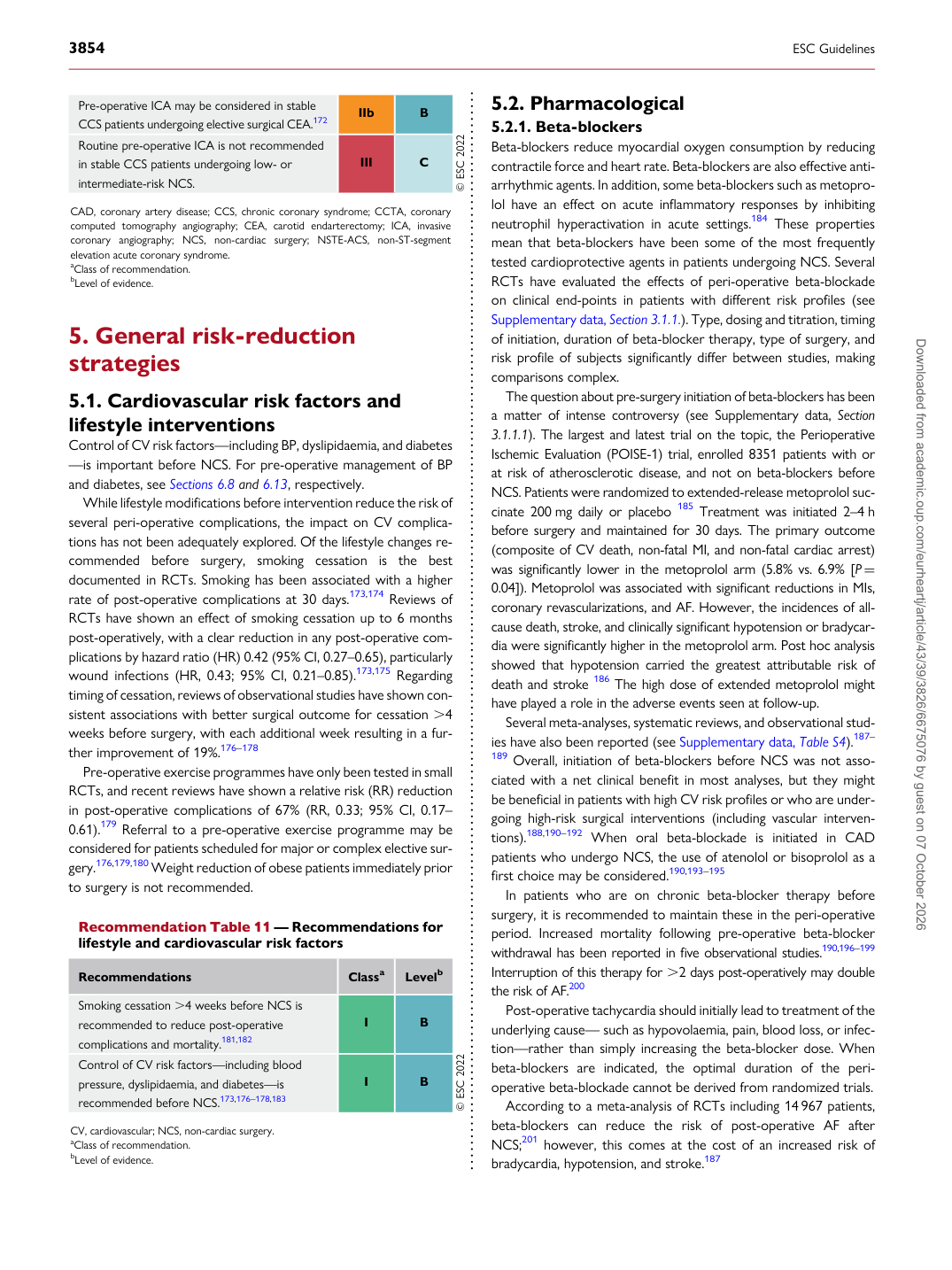
Pre-operative ICA may be considered in stable CCS patients undergoing elective surgical CEA.172 IIb B Routine pre-operative ICA is not recommended in stable CCS patients undergoing low- or intermediate-risk NCS. III C © ESC 2022

CAD, coronary artery disease; CCS, chronic coronary syndrome; CCTA, coronary computed tomography angiography; CEA, carotid endarterectomy; ICA, invasive coronary angiography; NCS, non-cardiac surgery; NSTE-ACS, non-ST-segment elevation acute coronary syndrome. aClass of recommendation. bLevel of evidence.

Downloaded from academic.oup.com/eurheartj/article/43/39/3826/6675076 by guest on 07 October 2026