p.26 抽出テキスト
Both Hs-cTn T/I and BNP/NT-proBNP complement clinical assessment and ECG in risk prediction.9,52,53,101–103 Hs-cTn T/I and, to a lesser extent, BNP/NT-proBNP concentrations are higher in patients with stress-induced myocardial ischaemia vs. those without, and very low hs-cTn T/I concentrations achieve a very high negative predictive value to rule out myocardial ischaemia.104–107 Several large prospective studies have shown that both hs-cTn T/I and BNP/NT-proBNP have high and incremental prognostic value for peri-operative cardiac complications, including CV death, cardiac arrest, acute HF, and tachyarrhythmias. In a cohort of nearly 1000 subjects undergoing major elective NCS, individuals with preoperative hs-cTn T concentrations of .14 ng/L had an in-hospital mortality of 6.9% vs. 1.2% in patients with hs-cTn T concentrations ≤14 ng/L (P , 0.001; AUC 0.81).53 In a large prospective cohort study including 10 402 patients from 16 centres, NT-proBNP improved risk predication beyond the RCRI.52 Among 1923 patients undergoing NCS, NT-proBNP outperformed both RCRI and echocardiographic parameters in the prediction of peri-operative CV events.103 Overall, hs-cTn T/I and BNP/NT-proBNP seem to have comparable accuracy in the prediction of cardiac complications.52,53,98–103,108 However, Hs-cTn T/I has four advantages over BNP/NT-proBNP: (i) it is more widely available; (ii) it is less expensive; (iii) if normal, it enables acute MI to be ruled out in the preceding days; and (iv) availability of pre-operative hs-cTn T/I concentration enables accurate diagnosis of PMI on Day 1 after surgery.109–111 See Section 8 for more details on diagnosis and treatment of PMI. B-type natriuretic peptide/NT-proBNP has two advantages. First, if elevated, evidence from randomized controlled screening studies performed outside the peri-operative setting has supported the concept that BNP/NT-proBNP-triggered cardiac work-up and intensification of therapy improve outcomes.112,113 Second, HF is a frequently undiagnosed condition in the elderly population most often undergoing NCS.47,114 Interpreting BNP/NT-proBNP concentrations as quantitative markers of HF with evolving rule-in cut-offs may facilitate detection of HF, optimal intra-operative monitoring, and initiation or optimization of HF therapy after surgery.114 To date, there is insufficient evidence in support of other CV biomarkers for this specific indication.115,116 4.5 Non-invasive and invasive

procedures 4.5.1. Resting transthoracic echocardiography In large retrospective cohorts, routine pre-operative TTE before high-risk NCS did not reduce the risk of post-operative MACE or provide more information than clinical risk models.120–122 Poor exercise tolerance, abnormal ECG, suspected new or significant CVDs without follow-up within the last 90 days, unexplained dyspnoea, or coexisting clinical risk factors are appropriate indications for TTE.123,124 Pre-operative TTE provides information on three main risk markers for post-operative cardiac events: LV dysfunction, VHDs, and cardiomyopathies. Left ventricular systolic dysfunction is an important predictor of post-operative HF.125 However, low ventricular ejection fraction is a borderline independent predictor of major post-operative CV complications.126–128 Pre-operative FOCUS examination—with a hand-held ultrasound device for the assessment of murmurs, haemodynamic instability, ventricular function, and dyspnea—may impact patient management by improving the diagnostic accuracy of clinical assessment, and help to triage candidates for standard TTE, plan surgery and anaesthesia technique, and with post-operative monitoring.129–131 However, current evidence remains mostly confined to uncontrolled or retrospective observational studies with no clear benefits on the outcome, despite a favourable impact on peri-operative management.130,132 In a multicentre randomized trial, preliminary results showed that preoperative FOCUS significantly reduced all-cause mortality.133 Notably, because of the lack of spectral Doppler capabilities, the FOCUS examination is only accurate for assessing main structural and functional abnormalities. Patients with diastolic dysfunction are usually old, more hypertensive, obese, diabetic, and likely to have AF or chronic renal disease. Several studies with different clinical end-points have underlined

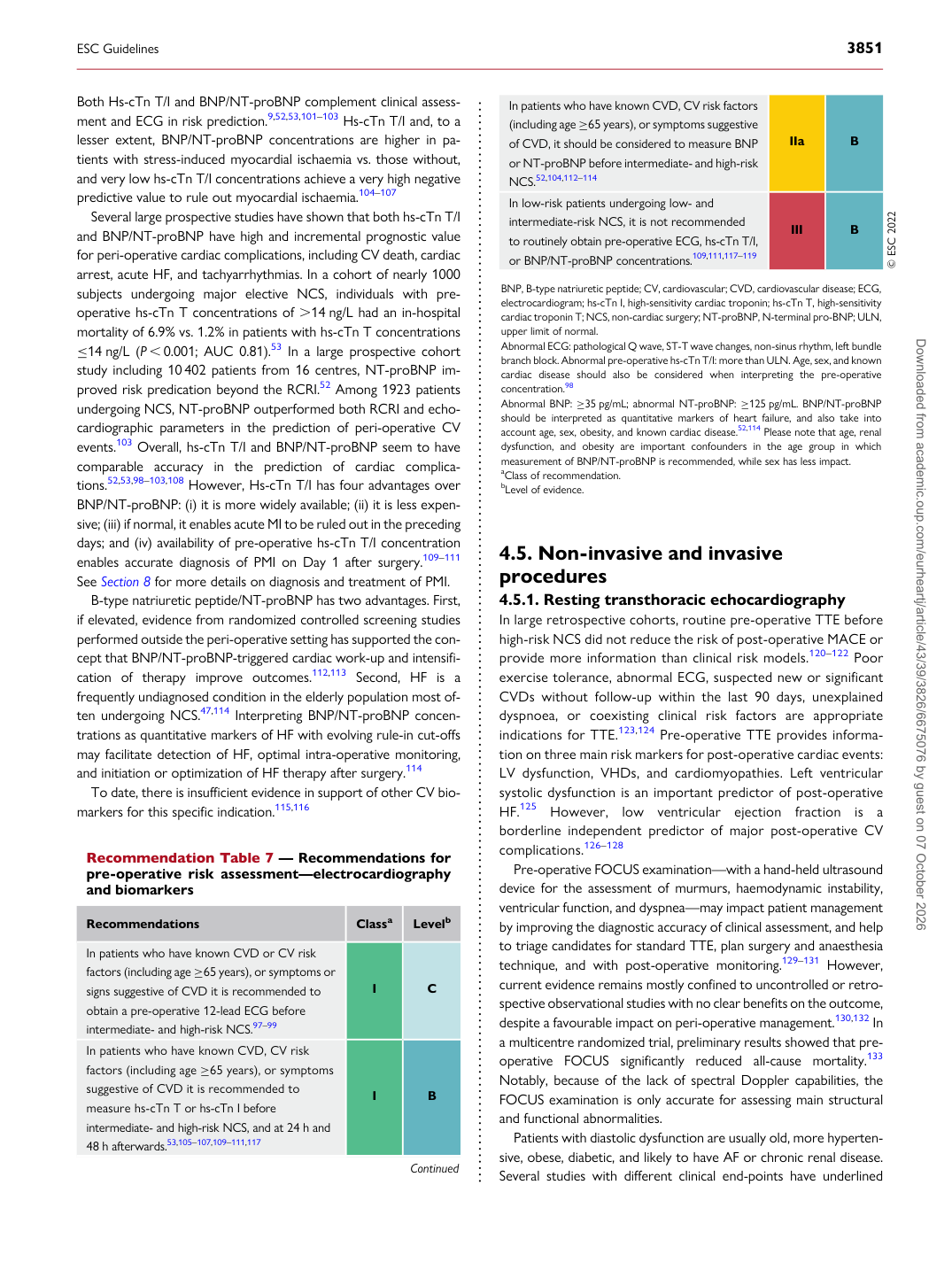
Recommendation Table 7 — Recommendations for pre-operative risk assessment—electrocardiography and biomarkers

Recommendations Classa Levelb

In patients who have known CVD or CV risk factors (including age ≥65 years), or symptoms or signs suggestive of CVD it is recommended to obtain a pre-operative 12-lead ECG before intermediate- and high-risk NCS.97–99 I C In patients who have known CVD, CV risk factors (including age ≥65 years), or symptoms suggestive of CVD it is recommended to measure hs-cTn T or hs-cTn I before intermediate- and high-risk NCS, and at 24 h and 48 h afterwards.53,105–107,109–111,117 I B

Continued In patients who have known CVD, CV risk factors

(including age ≥65 years), or symptoms suggestive of CVD, it should be considered to measure BNP or NT-proBNP before intermediate- and high-risk NCS.52,104,112–114 IIa B In low-risk patients undergoing low- and intermediate-risk NCS, it is not recommended to routinely obtain pre-operative ECG, hs-cTn T/I, or BNP/NT-proBNP concentrations.109,111,117–119 III B © ESC 2022

BNP, B-type natriuretic peptide; CV, cardiovascular; CVD, cardiovascular disease; ECG, electrocardiogram; hs-cTn I, high-sensitivity cardiac troponin; hs-cTn T, high-sensitivity cardiac troponin T; NCS, non-cardiac surgery; NT-proBNP, N-terminal pro-BNP; ULN, upper limit of normal. Abnormal ECG: pathological Q wave, ST-T wave changes, non-sinus rhythm, left bundle branch block. Abnormal pre-operative hs-cTn T/I: more than ULN. Age, sex, and known cardiac disease should also be considered when interpreting the pre-operative concentration.98 Abnormal BNP: ≥35 pg/mL; abnormal NT-proBNP: ≥125 pg/mL. BNP/NT-proBNP should be interpreted as quantitative markers of heart failure, and also take into account age, sex, obesity, and known cardiac disease.52,114 Please note that age, renal dysfunction, and obesity are important confounders in the age group in which measurement of BNP/NT-proBNP is recommended, while sex has less impact. aClass of recommendation. bLevel of evidence.

ESC Guidelines                                                                                                                                                                                     3851

Downloaded from academic.oup.com/eurheartj/article/43/39/3826/6675076 by guest on 07 October 2026