p.25 抽出テキスト
4.3 Electrocardiography

The 12-lead ECG is a widely available, simple, and inexpensive tool that is able to semi-quantitatively assess cardiac risk (e.g. Q waves indicative of previous MI), and detect unknown CV conditions requiring therapy (e.g. atrial fibrillation [AF] or AV-block).97–99 It is recommended to obtain a pre-operative 12-lead ECG in patients who are aged ≥65 years or have known CVD, CV risk factors, or symptoms suggestive of cardiac disorders, and scheduled to undergo intermediate- or high-risk surgery. It is not recommended to routinely obtain a pre-operative ECG in low-risk patients undergoing lowrisk NCS.100

Comparison with previous ECG recordings is helpful whenever relevant abnormalities are identified. Pre-operative recording of ECG also enables identification of intra- and post-operative ECG changes.

4.4 Biomarkers

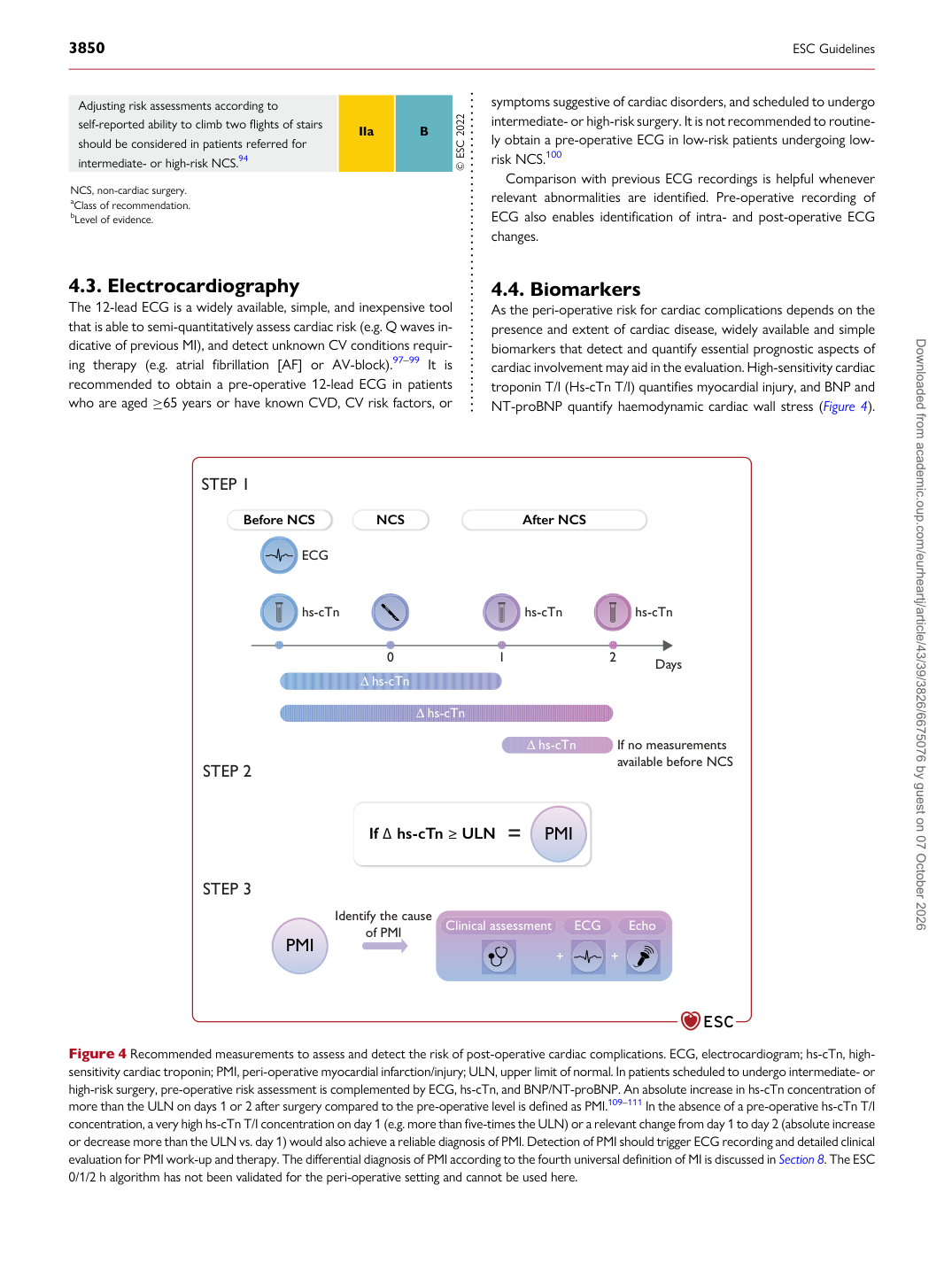
As the peri-operative risk for cardiac complications depends on the presence and extent of cardiac disease, widely available and simple biomarkers that detect and quantify essential prognostic aspects of cardiac involvement may aid in the evaluation. High-sensitivity cardiac troponin T/I (Hs-cTn T/I) quantifies myocardial injury, and BNP and NT-proBNP quantify haemodynamic cardiac wall stress (Figure 4).

Adjusting risk assessments according to self-reported ability to climb two flights of stairs should be considered in patients referred for intermediate- or high-risk NCS.94 IIa B © ESC 2022

NCS, non-cardiac surgery. aClass of recommendation. bLevel of evidence.

0 1

hs-cTn

STEP 1

STEP 2 2 Days

ECG

Before NCS After NCS NCS

∆ hs-cTn

If no measurements available before NCS

∆ hs-cTn

∆ hs-cTn

PMI = If ∆ hs-cTn ≥ ULN

STEP 3

ECG Echo Clinical assessment

+ +

Identify the cause

of PMI

PMI hs-cTn hs-cTn

Figure 4 Recommended measurements to assess and detect the risk of post-operative cardiac complications. ECG, electrocardiogram; hs-cTn, highsensitivity cardiac troponin; PMI, peri-operative myocardial infarction/injury; ULN, upper limit of normal. In patients scheduled to undergo intermediate- or high-risk surgery, pre-operative risk assessment is complemented by ECG, hs-cTn, and BNP/NT-proBNP. An absolute increase in hs-cTn concentration of more than the ULN on days 1 or 2 after surgery compared to the pre-operative level is defined as PMI.109–111 In the absence of a pre-operative hs-cTn T/I concentration, a very high hs-cTn T/I concentration on day 1 (e.g. more than five-times the ULN) or a relevant change from day 1 to day 2 (absolute increase or decrease more than the ULN vs. day 1) would also achieve a reliable diagnosis of PMI. Detection of PMI should trigger ECG recording and detailed clinical evaluation for PMI work-up and therapy. The differential diagnosis of PMI according to the fourth universal definition of MI is discussed in Section 8. The ESC 0/1/2 h algorithm has not been validated for the peri-operative setting and cannot be used here. Downloaded from academic.oup.com/eurheartj/article/43/39/3826/6675076 by guest on 07 October 2026