p.21 抽出テキスト
3.4 Timing of adequate risk evaluation

Pre-operative CV assessment should be performed prior to surgery, ideally at the time when the decision for NCS has been made. Accurate estimates of the risks and benefits of surgery is a prerequisite for informed decision-making by both physicians and patients about the appropriateness of surgery. These estimates should also help in guiding surgical (endovascular/endoscopic vs. open approach) and monitoring (intermediate care, screening for CV complications) approaches, and help to detect an unexpectedly high CV risk.47 Therefore, the prognostic value of pre-operative CV risk assessment is much higher in elective vs. immediate or urgent surgery. Explicit communication of perioperative CV risk, on the basis of the expected event rates,47 and risk communication tools such as the A to Z Inventory of Decision Aids (https://decisionaid.ohri.ca/AZinvent.php) are recommended.

3.5 Avoidance or allowance for surgery

in the individual patient In the clinical setting it can be difficult to decide whether CVD represents a contraindication to NCS. In general, the risk for the patient if not operated on must be considerably higher than the risk of the treatment. Ideally, an unstable cardiac patient should be stabilized before NCS, but waiting can be detrimental for acute surgical disease. No definite list can be made for which cardiac disease is a clear contraindication to NCS, but in patients with severe HF (New York Heart Association [NYHA] class IV), cardiogenic shock, severe pulmonary hypertension, or patients with severe frailty (see Section 4.1.2 for frailty assessment), high-risk NCS should probably be avoided. Life expectancy and quality of life should also be taken into consideration. However, the decision should be made after discussions between the surgeon, anaesthesiologist, cardiologist, and also a geriatrician for elderly patients, along with the patient and relatives.

3.6 The patient perspective

Patients with established CVD may face concerns about their underlying disease and current CV medication, co-ordination between the surgical team and their cardiologist (examples provided in Figure 3), and the potential excessive risk compared with the expected outcome of the surgery. Time should be allowed to address concerns and to provide evidence-based information on the risk–benefit trade-offs and the surgical treatment options (including non-surgical or ‘do nothing’ alternatives) to ensure informed consent, and to allow patients to engage in shared decision-making with the aim of supporting the best decision. The team needs to understand the patient’s concerns and expectations about the treatment and shortand long-term goals, as the risk-benefits of the intervention may not be aligned with patient preferences and wishes. Communicating in plain language (oral and written) and targeting communication to fit the individual level of health literacy is pivotal. Several studies have indicated a relatively high prevalence of limited health literacy in patients with CVD (e.g. with HF),62 and limited health literacy is associated with adverse outcomes.63 An example of a patient information sheet to be used in the communication with patients is given in the Supplementary data, Table S1. Recent systematic reviews and meta-analyses have focused on shared decision-making in the field of surgery across disease areas.64–67 In general, shared decision-making positively impacts decisional conflicts, knowledge gained, satisfaction, and decisional anxiety (although cultural variations may exist).67 In the breast cancer/ endocrine and urology specialties, decision-making and communication aids appear to be effective methods for supporting patients’ involvement in decision-making when undergoing elective surgery. Moreover, educational information, provided through interactive multimedia, computer, or on DVD, used prior to the surgical consultation could enhance the decision-making process in addition to face-to-face communication.66 In Europe, the prevalence of pre-operative anxiety among patients undergoing surgical procedures varies from 27–80%.68 Although a certain level of anxiety in patients must be expected, peri-operative anxiety is associated with worse surgical outcomes and longer recovery,69–72 which highlights the importance of pre-surgical assessment and, in some patients, treatment of anxiety. Factors associated with pre-operative anxiety are complex and include, among others, age, sex, educational level, type of surgery, and fear of post-operative complications or the outcome.68 Psychological reactions in patients undergoing high- or medium–high-risk procedures and/or patients with previous negative experiences of NCS may warrant particular attention. Concerns and fears expressed by patients and relatives should be taken seriously. A number of reviews and meta-analyses have summarized the effects of interventions on surgical outcomes in abdominal, cardiac, and orthopaedic surgery, which may also be applicable to patients with CV conditions in these settings.73–75

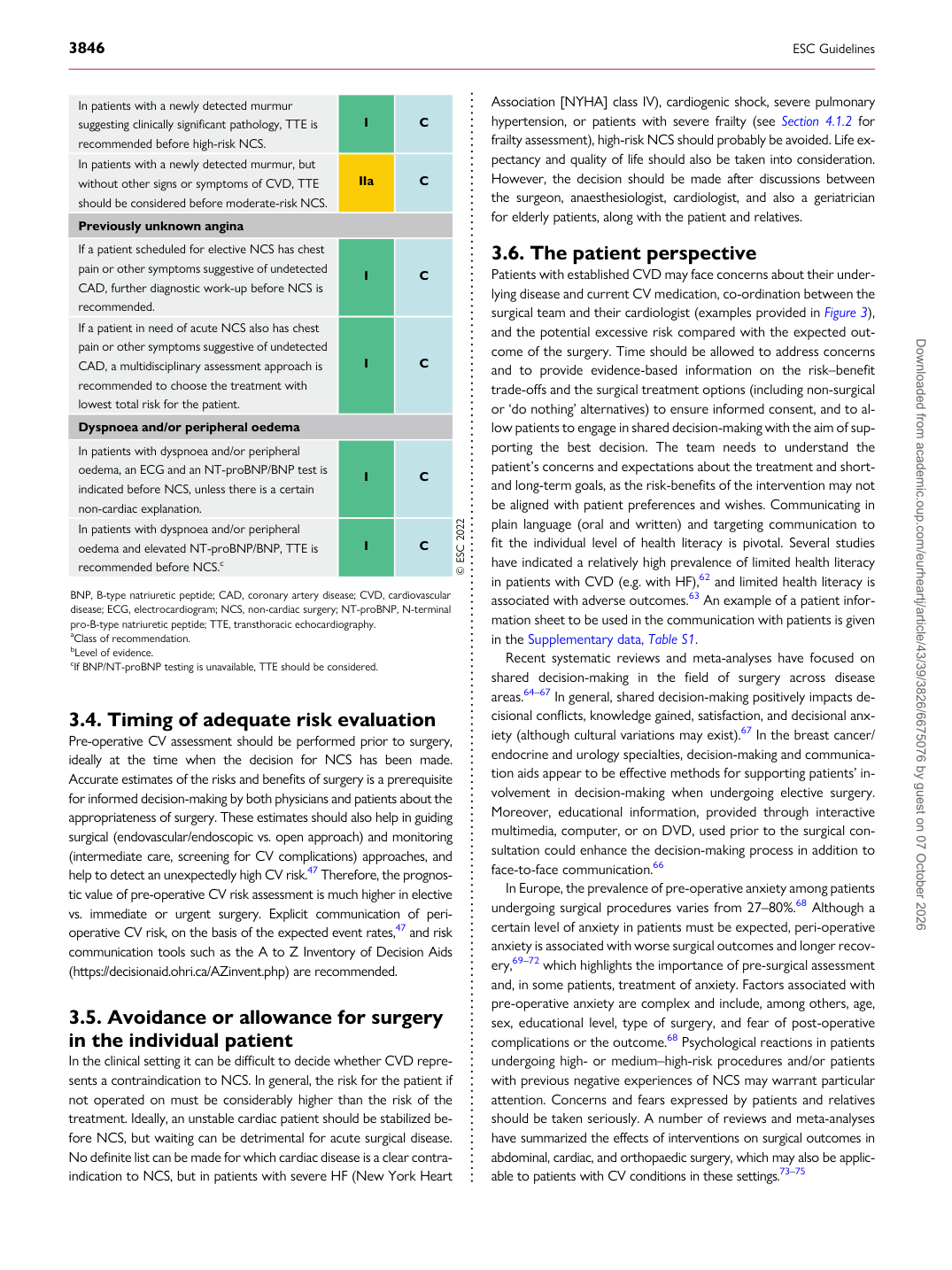
In patients with a newly detected murmur suggesting clinically significant pathology, TTE is recommended before high-risk NCS. I C In patients with a newly detected murmur, but without other signs or symptoms of CVD, TTE should be considered before moderate-risk NCS. IIa C Previously unknown angina If a patient scheduled for elective NCS has chest pain or other symptoms suggestive of undetected CAD, further diagnostic work-up before NCS is recommended. I C If a patient in need of acute NCS also has chest pain or other symptoms suggestive of undetected CAD, a multidisciplinary assessment approach is recommended to choose the treatment with lowest total risk for the patient. I C Dyspnoea and/or peripheral oedema In patients with dyspnoea and/or peripheral oedema, an ECG and an NT-proBNP/BNP test is indicated before NCS, unless there is a certain non-cardiac explanation. I C In patients with dyspnoea and/or peripheral oedema and elevated NT-proBNP/BNP, TTE is recommended before NCS.c I C © ESC 2022

BNP, B-type natriuretic peptide; CAD, coronary artery disease; CVD, cardiovascular disease; ECG, electrocardiogram; NCS, non-cardiac surgery; NT-proBNP, N-terminal pro-B-type natriuretic peptide; TTE, transthoracic echocardiography. aClass of recommendation. bLevel of evidence. cIf BNP/NT-proBNP testing is unavailable, TTE should be considered. Downloaded from academic.oup.com/eurheartj/article/43/39/3826/6675076 by guest on 07 October 2026