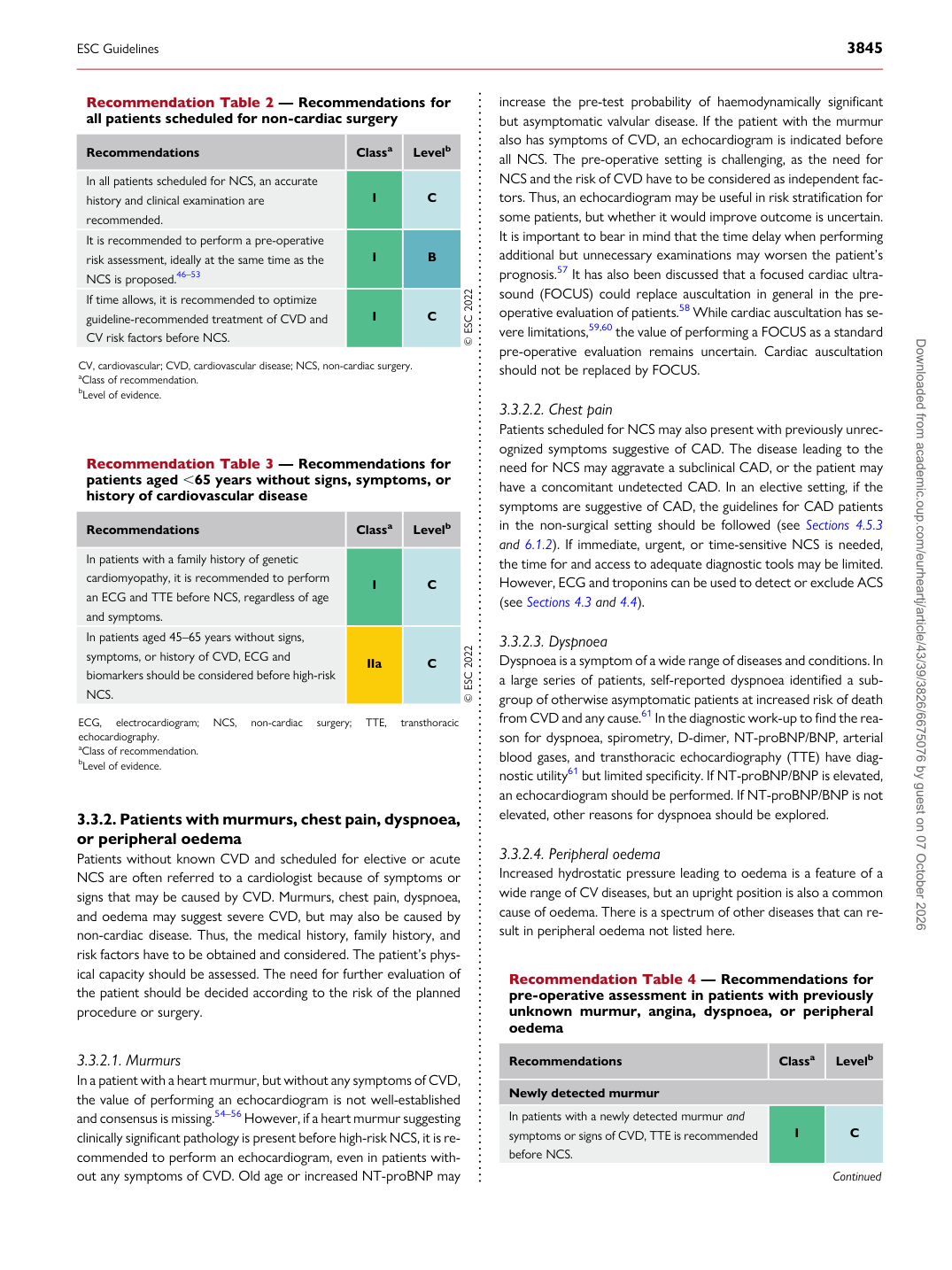
p.20 抽出テキスト
3.3.2. Patients with murmurs, chest pain, dyspnoea, or peripheral oedema Patients without known CVD and scheduled for elective or acute NCS are often referred to a cardiologist because of symptoms or signs that may be caused by CVD. Murmurs, chest pain, dyspnoea, and oedema may suggest severe CVD, but may also be caused by non-cardiac disease. Thus, the medical history, family history, and risk factors have to be obtained and considered. The patient’s physical capacity should be assessed. The need for further evaluation of the patient should be decided according to the risk of the planned procedure or surgery.

3.3.2.1 Murmurs

In a patient with a heart murmur, but without any symptoms of CVD, the value of performing an echocardiogram is not well-established and consensus is missing.54–56 However, if a heart murmur suggesting clinically significant pathology is present before high-risk NCS, it is recommended to perform an echocardiogram, even in patients without any symptoms of CVD. Old age or increased NT-proBNP may increase the pre-test probability of haemodynamically significant but asymptomatic valvular disease. If the patient with the murmur also has symptoms of CVD, an echocardiogram is indicated before all NCS. The pre-operative setting is challenging, as the need for NCS and the risk of CVD have to be considered as independent factors. Thus, an echocardiogram may be useful in risk stratification for some patients, but whether it would improve outcome is uncertain. It is important to bear in mind that the time delay when performing additional but unnecessary examinations may worsen the patient’s prognosis.57 It has also been discussed that a focused cardiac ultrasound (FOCUS) could replace auscultation in general in the preoperative evaluation of patients.58 While cardiac auscultation has severe limitations,59,60 the value of performing a FOCUS as a standard pre-operative evaluation remains uncertain. Cardiac auscultation should not be replaced by FOCUS.

3.3.2.2 Chest pain

Patients scheduled for NCS may also present with previously unrecognized symptoms suggestive of CAD. The disease leading to the need for NCS may aggravate a subclinical CAD, or the patient may have a concomitant undetected CAD. In an elective setting, if the symptoms are suggestive of CAD, the guidelines for CAD patients in the non-surgical setting should be followed (see Sections 4.5.3 and 6.1.2). If immediate, urgent, or time-sensitive NCS is needed, the time for and access to adequate diagnostic tools may be limited. However, ECG and troponins can be used to detect or exclude ACS (see Sections 4.3 and 4.4).

3.3.2.3 Dyspnoea

Dyspnoea is a symptom of a wide range of diseases and conditions. In a large series of patients, self-reported dyspnoea identified a subgroup of otherwise asymptomatic patients at increased risk of death from CVD and any cause.61 In the diagnostic work-up to find the reason for dyspnoea, spirometry, D-dimer, NT-proBNP/BNP, arterial blood gases, and transthoracic echocardiography (TTE) have diagnostic utility61 but limited specificity. If NT-proBNP/BNP is elevated, an echocardiogram should be performed. If NT-proBNP/BNP is not elevated, other reasons for dyspnoea should be explored.

3.3.2.4 Peripheral oedema

Increased hydrostatic pressure leading to oedema is a feature of a wide range of CV diseases, but an upright position is also a common cause of oedema. There is a spectrum of other diseases that can result in peripheral oedema not listed here.

Recommendation Table 2 — Recommendations for all patients scheduled for non-cardiac surgery

Recommendations Classa Levelb

In all patients scheduled for NCS, an accurate history and clinical examination are recommended. I C It is recommended to perform a pre-operative risk assessment, ideally at the same time as the NCS is proposed.46–53 I B If time allows, it is recommended to optimize guideline-recommended treatment of CVD and CV risk factors before NCS. I C © ESC 2022

CV, cardiovascular; CVD, cardiovascular disease; NCS, non-cardiac surgery. aClass of recommendation. bLevel of evidence.

Recommendation Table 3 — Recommendations for patients aged ,65 years without signs, symptoms, or history of cardiovascular disease

Recommendations Classa Levelb

In patients with a family history of genetic cardiomyopathy, it is recommended to perform an ECG and TTE before NCS, regardless of age and symptoms. I C In patients aged 45–65 years without signs, symptoms, or history of CVD, ECG and biomarkers should be considered before high-risk NCS. IIa C © ESC 2022

ECG, electrocardiogram; NCS, non-cardiac surgery; TTE, transthoracic echocardiography. aClass of recommendation. bLevel of evidence.

Recommendation Table 4 — Recommendations for pre-operative assessment in patients with previously unknown murmur, angina, dyspnoea, or peripheral oedema

Recommendations Classa Levelb

Newly detected murmur In patients with a newly detected murmur and symptoms or signs of CVD, TTE is recommended before NCS. I C

Continued

ESC Guidelines                                                                                                                                                                                     3845

Downloaded from academic.oup.com/eurheartj/article/43/39/3826/6675076 by guest on 07 October 2026