p.18 抽出テキスト
and hospital volume; however, few studies provide direct measures of cardiac complications.31–33 The benefit of laparoscopic procedures is probably greater in elderly patients, with reduced length of hospital stay, intra-operative blood loss, incidence of postoperative pneumonia, time to return of normal bowel function, incidence of post-operative cardiac complications, and wound infections.34

3.2.1.1 Vascular and endovascular procedures

Endovascular abdominal aortic aneurysm repair (EVAR) is a procedure using femoral artery access only, and is therefore associated with lower operative mortality and morbidity than open repair. It minimizes the surgical risk in simultaneous surgery for the treatment of abdominal aortic aneurysm (AAA) and a noncardiac disorder, and shortens the time delay from the treatment of AAA and the non-cardiac disorder in patients undergoing twophase surgery.35–37 The early gain in mortality from EVAR procedures is lost after 3–4 years, compared with open surgical treatment, due to general morbidity (especially CV mortality) of AAA patients. Various vascular and non-vascular NCS procedures bear different operative risks. While aortic and infra-inguinal vascular surgical procedures are both regarded as high-risk procedures, their risk can be modified by adequate peri-operative measures.38 For patients undergoing treatment of femoropopliteal artery disease, an endovascular-first approach may be advisable in case of additional significant comorbidity. A meta-analysis of studies comparing open surgery with PCI for the treatment of femoropopliteal arterial disease showed that femoral bypass surgery was associated with higher morbidity (odds ratio [OR] 2.93; 95% confidence interval [CI], 1.34– 6.41) but similar mortality at 30 days compared with endovascular treatment.39

3.2.1.2 Video-assisted non-cardiac surgery

Video-assisted thoracic surgery (VATS) is supported by a trial showing fewer peri-operative complications and a better quality of life in the first year following surgery for stage 1 lung cancer compared with anterolateral thoracotomy.20 Also, a large propensity matched study conducted by the European Society of Thoracic Surgeons (ESTS) showed fewer post-operative complications following VATS compared with open thoracotomy.21 Overall, the benefits seem greatest in patients with reduced functional lung capacity. 3.3 Patient-related risk

3.3.1. Initial assessment Patient-related risk is determined by patient’s age, the presence or absence of CV risk factors (e.g. smoking, hypertension, diabetes, dyslipidaemia, family disposition)40 or established CV disease, and comorbidities.41 Identification of patients at risk of CV complications is of paramount importance to choice of therapy when non-surgical options are available, or when the type of surgery or anaesthesia impacts the risk of complications. When emergency surgery is needed, the evaluation must necessarily be limited; however, most clinical circumstances allow a systematic approach. As an initial assessment, it is recommended that all patients scheduled for NCS are evaluated by accurate history and physical examination, with special emphasis on CV risk factors, established CV disease, and comorbidities.40 It is also recommended to measure standard laboratory tests (e.g. haemoglobin and renal function) in all patients undergoing intermediate- to high-risk surgery. Based on this information, further assessment of patient-related risk can proceed depending on the surgery-related risk, as shown in Figure 2. It is recommended to perform an electrocardiogram (ECG), assess the functional capacity, and/or measure biomarkers (cardiac troponins and/or N-terminal pro-B-type natriuretic peptide [NT-proBNP]/B-type natriuretic peptide [BNP]) depending on the patient-related and surgery-related risk (Figure 2). Detailed information on available tools for risk assessment, their prognostic ability, and indications to perform them is given in Section 4. More details on pre-operative management of patients with specific CV diseases are given in Section 6.

3.3.1.1 Patients aged ,65 years without a history of

cardiovascular disease or cardiovascular risk factors Patients aged ,65 years without signs, symptoms, or history of CVD or CV risk factors are considered to be of low risk, and can proceed to low- and moderate-risk surgery without additional pre-operative risk assessment.41 Before high-risk surgery, ECG and biomarkers should be considered (see Sections 4.3 and 4.4).42 Patients without signs or symptoms of CVD, but with a family history of genetic cardiomyopathy (i.e. dilatated, hypertrophic, arrhythmic, or restrictive cardiomyopathy, or LV non-compaction) should be evaluated with an ECG and an echocardiographic examination to rule out the presence of the disease, irrespective of the age.43 No specific data are available in the literature regarding risk of family members without the phenotype; however, they are at risk of developing the disease, which may be subclinical at the time of the NCS.43

3.3.1.2 Patients aged ≥65 years or with cardiovascular risk

factors Patients who are aged ≥65 years and patients with risk factors for CVD—such as hypertension, dyslipidaemia, or smoking—have an increased risk of having undetected CVD. The SCORE2 riskprediction tool can be used to estimate their 10 year CVD risk outside the setting of NCS.40 Patients who are aged ≥65 years and patients with risk factors for CVD also have an increased risk of peri-operative complications during NCS.41,44 These patients need additional assessment before intermediate- and high-risk surgery (Figure 2) and optimal treatment of risk factors.

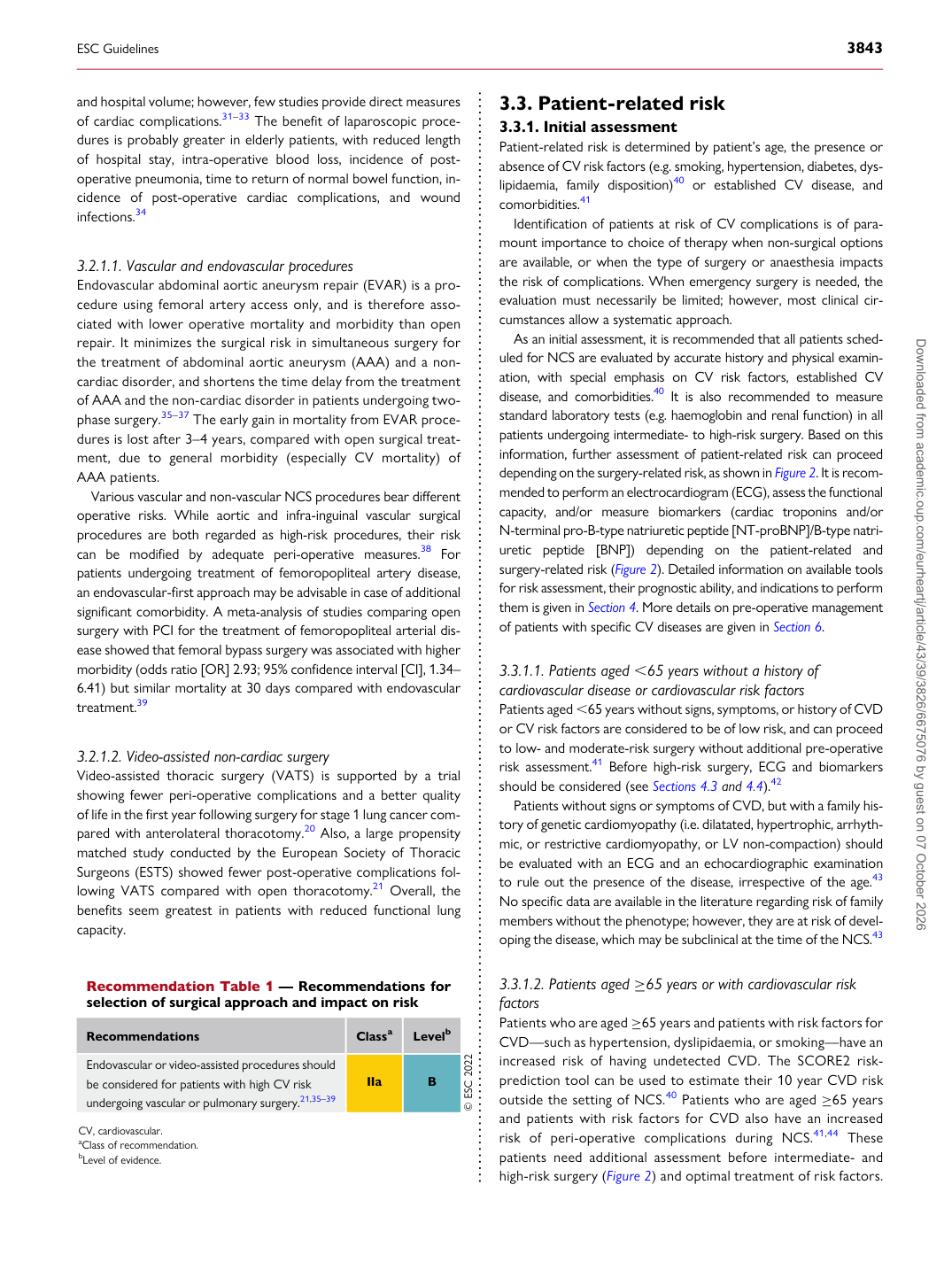
Recommendation Table 1 — Recommendations for selection of surgical approach and impact on risk

Recommendations Classa Levelb

Endovascular or video-assisted procedures should be considered for patients with high CV risk undergoing vascular or pulmonary surgery.21,35–39 IIa B © ESC 2022

CV, cardiovascular. aClass of recommendation. bLevel of evidence.

ESC Guidelines                                                                                                                                                                                     3843

Downloaded from academic.oup.com/eurheartj/article/43/39/3826/6675076 by guest on 07 October 2026