p.17 抽出テキスト
3.1.1 Timing of surgery

In general, acute procedures carry a higher risk of complications than elective procedures. Uniform timing definitions are unfeasible, as the time spans may vary between diseases. These guidelines use the timing definitions below. Immediate: surgery/intervention should be performed without any delay to save life or organ function. Urgent: surgery/intervention should be performed without unnecessary delay to save life, limb, or organ function. Time-sensitive: surgery/intervention should be performed as soon as possible as there is a time-dependent risk of losing limb or organ function, or increased risk of complications. Cancer surgery is typically time-sensitive, as is carotid surgery to prevent stroke in a symptomatic case. The time window for time-sensitive surgery will vary depending on the underlying disease. Elective: surgery/intervention can be performed electively (not further defined) without significant risk of losing limb, or organ function, or increased risks of complications. Many factors affect outcomes when comparing acute or timesensitive vs. elective surgery: the general condition of the patient vs. the stage of the acute illness, and how far it has progressed. The best interests of the patient should be considered before deciding on treatment, informed consent to management should be obtained, if at all possible, and decisions should be clearly recorded.24 The degree of urgency should also be considered (i.e. does the procedure need to be performed outside working hours or can it wait until the next day?). In general, competences and supportive functions are not always present in the evenings or during the night; thus, an overall evaluation of what best serves the patient is necessary. The optimal timing of NCS should be discussed within the multidisciplinary team, including an anaesthesiologist, in order to achieve optimized anaesthesia for each patient (see Section 7).

3.2 Type of surgical approach

New surgical techniques have been introduced to replace open surgery and to reduce the overall risk for the patient.

3.2.1 Laparoscopy

Laparoscopic procedures, compared with open surgical procedures, have the advantage of causing less tissue trauma and intestinal paralysis, resulting in less incisional pain, better post-operative pulmonary function, significantly fewer wall complications, and diminished postoperative fluid shifts related to bowel paralysis.25 However, the pneumoperitoneum required for these procedures results in elevated intra-abdominal pressure and a reduction in venous return. Typical physiological sequelae are secondary to increased intra-abdominal pressure and absorption of the gaseous medium used for insufflation. While healthy individuals on controlled ventilation typically tolerate pneumoperitoneum, patients with CVD, some types of adults with congenital heart disease (ACHD), and obese patients may experience adverse consequences.26 Pneumoperitoneum and Trendelenburg position result in increased mean arterial pressure, central venous pressure, mean pulmonary artery pressure, pulmonary capillary wedge pressure, and systemic vascular resistance impairing cardiac function.27,28 Therefore, compared with open surgery, the CV risk in patients with CVD is not necessarily reduced in patients undergoing laparoscopy, and both should be evaluated in the same way. This is especially true in patients undergoing interventions for morbid obesity, but also in other types of surgery, considering the risk of conversion to an open procedure.29,30 Superior short-term outcomes of laparoscopic vs. open procedures have been reported, depending on type of surgery, operator experience,

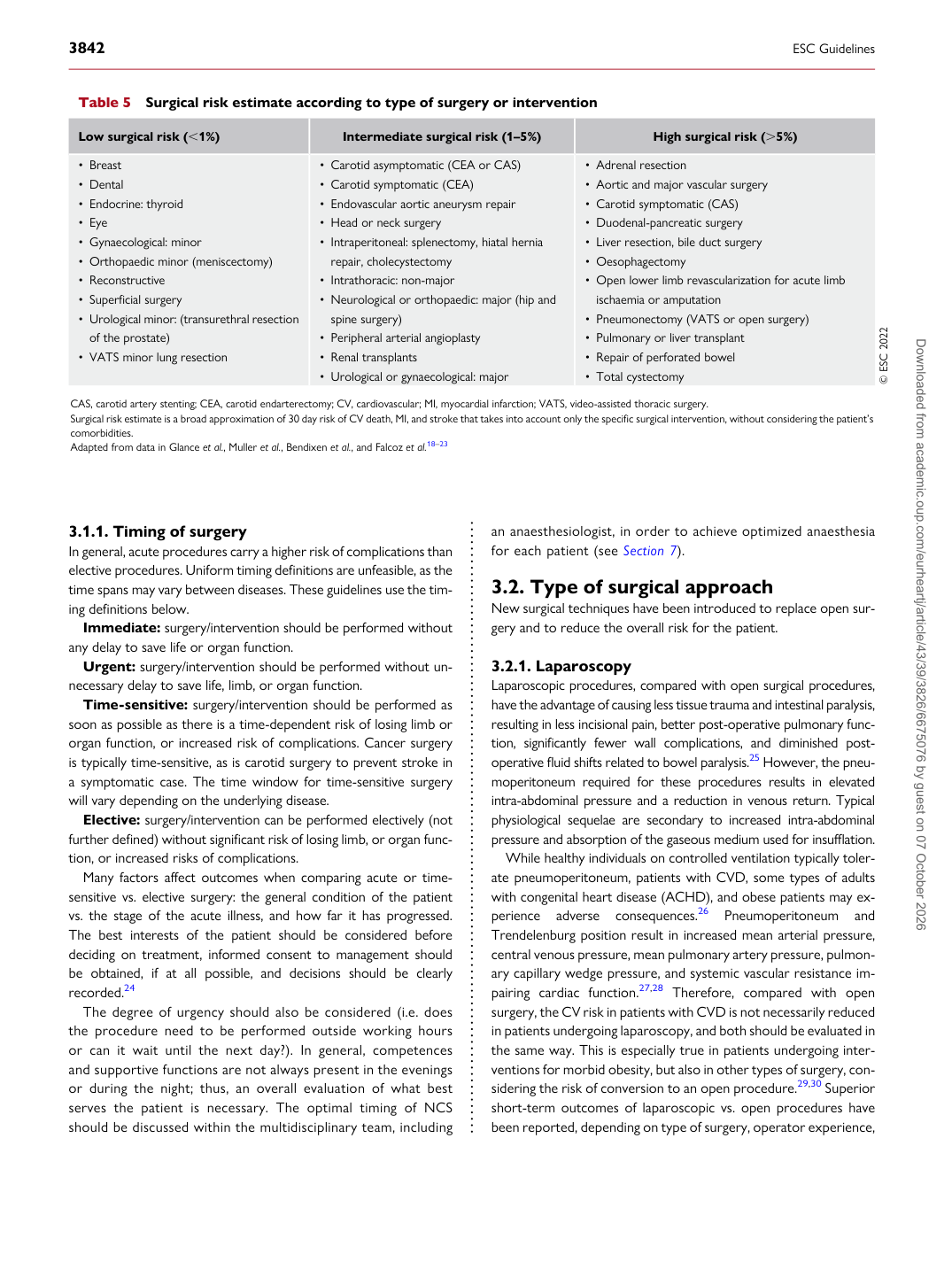
Table 5 Surgical risk estimate according to type of surgery or intervention

Low surgical risk (,1%) Intermediate surgical risk (1–5%) High surgical risk (.5%)

• Breast • Dental • Endocrine: thyroid • Eye • Gynaecological: minor • Orthopaedic minor (meniscectomy) • Reconstructive • Superficial surgery • Urological minor: (transurethral resection of the prostate) • VATS minor lung resection • Carotid asymptomatic (CEA or CAS) • Carotid symptomatic (CEA)

• Endovascular aortic aneurysm repair • Head or neck surgery • Intraperitoneal: splenectomy, hiatal hernia

repair, cholecystectomy • Intrathoracic: non-major • Neurological or orthopaedic: major (hip and

spine surgery) • Peripheral arterial angioplasty • Renal transplants • Urological or gynaecological: major • Adrenal resection • Aortic and major vascular surgery

• Carotid symptomatic (CAS) • Duodenal-pancreatic surgery • Liver resection, bile duct surgery • Oesophagectomy • Open lower limb revascularization for acute limb ischaemia or amputation • Pneumonectomy (VATS or open surgery) • Pulmonary or liver transplant • Repair of perforated bowel • Total cystectomy © ESC 2022

CAS, carotid artery stenting; CEA, carotid endarterectomy; CV, cardiovascular; MI, myocardial infarction; VATS, video-assisted thoracic surgery. Surgical risk estimate is a broad approximation of 30 day risk of CV death, MI, and stroke that takes into account only the specific surgical intervention, without considering the patient’s comorbidities. Adapted from data in Glance et al., Muller et al., Bendixen et al., and Falcoz et al.18–23 Downloaded from academic.oup.com/eurheartj/article/43/39/3826/6675076 by guest on 07 October 2026