p.14 抽出テキスト
2.2 The magnitude of the problem

The annual volume of major surgery worldwide is estimated to be more than 300 million patients (about 5% of the world population), which is a 34% increase from 2004 to 2012.1,2 Nearly 74% of these operations are performed in countries spending substantial amounts on health care. When applied to European Union countries, which had an overall population of 448 million in 2020 (27 countries), this figure translates into a crude estimate of nearly 22 million major procedures annually.2

Nearly 85% of major operations are non-cardiac surgical procedures.3 In a recent report from the USA National Inpatient Sample database, nearly half of adults aged ≥45 years undergoing major non-

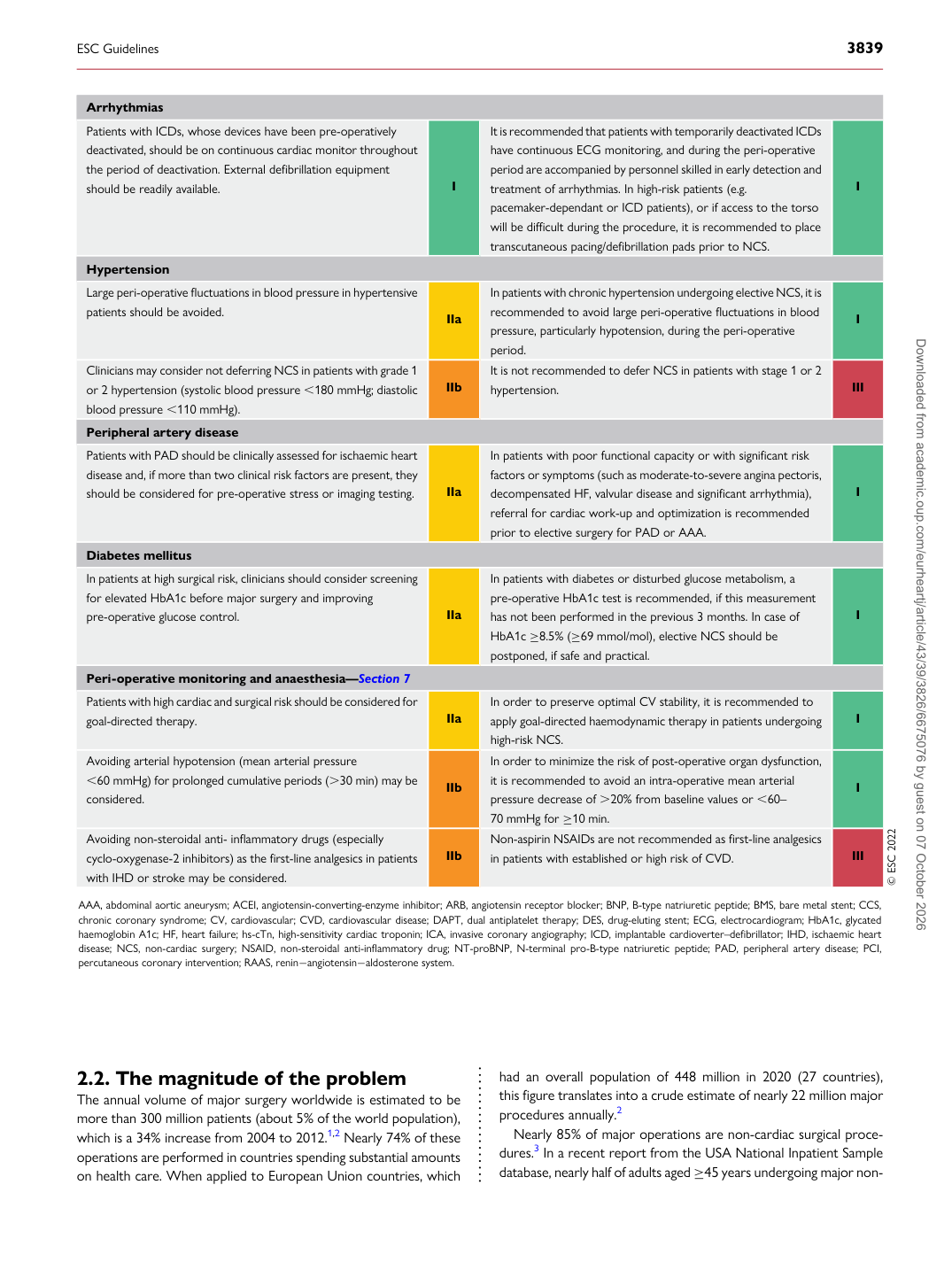
Arrhythmias Patients with ICDs, whose devices have been pre-operatively deactivated, should be on continuous cardiac monitor throughout the period of deactivation. External defibrillation equipment should be readily available. I It is recommended that patients with temporarily deactivated ICDs

have continuous ECG monitoring, and during the peri-operative period are accompanied by personnel skilled in early detection and treatment of arrhythmias. In high-risk patients (e.g. pacemaker-dependant or ICD patients), or if access to the torso will be difficult during the procedure, it is recommended to place transcutaneous pacing/defibrillation pads prior to NCS. I

Hypertension Large peri-operative fluctuations in blood pressure in hypertensive patients should be avoided. IIa In patients with chronic hypertension undergoing elective NCS, it is

recommended to avoid large peri-operative fluctuations in blood pressure, particularly hypotension, during the peri-operative period. I

Clinicians may consider not deferring NCS in patients with grade 1 or 2 hypertension (systolic blood pressure ,180 mmHg; diastolic blood pressure ,110 mmHg). IIb It is not recommended to defer NCS in patients with stage 1 or 2

hypertension. III

Peripheral artery disease Patients with PAD should be clinically assessed for ischaemic heart disease and, if more than two clinical risk factors are present, they should be considered for pre-operative stress or imaging testing. IIa In patients with poor functional capacity or with significant risk

factors or symptoms (such as moderate-to-severe angina pectoris, decompensated HF, valvular disease and significant arrhythmia), referral for cardiac work-up and optimization is recommended prior to elective surgery for PAD or AAA. I

Diabetes mellitus In patients at high surgical risk, clinicians should consider screening for elevated HbA1c before major surgery and improving pre-operative glucose control. IIa In patients with diabetes or disturbed glucose metabolism, a

pre-operative HbA1c test is recommended, if this measurement has not been performed in the previous 3 months. In case of HbA1c ≥8.5% (≥69 mmol/mol), elective NCS should be postponed, if safe and practical. I

Peri-operative monitoring and anaesthesia—Section 7 Patients with high cardiac and surgical risk should be considered for goal-directed therapy. IIa In order to preserve optimal CV stability, it is recommended to apply goal-directed haemodynamic therapy in patients undergoing

high-risk NCS. I

Avoiding arterial hypotension (mean arterial pressure ,60 mmHg) for prolonged cumulative periods (.30 min) may be considered. IIb In order to minimize the risk of post-operative organ dysfunction,

it is recommended to avoid an intra-operative mean arterial pressure decrease of .20% from baseline values or ,60– 70 mmHg for ≥10 min. I

Avoiding non-steroidal anti- inflammatory drugs (especially cyclo-oxygenase-2 inhibitors) as the first-line analgesics in patients with IHD or stroke may be considered. IIb Non-aspirin NSAIDs are not recommended as first-line analgesics

in patients with established or high risk of CVD. III © ESC 2022

AAA, abdominal aortic aneurysm; ACEI, angiotensin-converting-enzyme inhibitor; ARB, angiotensin receptor blocker; BNP, B-type natriuretic peptide; BMS, bare metal stent; CCS, chronic coronary syndrome; CV, cardiovascular; CVD, cardiovascular disease; DAPT, dual antiplatelet therapy; DES, drug-eluting stent; ECG, electrocardiogram; HbA1c, glycated haemoglobin A1c; HF, heart failure; hs-cTn, high-sensitivity cardiac troponin; ICA, invasive coronary angiography; ICD, implantable cardioverter–defibrillator; IHD, ischaemic heart disease; NCS, non-cardiac surgery; NSAID, non-steroidal anti-inflammatory drug; NT-proBNP, N-terminal pro-B-type natriuretic peptide; PAD, peripheral artery disease; PCI, percutaneous coronary intervention; RAAS, renin−angiotensin−aldosterone system.

ESC Guidelines                                                                                                                                                                                     3839

Downloaded from academic.oup.com/eurheartj/article/43/39/3826/6675076 by guest on 07 October 2026