p.13 抽出テキスト
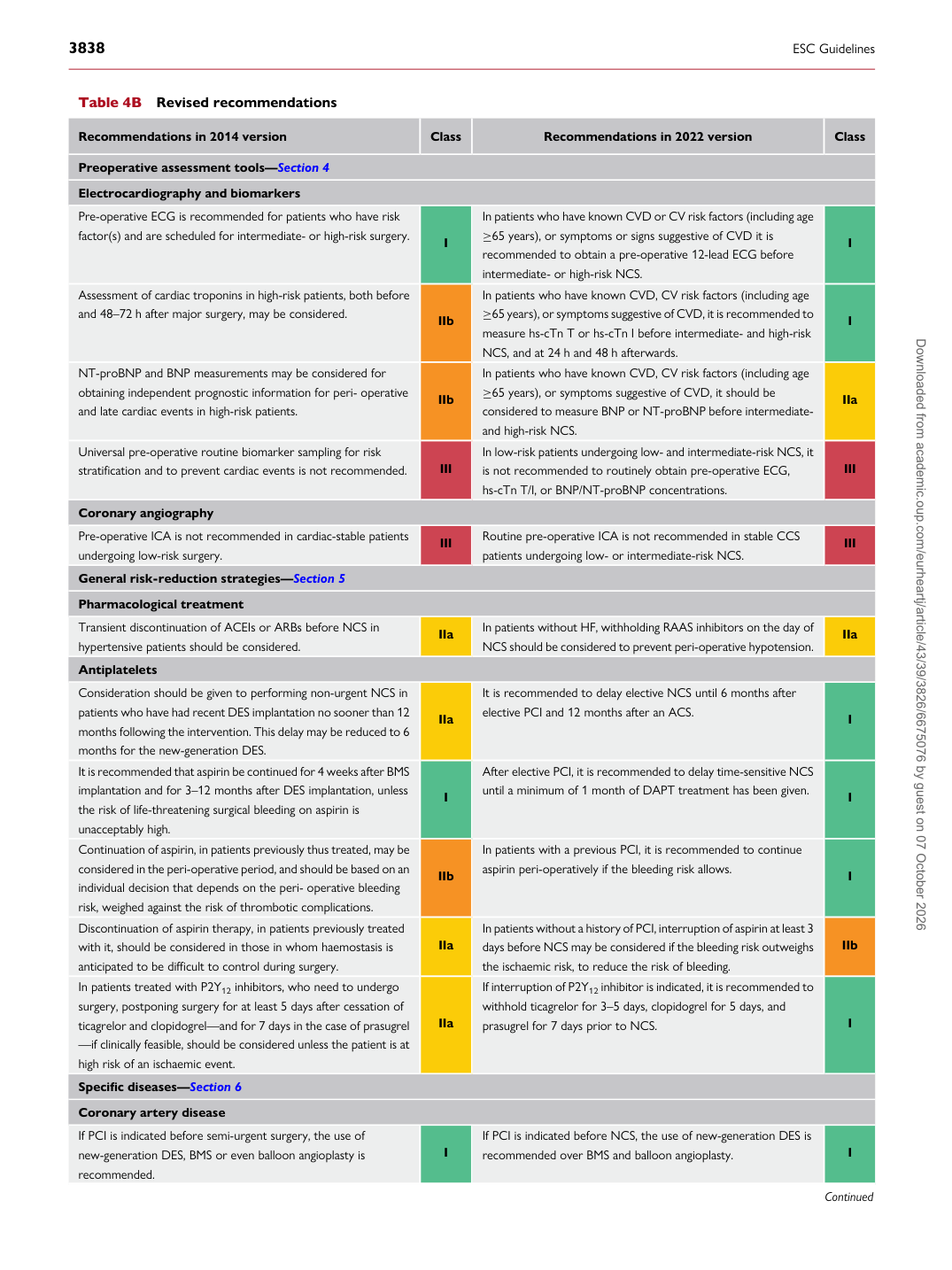
Table 4B Revised recommendations

Recommendations in 2014 version Class Recommendations in 2022 version Class

Preoperative assessment tools—Section 4 Electrocardiography and biomarkers Pre-operative ECG is recommended for patients who have risk factor(s) and are scheduled for intermediate- or high-risk surgery. I In patients who have known CVD or CV risk factors (including age

≥65 years), or symptoms or signs suggestive of CVD it is recommended to obtain a pre-operative 12-lead ECG before intermediate- or high-risk NCS. I

Assessment of cardiac troponins in high-risk patients, both before and 48–72 h after major surgery, may be considered. IIb In patients who have known CVD, CV risk factors (including age

≥65 years), or symptoms suggestive of CVD, it is recommended to measure hs-cTn T or hs-cTn I before intermediate- and high-risk NCS, and at 24 h and 48 h afterwards. I

NT-proBNP and BNP measurements may be considered for obtaining independent prognostic information for peri- operative and late cardiac events in high-risk patients. IIb In patients who have known CVD, CV risk factors (including age ≥65 years), or symptoms suggestive of CVD, it should be

considered to measure BNP or NT-proBNP before intermediateand high-risk NCS. IIa

Universal pre-operative routine biomarker sampling for risk stratification and to prevent cardiac events is not recommended. III In low-risk patients undergoing low- and intermediate-risk NCS, it

is not recommended to routinely obtain pre-operative ECG, hs-cTn T/I, or BNP/NT-proBNP concentrations. III

Coronary angiography Pre-operative ICA is not recommended in cardiac-stable patients undergoing low-risk surgery. III Routine pre-operative ICA is not recommended in stable CCS

patients undergoing low- or intermediate-risk NCS. III

General risk-reduction strategies—Section 5 Pharmacological treatment Transient discontinuation of ACEIs or ARBs before NCS in hypertensive patients should be considered. IIa In patients without HF, withholding RAAS inhibitors on the day of

NCS should be considered to prevent peri-operative hypotension. IIa

Antiplatelets Consideration should be given to performing non-urgent NCS in patients who have had recent DES implantation no sooner than 12 months following the intervention. This delay may be reduced to 6 months for the new-generation DES. IIa It is recommended to delay elective NCS until 6 months after elective PCI and 12 months after an ACS. I It is recommended that aspirin be continued for 4 weeks after BMS implantation and for 3–12 months after DES implantation, unless the risk of life-threatening surgical bleeding on aspirin is unacceptably high. I After elective PCI, it is recommended to delay time-sensitive NCS until a minimum of 1 month of DAPT treatment has been given. I Continuation of aspirin, in patients previously thus treated, may be considered in the peri-operative period, and should be based on an individual decision that depends on the peri- operative bleeding risk, weighed against the risk of thrombotic complications. IIb In patients with a previous PCI, it is recommended to continue

aspirin peri-operatively if the bleeding risk allows. I

Discontinuation of aspirin therapy, in patients previously treated with it, should be considered in those in whom haemostasis is anticipated to be difficult to control during surgery. IIa In patients without a history of PCI, interruption of aspirin at least 3

days before NCS may be considered if the bleeding risk outweighs the ischaemic risk, to reduce the risk of bleeding. IIb

In patients treated with P2Y12 inhibitors, who need to undergo surgery, postponing surgery for at least 5 days after cessation of ticagrelor and clopidogrel—and for 7 days in the case of prasugrel —if clinically feasible, should be considered unless the patient is at high risk of an ischaemic event. IIa If interruption of P2Y12 inhibitor is indicated, it is recommended to

withhold ticagrelor for 3–5 days, clopidogrel for 5 days, and prasugrel for 7 days prior to NCS. I

Specific diseases—Section 6 Coronary artery disease If PCI is indicated before semi-urgent surgery, the use of new-generation DES, BMS or even balloon angioplasty is recommended. I If PCI is indicated before NCS, the use of new-generation DES is

recommended over BMS and balloon angioplasty. I

Continued Downloaded from academic.oup.com/eurheartj/article/43/39/3826/6675076 by guest on 07 October 2026