p.12 抽出テキスト
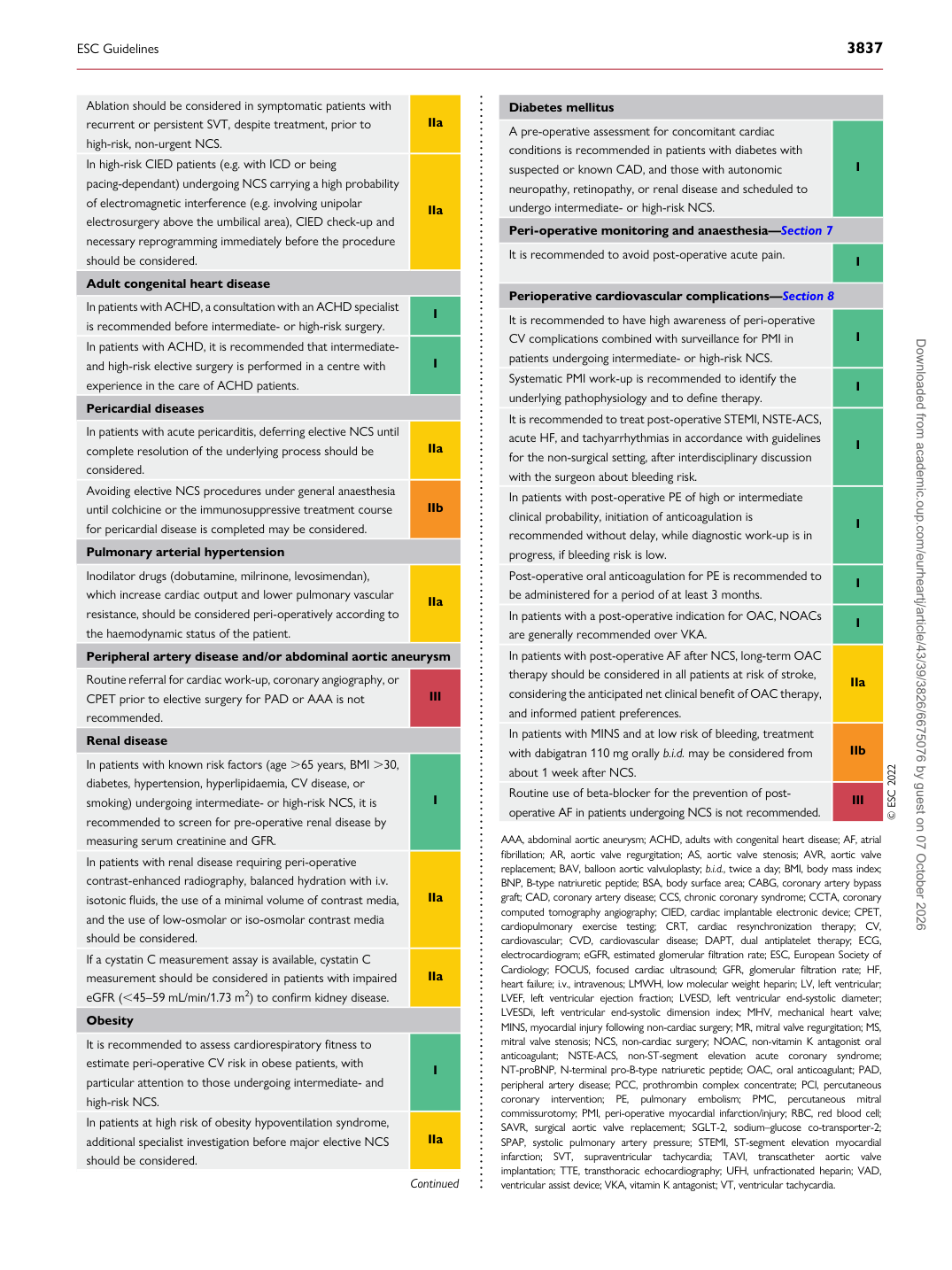
Ablation should be considered in symptomatic patients with recurrent or persistent SVT, despite treatment, prior to high-risk, non-urgent NCS. IIa In high-risk CIED patients (e.g. with ICD or being pacing-dependant) undergoing NCS carrying a high probability of electromagnetic interference (e.g. involving unipolar electrosurgery above the umbilical area), CIED check-up and necessary reprogramming immediately before the procedure should be considered. IIa Adult congenital heart disease In patients with ACHD, a consultation with an ACHD specialist is recommended before intermediate- or high-risk surgery. I In patients with ACHD, it is recommended that intermediateand high-risk elective surgery is performed in a centre with experience in the care of ACHD patients. I Pericardial diseases In patients with acute pericarditis, deferring elective NCS until complete resolution of the underlying process should be considered. IIa Avoiding elective NCS procedures under general anaesthesia until colchicine or the immunosuppressive treatment course for pericardial disease is completed may be considered. IIb Pulmonary arterial hypertension Inodilator drugs (dobutamine, milrinone, levosimendan), which increase cardiac output and lower pulmonary vascular resistance, should be considered peri-operatively according to the haemodynamic status of the patient. IIa Peripheral artery disease and/or abdominal aortic aneurysm Routine referral for cardiac work-up, coronary angiography, or CPET prior to elective surgery for PAD or AAA is not recommended. III Renal disease In patients with known risk factors (age .65 years, BMI .30, diabetes, hypertension, hyperlipidaemia, CV disease, or smoking) undergoing intermediate- or high-risk NCS, it is recommended to screen for pre-operative renal disease by measuring serum creatinine and GFR. I In patients with renal disease requiring peri-operative contrast-enhanced radiography, balanced hydration with i.v. isotonic fluids, the use of a minimal volume of contrast media, and the use of low-osmolar or iso-osmolar contrast media should be considered. IIa If a cystatin C measurement assay is available, cystatin C measurement should be considered in patients with impaired eGFR (,45–59 mL/min/1.73 m2) to confirm kidney disease. IIa Obesity It is recommended to assess cardiorespiratory fitness to estimate peri-operative CV risk in obese patients, with particular attention to those undergoing intermediate- and high-risk NCS. I In patients at high risk of obesity hypoventilation syndrome, additional specialist investigation before major elective NCS should be considered. IIa

Continued Diabetes mellitus

A pre-operative assessment for concomitant cardiac conditions is recommended in patients with diabetes with suspected or known CAD, and those with autonomic neuropathy, retinopathy, or renal disease and scheduled to undergo intermediate- or high-risk NCS. I Peri-operative monitoring and anaesthesia—Section 7 It is recommended to avoid post-operative acute pain. I

Perioperative cardiovascular complications—Section 8 It is recommended to have high awareness of peri-operative CV complications combined with surveillance for PMI in patients undergoing intermediate- or high-risk NCS. I Systematic PMI work-up is recommended to identify the underlying pathophysiology and to define therapy. I It is recommended to treat post-operative STEMI, NSTE-ACS, acute HF, and tachyarrhythmias in accordance with guidelines for the non-surgical setting, after interdisciplinary discussion with the surgeon about bleeding risk. I In patients with post-operative PE of high or intermediate clinical probability, initiation of anticoagulation is recommended without delay, while diagnostic work-up is in progress, if bleeding risk is low. I Post-operative oral anticoagulation for PE is recommended to be administered for a period of at least 3 months. I In patients with a post-operative indication for OAC, NOACs are generally recommended over VKA. I In patients with post-operative AF after NCS, long-term OAC therapy should be considered in all patients at risk of stroke, considering the anticipated net clinical benefit of OAC therapy, and informed patient preferences. IIa In patients with MINS and at low risk of bleeding, treatment with dabigatran 110 mg orally b.i.d. may be considered from about 1 week after NCS. IIb Routine use of beta-blocker for the prevention of postoperative AF in patients undergoing NCS is not recommended. III © ESC 2022

AAA, abdominal aortic aneurysm; ACHD, adults with congenital heart disease; AF, atrial fibrillation; AR, aortic valve regurgitation; AS, aortic valve stenosis; AVR, aortic valve replacement; BAV, balloon aortic valvuloplasty; b.i.d., twice a day; BMI, body mass index; BNP, B-type natriuretic peptide; BSA, body surface area; CABG, coronary artery bypass graft; CAD, coronary artery disease; CCS, chronic coronary syndrome; CCTA, coronary computed tomography angiography; CIED, cardiac implantable electronic device; CPET, cardiopulmonary exercise testing; CRT, cardiac resynchronization therapy; CV, cardiovascular; CVD, cardiovascular disease; DAPT, dual antiplatelet therapy; ECG, electrocardiogram; eGFR, estimated glomerular filtration rate; ESC, European Society of Cardiology; FOCUS, focused cardiac ultrasound; GFR, glomerular filtration rate; HF, heart failure; i.v., intravenous; LMWH, low molecular weight heparin; LV, left ventricular; LVEF, left ventricular ejection fraction; LVESD, left ventricular end-systolic diameter; LVESDi, left ventricular end-systolic dimension index; MHV, mechanical heart valve; MINS, myocardial injury following non-cardiac surgery; MR, mitral valve regurgitation; MS, mitral valve stenosis; NCS, non-cardiac surgery; NOAC, non-vitamin K antagonist oral anticoagulant; NSTE-ACS, non-ST-segment elevation acute coronary syndrome; NT-proBNP, N-terminal pro-B-type natriuretic peptide; OAC, oral anticoagulant; PAD, peripheral artery disease; PCC, prothrombin complex concentrate; PCI, percutaneous coronary intervention; PE, pulmonary embolism; PMC, percutaneous mitral commissurotomy; PMI, peri-operative myocardial infarction/injury; RBC, red blood cell; SAVR, surgical aortic valve replacement; SGLT-2, sodium–glucose co-transporter-2; SPAP, systolic pulmonary artery pressure; STEMI, ST-segment elevation myocardial infarction; SVT, supraventricular tachycardia; TAVI, transcatheter aortic valve implantation; TTE, transthoracic echocardiography; UFH, unfractionated heparin; VAD, ventricular assist device; VKA, vitamin K antagonist; VT, ventricular tachycardia.

ESC Guidelines                                                                                                                                                                                     3837

Downloaded from academic.oup.com/eurheartj/article/43/39/3826/6675076 by guest on 07 October 2026