p.11 抽出テキスト
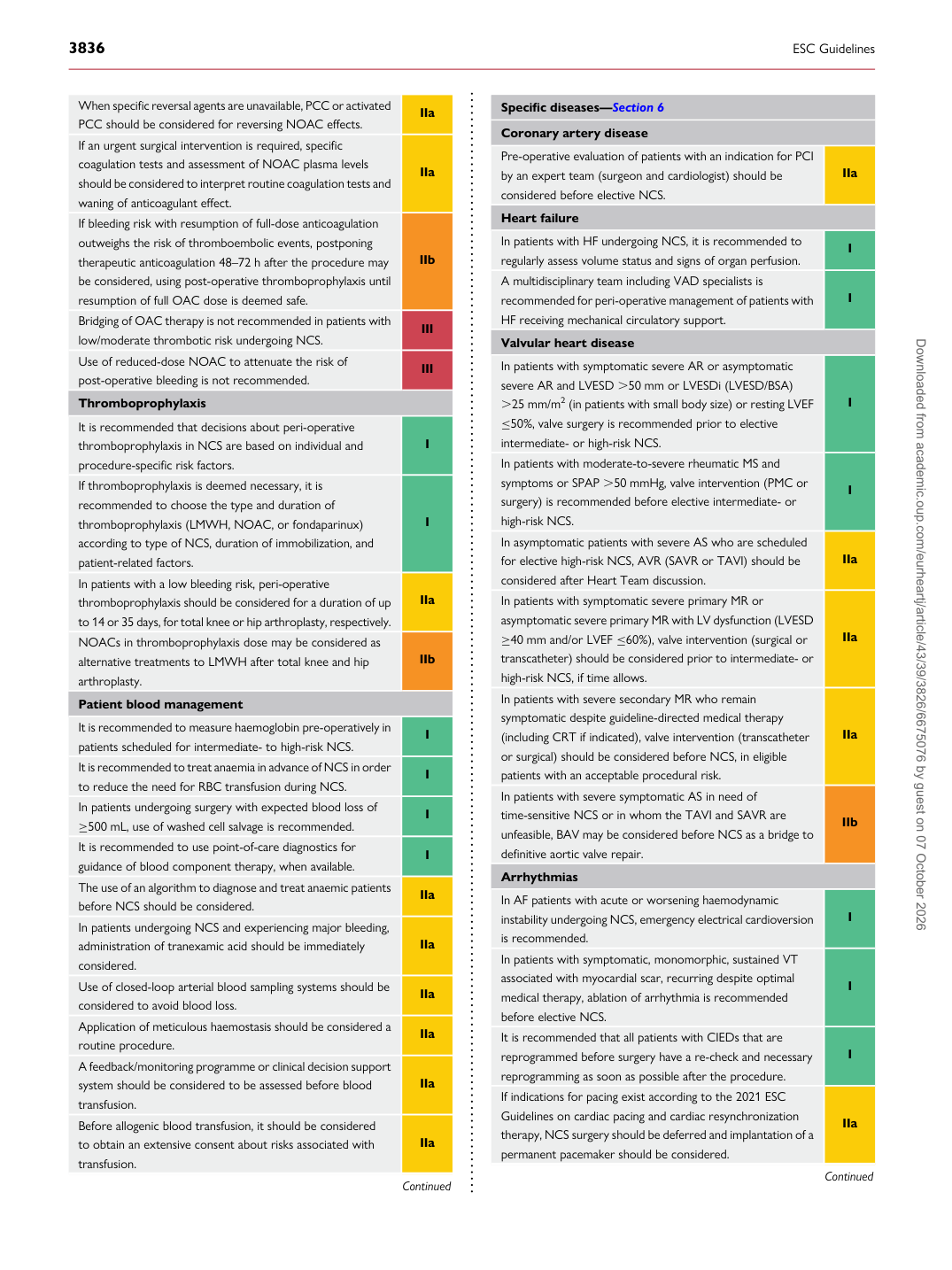
When specific reversal agents are unavailable, PCC or activated PCC should be considered for reversing NOAC effects. IIa If an urgent surgical intervention is required, specific coagulation tests and assessment of NOAC plasma levels should be considered to interpret routine coagulation tests and waning of anticoagulant effect. IIa If bleeding risk with resumption of full-dose anticoagulation outweighs the risk of thromboembolic events, postponing therapeutic anticoagulation 48–72 h after the procedure may be considered, using post-operative thromboprophylaxis until resumption of full OAC dose is deemed safe. IIb Bridging of OAC therapy is not recommended in patients with low/moderate thrombotic risk undergoing NCS. III Use of reduced-dose NOAC to attenuate the risk of post-operative bleeding is not recommended. III Thromboprophylaxis It is recommended that decisions about peri-operative thromboprophylaxis in NCS are based on individual and procedure-specific risk factors. I If thromboprophylaxis is deemed necessary, it is recommended to choose the type and duration of thromboprophylaxis (LMWH, NOAC, or fondaparinux) according to type of NCS, duration of immobilization, and patient-related factors. I In patients with a low bleeding risk, peri-operative thromboprophylaxis should be considered for a duration of up to 14 or 35 days, for total knee or hip arthroplasty, respectively. IIa NOACs in thromboprophylaxis dose may be considered as alternative treatments to LMWH after total knee and hip arthroplasty. IIb Patient blood management It is recommended to measure haemoglobin pre-operatively in patients scheduled for intermediate- to high-risk NCS. I It is recommended to treat anaemia in advance of NCS in order to reduce the need for RBC transfusion during NCS. I In patients undergoing surgery with expected blood loss of ≥500 mL, use of washed cell salvage is recommended. I It is recommended to use point-of-care diagnostics for guidance of blood component therapy, when available. I The use of an algorithm to diagnose and treat anaemic patients before NCS should be considered. IIa In patients undergoing NCS and experiencing major bleeding, administration of tranexamic acid should be immediately considered. IIa Use of closed-loop arterial blood sampling systems should be considered to avoid blood loss. IIa Application of meticulous haemostasis should be considered a routine procedure. IIa A feedback/monitoring programme or clinical decision support system should be considered to be assessed before blood transfusion. IIa Before allogenic blood transfusion, it should be considered to obtain an extensive consent about risks associated with transfusion. IIa

Continued Specific diseases—Section 6

Coronary artery disease Pre-operative evaluation of patients with an indication for PCI by an expert team (surgeon and cardiologist) should be considered before elective NCS. IIa Heart failure In patients with HF undergoing NCS, it is recommended to regularly assess volume status and signs of organ perfusion. I A multidisciplinary team including VAD specialists is recommended for peri-operative management of patients with HF receiving mechanical circulatory support. I Valvular heart disease In patients with symptomatic severe AR or asymptomatic severe AR and LVESD .50 mm or LVESDi (LVESD/BSA) .25 mm/m2 (in patients with small body size) or resting LVEF ≤50%, valve surgery is recommended prior to elective intermediate- or high-risk NCS. I In patients with moderate-to-severe rheumatic MS and symptoms or SPAP .50 mmHg, valve intervention (PMC or surgery) is recommended before elective intermediate- or high-risk NCS. I In asymptomatic patients with severe AS who are scheduled for elective high-risk NCS, AVR (SAVR or TAVI) should be considered after Heart Team discussion. IIa In patients with symptomatic severe primary MR or asymptomatic severe primary MR with LV dysfunction (LVESD ≥40 mm and/or LVEF ≤60%), valve intervention (surgical or transcatheter) should be considered prior to intermediate- or high-risk NCS, if time allows. IIa In patients with severe secondary MR who remain symptomatic despite guideline-directed medical therapy (including CRT if indicated), valve intervention (transcatheter or surgical) should be considered before NCS, in eligible patients with an acceptable procedural risk. IIa In patients with severe symptomatic AS in need of time-sensitive NCS or in whom the TAVI and SAVR are unfeasible, BAV may be considered before NCS as a bridge to definitive aortic valve repair. IIb Arrhythmias In AF patients with acute or worsening haemodynamic instability undergoing NCS, emergency electrical cardioversion is recommended. I In patients with symptomatic, monomorphic, sustained VT associated with myocardial scar, recurring despite optimal medical therapy, ablation of arrhythmia is recommended before elective NCS. I It is recommended that all patients with CIEDs that are reprogrammed before surgery have a re-check and necessary reprogramming as soon as possible after the procedure. I If indications for pacing exist according to the 2021 ESC Guidelines on cardiac pacing and cardiac resynchronization therapy, NCS surgery should be deferred and implantation of a permanent pacemaker should be considered. IIa

Continued Downloaded from academic.oup.com/eurheartj/article/43/39/3826/6675076 by guest on 07 October 2026