p.10 抽出テキスト
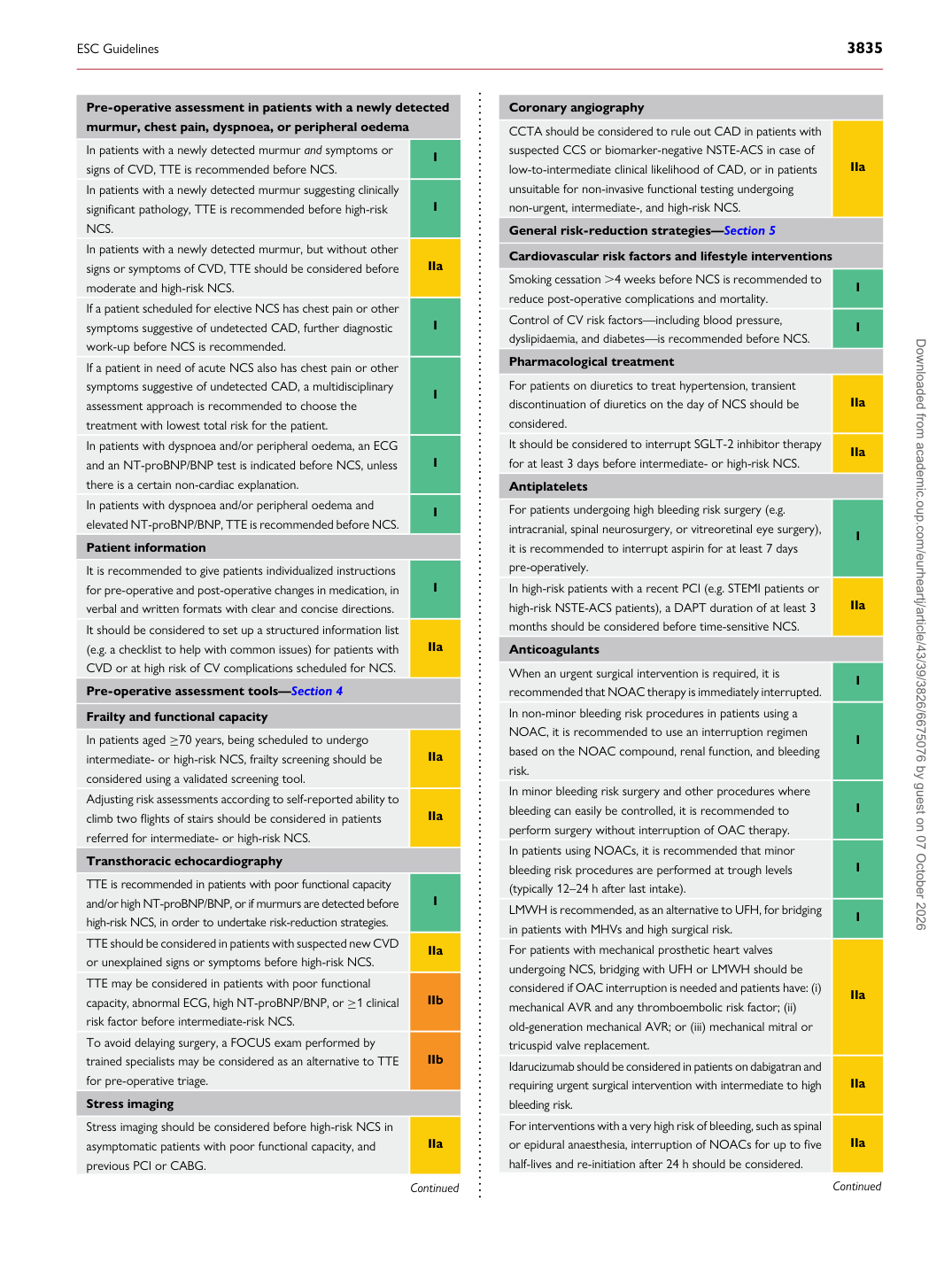
Pre-operative assessment in patients with a newly detected murmur, chest pain, dyspnoea, or peripheral oedema In patients with a newly detected murmur and symptoms or signs of CVD, TTE is recommended before NCS. I In patients with a newly detected murmur suggesting clinically significant pathology, TTE is recommended before high-risk NCS. I In patients with a newly detected murmur, but without other signs or symptoms of CVD, TTE should be considered before moderate and high-risk NCS. IIa If a patient scheduled for elective NCS has chest pain or other symptoms suggestive of undetected CAD, further diagnostic work-up before NCS is recommended. I If a patient in need of acute NCS also has chest pain or other symptoms suggestive of undetected CAD, a multidisciplinary assessment approach is recommended to choose the treatment with lowest total risk for the patient. I In patients with dyspnoea and/or peripheral oedema, an ECG and an NT-proBNP/BNP test is indicated before NCS, unless there is a certain non-cardiac explanation. I In patients with dyspnoea and/or peripheral oedema and elevated NT-proBNP/BNP, TTE is recommended before NCS. I Patient information It is recommended to give patients individualized instructions for pre-operative and post-operative changes in medication, in verbal and written formats with clear and concise directions. I It should be considered to set up a structured information list (e.g. a checklist to help with common issues) for patients with CVD or at high risk of CV complications scheduled for NCS. IIa Pre-operative assessment tools—Section 4 Frailty and functional capacity In patients aged ≥70 years, being scheduled to undergo intermediate- or high-risk NCS, frailty screening should be considered using a validated screening tool. IIa Adjusting risk assessments according to self-reported ability to climb two flights of stairs should be considered in patients referred for intermediate- or high-risk NCS. IIa Transthoracic echocardiography TTE is recommended in patients with poor functional capacity and/or high NT-proBNP/BNP, or if murmurs are detected before high-risk NCS, in order to undertake risk-reduction strategies. I TTE should be considered in patients with suspected new CVD or unexplained signs or symptoms before high-risk NCS. IIa TTE may be considered in patients with poor functional capacity, abnormal ECG, high NT-proBNP/BNP, or ≥1 clinical risk factor before intermediate-risk NCS. IIb To avoid delaying surgery, a FOCUS exam performed by trained specialists may be considered as an alternative to TTE for pre-operative triage. IIb Stress imaging Stress imaging should be considered before high-risk NCS in asymptomatic patients with poor functional capacity, and previous PCI or CABG. IIa

Continued Coronary angiography

CCTA should be considered to rule out CAD in patients with suspected CCS or biomarker-negative NSTE-ACS in case of low-to-intermediate clinical likelihood of CAD, or in patients unsuitable for non-invasive functional testing undergoing non-urgent, intermediate-, and high-risk NCS. IIa General risk-reduction strategies—Section 5 Cardiovascular risk factors and lifestyle interventions Smoking cessation .4 weeks before NCS is recommended to reduce post-operative complications and mortality. I Control of CV risk factors—including blood pressure, dyslipidaemia, and diabetes—is recommended before NCS. I Pharmacological treatment For patients on diuretics to treat hypertension, transient discontinuation of diuretics on the day of NCS should be considered. IIa It should be considered to interrupt SGLT-2 inhibitor therapy for at least 3 days before intermediate- or high-risk NCS. IIa Antiplatelets For patients undergoing high bleeding risk surgery (e.g. intracranial, spinal neurosurgery, or vitreoretinal eye surgery), it is recommended to interrupt aspirin for at least 7 days pre-operatively. I In high-risk patients with a recent PCI (e.g. STEMI patients or high-risk NSTE-ACS patients), a DAPT duration of at least 3 months should be considered before time-sensitive NCS. IIa Anticoagulants When an urgent surgical intervention is required, it is recommended that NOAC therapy is immediately interrupted. I In non-minor bleeding risk procedures in patients using a NOAC, it is recommended to use an interruption regimen based on the NOAC compound, renal function, and bleeding risk. I In minor bleeding risk surgery and other procedures where bleeding can easily be controlled, it is recommended to perform surgery without interruption of OAC therapy. I In patients using NOACs, it is recommended that minor bleeding risk procedures are performed at trough levels (typically 12–24 h after last intake). I LMWH is recommended, as an alternative to UFH, for bridging in patients with MHVs and high surgical risk. I For patients with mechanical prosthetic heart valves undergoing NCS, bridging with UFH or LMWH should be considered if OAC interruption is needed and patients have: (i) mechanical AVR and any thromboembolic risk factor; (ii) old-generation mechanical AVR; or (iii) mechanical mitral or tricuspid valve replacement. IIa Idarucizumab should be considered in patients on dabigatran and requiring urgent surgical intervention with intermediate to high bleeding risk. IIa For interventions with a very high risk of bleeding, such as spinal or epidural anaesthesia, interruption of NOACs for up to five half-lives and re-initiation after 24 h should be considered. IIa

Continued

ESC Guidelines                                                                                                                                                                                     3835

Downloaded from academic.oup.com/eurheartj/article/43/39/3826/6675076 by guest on 07 October 2026