p.99 抽出テキスト
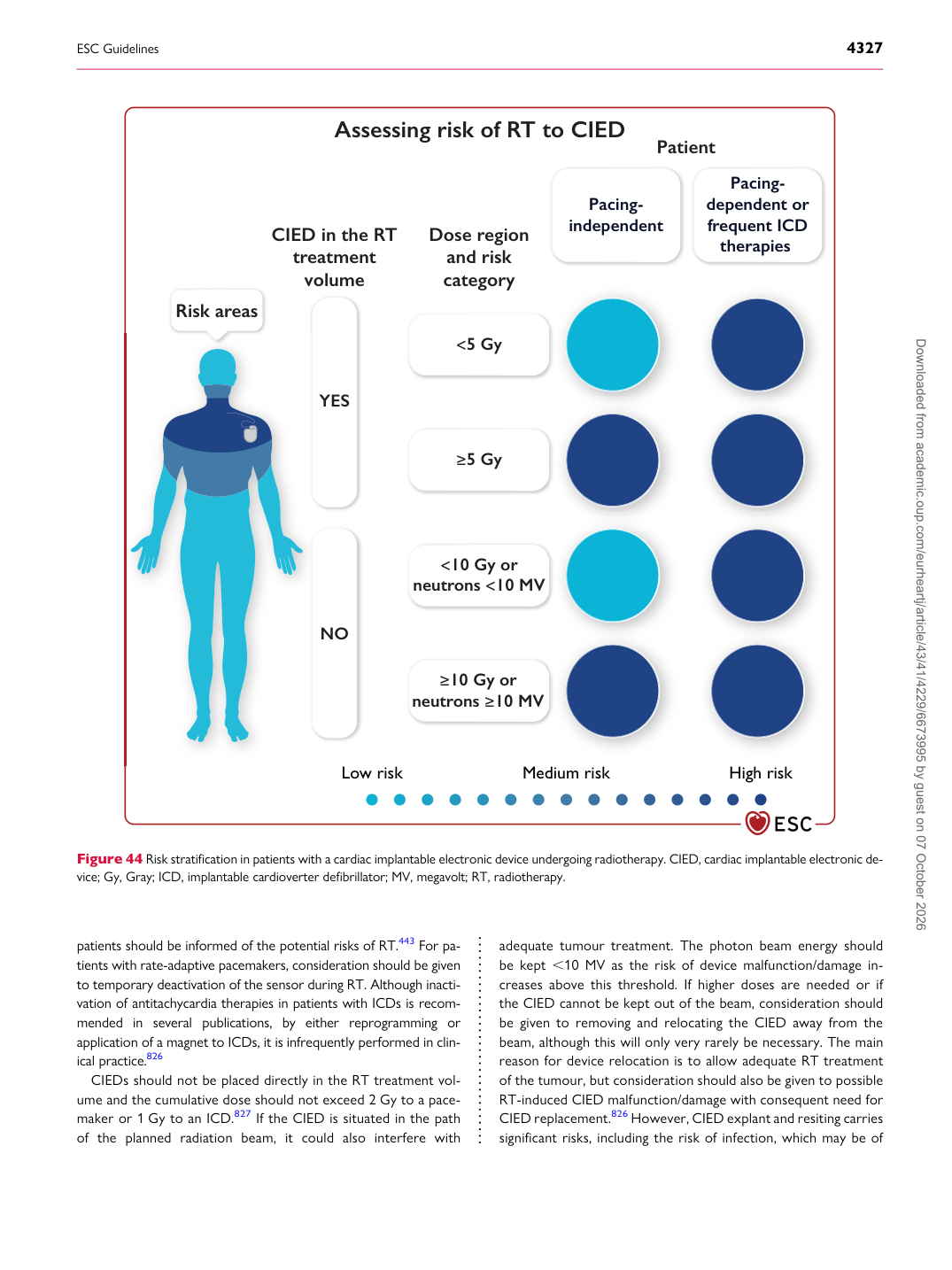
patients should be informed of the potential risks of RT.443 For patients with rate-adaptive pacemakers, consideration should be given to temporary deactivation of the sensor during RT. Although inactivation of antitachycardia therapies in patients with ICDs is recommended in several publications, by either reprogramming or application of a magnet to ICDs, it is infrequently performed in clinical practice.826 CIEDs should not be placed directly in the RT treatment volume and the cumulative dose should not exceed 2 Gy to a pacemaker or 1 Gy to an ICD.827 If the CIED is situated in the path of the planned radiation beam, it could also interfere with adequate tumour treatment. The photon beam energy should be kept ,10 MV as the risk of device malfunction/damage increases above this threshold. If higher doses are needed or if the CIED cannot be kept out of the beam, consideration should be given to removing and relocating the CIED away from the beam, although this will only very rarely be necessary. The main reason for device relocation is to allow adequate RT treatment of the tumour, but consideration should also be given to possible RT-induced CIED malfunction/damage with consequent need for CIED replacement.826 However, CIED explant and resiting carries significant risks, including the risk of infection, which may be of

Pacingdependent or

frequent ICD

therapies

Pacingindependent

<5 Gy

≥5 Gy

<10 Gy or neutrons <10 MV

≥10 Gy or neutrons ≥10 MV

Patient Assessing risk of RT to CIED

Dose region

and risk category

Low risk High risk

Medium risk

CIED in the RT

treatment

volume

YES

NO

Risk areas

Figure 44 Risk stratification in patients with a cardiac implantable electronic device undergoing radiotherapy. CIED, cardiac implantable electronic device; Gy, Gray; ICD, implantable cardioverter defibrillator; MV, megavolt; RT, radiotherapy. Downloaded from academic.oup.com/eurheartj/article/43/41/4229/6673995 by guest on 07 October 2026