p.98 抽出テキスト
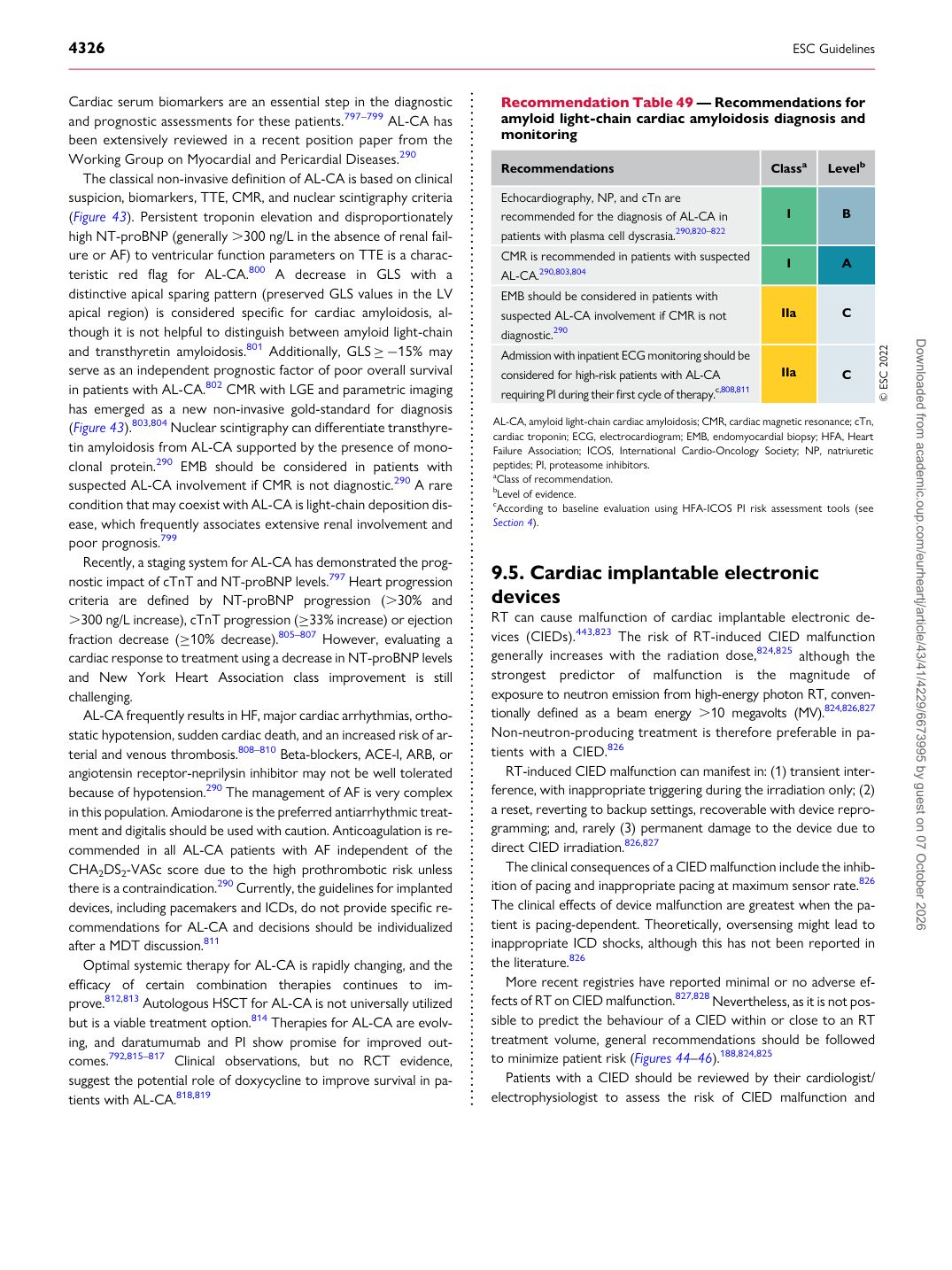
Cardiac serum biomarkers are an essential step in the diagnostic and prognostic assessments for these patients.797–799 AL-CA has been extensively reviewed in a recent position paper from the Working Group on Myocardial and Pericardial Diseases.290 The classical non-invasive definition of AL-CA is based on clinical suspicion, biomarkers, TTE, CMR, and nuclear scintigraphy criteria (Figure 43). Persistent troponin elevation and disproportionately high NT-proBNP (generally .300 ng/L in the absence of renal failure or AF) to ventricular function parameters on TTE is a characteristic red flag for AL-CA.800 A decrease in GLS with a distinctive apical sparing pattern (preserved GLS values in the LV apical region) is considered specific for cardiac amyloidosis, although it is not helpful to distinguish between amyloid light-chain and transthyretin amyloidosis.801 Additionally, GLS ≥−15% may serve as an independent prognostic factor of poor overall survival in patients with AL-CA.802 CMR with LGE and parametric imaging has emerged as a new non-invasive gold-standard for diagnosis (Figure 43).803,804 Nuclear scintigraphy can differentiate transthyretin amyloidosis from AL-CA supported by the presence of monoclonal protein.290 EMB should be considered in patients with suspected AL-CA involvement if CMR is not diagnostic.290 A rare condition that may coexist with AL-CA is light-chain deposition disease, which frequently associates extensive renal involvement and poor prognosis.799 Recently, a staging system for AL-CA has demonstrated the prognostic impact of cTnT and NT-proBNP levels.797 Heart progression criteria are defined by NT-proBNP progression (.30% and .300 ng/L increase), cTnT progression (≥33% increase) or ejection fraction decrease (≥10% decrease).805–807 However, evaluating a cardiac response to treatment using a decrease in NT-proBNP levels and New York Heart Association class improvement is still challenging. AL-CA frequently results in HF, major cardiac arrhythmias, orthostatic hypotension, sudden cardiac death, and an increased risk of arterial and venous thrombosis.808–810 Beta-blockers, ACE-I, ARB, or angiotensin receptor-neprilysin inhibitor may not be well tolerated because of hypotension.290 The management of AF is very complex in this population. Amiodarone is the preferred antiarrhythmic treatment and digitalis should be used with caution. Anticoagulation is recommended in all AL-CA patients with AF independent of the CHA2DS2-VASc score due to the high prothrombotic risk unless there is a contraindication.290 Currently, the guidelines for implanted devices, including pacemakers and ICDs, do not provide specific recommendations for AL-CA and decisions should be individualized after a MDT discussion.811 Optimal systemic therapy for AL-CA is rapidly changing, and the efficacy of certain combination therapies continues to improve.812,813 Autologous HSCT for AL-CA is not universally utilized but is a viable treatment option.814 Therapies for AL-CA are evolving, and daratumumab and PI show promise for improved outcomes.792,815–817 Clinical observations, but no RCT evidence, suggest the potential role of doxycycline to improve survival in patients with AL-CA.818,819 9.5 Cardiac implantable electronic

devices RT can cause malfunction of cardiac implantable electronic devices (CIEDs).443,823 The risk of RT-induced CIED malfunction generally increases with the radiation dose,824,825 although the strongest predictor of malfunction is the magnitude of exposure to neutron emission from high-energy photon RT, conventionally defined as a beam energy .10 megavolts (MV).824,826,827 Non-neutron-producing treatment is therefore preferable in patients with a CIED.826 RT-induced CIED malfunction can manifest in: (1) transient interference, with inappropriate triggering during the irradiation only; (2) a reset, reverting to backup settings, recoverable with device reprogramming; and, rarely (3) permanent damage to the device due to direct CIED irradiation.826,827 The clinical consequences of a CIED malfunction include the inhibition of pacing and inappropriate pacing at maximum sensor rate.826 The clinical effects of device malfunction are greatest when the patient is pacing-dependent. Theoretically, oversensing might lead to inappropriate ICD shocks, although this has not been reported in the literature.826 More recent registries have reported minimal or no adverse effects of RT on CIED malfunction.827,828 Nevertheless, as it is not possible to predict the behaviour of a CIED within or close to an RT treatment volume, general recommendations should be followed to minimize patient risk (Figures 44–46).188,824,825 Patients with a CIED should be reviewed by their cardiologist/ electrophysiologist to assess the risk of CIED malfunction and

Recommendation Table 49 — Recommendations for amyloid light-chain cardiac amyloidosis diagnosis and monitoring

Recommendations Classa Levelb

Echocardiography, NP, and cTn are recommended for the diagnosis of AL-CA in patients with plasma cell dyscrasia.290,820–822 I B CMR is recommended in patients with suspected AL-CA.290,803,804 I A EMB should be considered in patients with suspected AL-CA involvement if CMR is not diagnostic.290 IIa C Admission with inpatient ECG monitoring should be considered for high-risk patients with AL-CA requiring PI during their first cycle of therapy.c,808,811 IIa C © ESC 2022

AL-CA, amyloid light-chain cardiac amyloidosis; CMR, cardiac magnetic resonance; cTn, cardiac troponin; ECG, electrocardiogram; EMB, endomyocardial biopsy; HFA, Heart Failure Association; ICOS, International Cardio-Oncology Society; NP, natriuretic peptides; PI, proteasome inhibitors. aClass of recommendation. bLevel of evidence. cAccording to baseline evaluation using HFA-ICOS PI risk assessment tools (see Section 4). Downloaded from academic.oup.com/eurheartj/article/43/41/4229/6673995 by guest on 07 October 2026