p.95 抽出テキスト
9.3 Carcinoid valvular heart disease

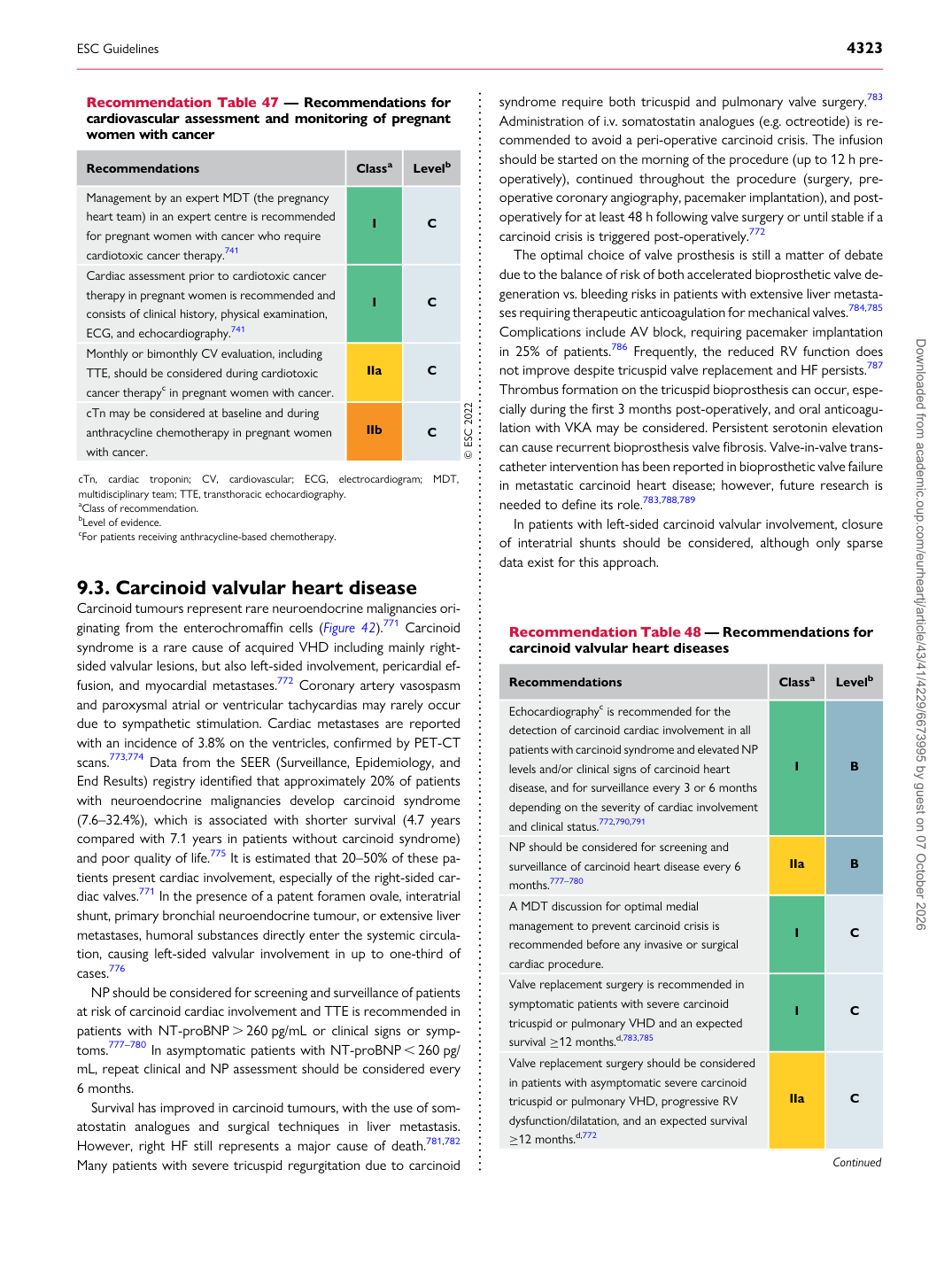
Carcinoid tumours represent rare neuroendocrine malignancies originating from the enterochromaffin cells (Figure 42).771 Carcinoid syndrome is a rare cause of acquired VHD including mainly rightsided valvular lesions, but also left-sided involvement, pericardial effusion, and myocardial metastases.772 Coronary artery vasospasm and paroxysmal atrial or ventricular tachycardias may rarely occur due to sympathetic stimulation. Cardiac metastases are reported with an incidence of 3.8% on the ventricles, confirmed by PET-CT scans.773,774 Data from the SEER (Surveillance, Epidemiology, and End Results) registry identified that approximately 20% of patients with neuroendocrine malignancies develop carcinoid syndrome (7.6–32.4%), which is associated with shorter survival (4.7 years compared with 7.1 years in patients without carcinoid syndrome) and poor quality of life.775 It is estimated that 20–50% of these patients present cardiac involvement, especially of the right-sided cardiac valves.771 In the presence of a patent foramen ovale, interatrial shunt, primary bronchial neuroendocrine tumour, or extensive liver metastases, humoral substances directly enter the systemic circulation, causing left-sided valvular involvement in up to one-third of cases.776 NP should be considered for screening and surveillance of patients at risk of carcinoid cardiac involvement and TTE is recommended in patients with NT-proBNP . 260 pg/mL or clinical signs or symptoms.777–780 In asymptomatic patients with NT-proBNP , 260 pg/ mL, repeat clinical and NP assessment should be considered every 6 months. Survival has improved in carcinoid tumours, with the use of somatostatin analogues and surgical techniques in liver metastasis. However, right HF still represents a major cause of death.781,782 Many patients with severe tricuspid regurgitation due to carcinoid syndrome require both tricuspid and pulmonary valve surgery.783

Administration of i.v. somatostatin analogues (e.g. octreotide) is recommended to avoid a peri-operative carcinoid crisis. The infusion should be started on the morning of the procedure (up to 12 h preoperatively), continued throughout the procedure (surgery, preoperative coronary angiography, pacemaker implantation), and postoperatively for at least 48 h following valve surgery or until stable if a carcinoid crisis is triggered post-operatively.772 The optimal choice of valve prosthesis is still a matter of debate due to the balance of risk of both accelerated bioprosthetic valve degeneration vs. bleeding risks in patients with extensive liver metastases requiring therapeutic anticoagulation for mechanical valves.784,785 Complications include AV block, requiring pacemaker implantation in 25% of patients.786 Frequently, the reduced RV function does not improve despite tricuspid valve replacement and HF persists.787 Thrombus formation on the tricuspid bioprosthesis can occur, especially during the first 3 months post-operatively, and oral anticoagulation with VKA may be considered. Persistent serotonin elevation can cause recurrent bioprosthesis valve fibrosis. Valve-in-valve transcatheter intervention has been reported in bioprosthetic valve failure in metastatic carcinoid heart disease; however, future research is needed to define its role.783,788,789 In patients with left-sided carcinoid valvular involvement, closure of interatrial shunts should be considered, although only sparse data exist for this approach.

Recommendation Table 47 — Recommendations for cardiovascular assessment and monitoring of pregnant women with cancer

Recommendations Classa Levelb

Management by an expert MDT (the pregnancy heart team) in an expert centre is recommended for pregnant women with cancer who require cardiotoxic cancer therapy.741 I C Cardiac assessment prior to cardiotoxic cancer therapy in pregnant women is recommended and consists of clinical history, physical examination, ECG, and echocardiography.741 I C Monthly or bimonthly CV evaluation, including TTE, should be considered during cardiotoxic cancer therapyc in pregnant women with cancer. IIa C cTn may be considered at baseline and during anthracycline chemotherapy in pregnant women with cancer. IIb C © ESC 2022

cTn, cardiac troponin; CV, cardiovascular; ECG, electrocardiogram; MDT, multidisciplinary team; TTE, transthoracic echocardiography. aClass of recommendation. bLevel of evidence. cFor patients receiving anthracycline-based chemotherapy.

Recommendation Table 48 — Recommendations for carcinoid valvular heart diseases

Recommendations Classa Levelb Echocardiographyc is recommended for the detection of carcinoid cardiac involvement in all patients with carcinoid syndrome and elevated NP levels and/or clinical signs of carcinoid heart disease, and for surveillance every 3 or 6 months depending on the severity of cardiac involvement and clinical status.772,790,791 I B NP should be considered for screening and surveillance of carcinoid heart disease every 6 months.777–780 IIa B A MDT discussion for optimal medial management to prevent carcinoid crisis is recommended before any invasive or surgical cardiac procedure. I C Valve replacement surgery is recommended in symptomatic patients with severe carcinoid tricuspid or pulmonary VHD and an expected survival ≥12 months.d,783,785 I C Valve replacement surgery should be considered in patients with asymptomatic severe carcinoid tricuspid or pulmonary VHD, progressive RV dysfunction/dilatation, and an expected survival ≥12 months.d,772 IIa C

Continued Downloaded from academic.oup.com/eurheartj/article/43/41/4229/6673995 by guest on 07 October 2026