p.91 抽出テキスト
Management by an expert MDT (the pregnancy heart team) is recommended for all CS with CTRCD who are considering pregnancy.739,741,742 The risk of HF in CS without CTRCD is low, although vigilance remains important for potential maternal cardiac complications.

8.10 Pulmonary hypertension

Long-term clinical evaluation may be considered in patients who develop PH during therapy (Section 6). In patients with new exertional dyspnoea, fatigue, or angina, a TTE is recommended to assess the probability of PH. As TTE alone is not enough to confirm the diagnosis of PH, CS diagnosed with high PH probability require a right-heart catheterization to confirm the diagnosis. PH should be treated according to general guidelines with referral to a specialist PH service.620

9 Special populations

9.1 Cardiac tumours

Cardiac tumours are classified as either benign or malignant.743 Over 90% of primary cardiac tumours are benign (myxomas are predominant in adults, rhabdomyomas in children).744 Malignant primary tumours most commonly consist of sarcomas (approximately 65%) or lymphomas (approximately 25%).745 Cardiac metastases (from melanoma, lymphoma, leukaemia, breast, lung, and oesophageal cancers) are much more common than primary cardiac tumours (Figure 39).746 Presenting symptoms are paraneoplastic (fever, weakness, fatigue), thromboembolic, haemodynamic (due to compression or obstruction from the tumour) or arrhythmic.747,748

The diagnostic pathway should be based on knowledge about tumour type epidemiology, imaging features, and usually the requirement for a histopathological diagnosis. This topic has been extensively reviewed in ESC CardioMed,749 and here we summarize the main recommendations for differential diagnosis and management. Differential diagnosis should exclude cardiac thrombi or the presence of chemotherapy catheters. Imaging must assess the possibilities of cardiac surgery, and may include: (1) echocardiography (initial approach using TTE or transoesophageal echocardiography)748,750; (2) CMR (for cardiac tumour tissue characterization)751,752; and (3) CT and PET (to distinguish malignant from benign lesions and assess for non-cardiac metastatic disease or primary cancers) (Figure 40).753,754 Myxomas are primarily treated with surgery with a good prognosis. Malignant tumours are associated with a poor prognosis and evidence of the best treatment is lacking. Complete surgical resection is often impossible and adjuvant RT, systemic chemotherapy, and/or debulking palliative surgery are needed.755 Cardiac aggressive B-cell lymphomas require histopathological diagnosis (often obtained via analysis of pericardial effusion, EMB, or direct surgical biopsy) and are treated with chemotherapy, possibly followed by RT (Table 13).756

9.2 Pregnant patients with cancer

The diagnosis of cancer during pregnancy is uncommon (1 in every 1000 pregnant women is diagnosed with cancer), with BC, melanoma, and cervical cancer being the most frequent diagnoses.757 Chemotherapy is generally not applied during the first trimester due to the high risk of foetal congenital abnormalities (up to 20%) and cytotoxic chemotherapies have different risk profiles during the second or third trimesters.758,759 Furthermore, chemotherapy administration is usually not given beyond week 34 of gestation to provide a 3-week window between the last cycle and delivery.757 Supplementary data, Table S19 summarizes the chemotherapies for pregnant patients with cancer.760,761 Cardiac assessment prior to chemotherapy in pregnant women with cancer should consist of clinical history, physical examination, ECG, cardiac biomarker assessment and TTE (Figure 41).741 Baseline and follow-up TTE should be interpreted in the context of physiological haemodynamic alterations during pregnancy. In normal pregnancy, increase in stroke volume, heart rate, and pre-load blood volume, and decrease in systemic vascular resistance, lead to an increase in cardiac output from the first trimester to 80–85% above baseline by the third trimester.762–764 An increase in LV mass and LV and RV volumes is observed in the third trimester. During normal pregnancy, LVEF is usually unchanged and can be used for CTRCD monitoring. Although NP and cTn may be slightly elevated during normal pregnancy (NT-proBNP , 300 ng/L, BNP , 100 pg/mL,14 and hs-cTnT765,766), serial evaluation may be useful for

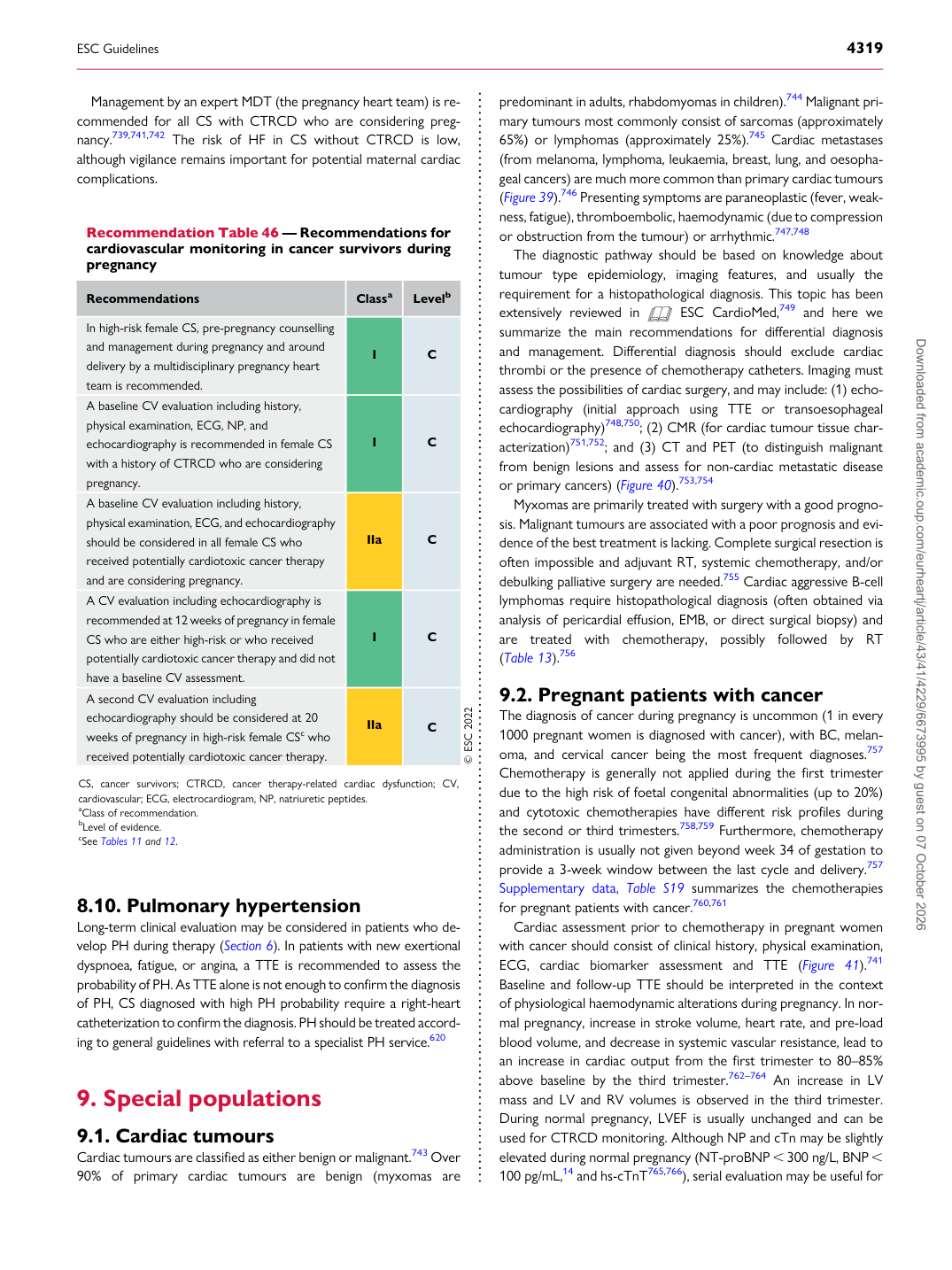
Recommendation Table 46 — Recommendations for cardiovascular monitoring in cancer survivors during pregnancy

Recommendations Classa Levelb

In high-risk female CS, pre-pregnancy counselling and management during pregnancy and around delivery by a multidisciplinary pregnancy heart team is recommended. I C A baseline CV evaluation including history, physical examination, ECG, NP, and echocardiography is recommended in female CS with a history of CTRCD who are considering pregnancy. I C A baseline CV evaluation including history, physical examination, ECG, and echocardiography should be considered in all female CS who received potentially cardiotoxic cancer therapy and are considering pregnancy. IIa C A CV evaluation including echocardiography is recommended at 12 weeks of pregnancy in female CS who are either high-risk or who received potentially cardiotoxic cancer therapy and did not have a baseline CV assessment. I C A second CV evaluation including echocardiography should be considered at 20 weeks of pregnancy in high-risk female CSc who received potentially cardiotoxic cancer therapy. IIa C © ESC 2022

CS, cancer survivors; CTRCD, cancer therapy-related cardiac dysfunction; CV, cardiovascular; ECG, electrocardiogram, NP, natriuretic peptides. aClass of recommendation. bLevel of evidence. cSee Tables 11 and 12. Downloaded from academic.oup.com/eurheartj/article/43/41/4229/6673995 by guest on 07 October 2026