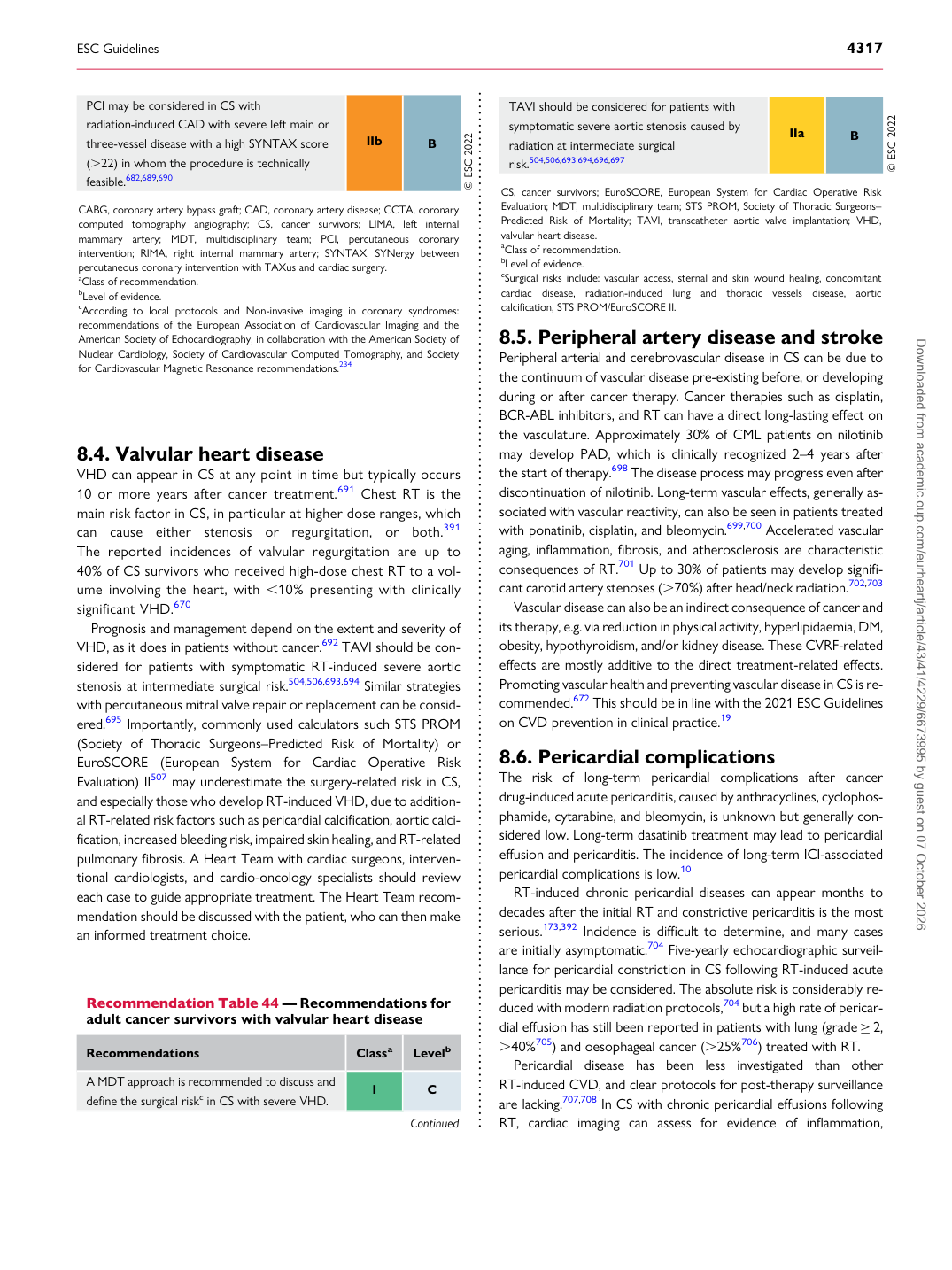
p.89 抽出テキスト
8.4 Valvular heart disease

VHD can appear in CS at any point in time but typically occurs 10 or more years after cancer treatment.691 Chest RT is the main risk factor in CS, in particular at higher dose ranges, which can cause either stenosis or regurgitation, or both.391 The reported incidences of valvular regurgitation are up to 40% of CS survivors who received high-dose chest RT to a volume involving the heart, with ,10% presenting with clinically significant VHD.670 Prognosis and management depend on the extent and severity of VHD, as it does in patients without cancer.692 TAVI should be considered for patients with symptomatic RT-induced severe aortic stenosis at intermediate surgical risk.504,506,693,694 Similar strategies with percutaneous mitral valve repair or replacement can be considered.695 Importantly, commonly used calculators such STS PROM (Society of Thoracic Surgeons–Predicted Risk of Mortality) or EuroSCORE (European System for Cardiac Operative Risk Evaluation) II507 may underestimate the surgery-related risk in CS, and especially those who develop RT-induced VHD, due to additional RT-related risk factors such as pericardial calcification, aortic calcification, increased bleeding risk, impaired skin healing, and RT-related pulmonary fibrosis. A Heart Team with cardiac surgeons, interventional cardiologists, and cardio-oncology specialists should review each case to guide appropriate treatment. The Heart Team recommendation should be discussed with the patient, who can then make an informed treatment choice. 8.5 Peripheral artery disease and stroke

Peripheral arterial and cerebrovascular disease in CS can be due to the continuum of vascular disease pre-existing before, or developing during or after cancer therapy. Cancer therapies such as cisplatin, BCR-ABL inhibitors, and RT can have a direct long-lasting effect on the vasculature. Approximately 30% of CML patients on nilotinib may develop PAD, which is clinically recognized 2–4 years after the start of therapy.698 The disease process may progress even after discontinuation of nilotinib. Long-term vascular effects, generally associated with vascular reactivity, can also be seen in patients treated with ponatinib, cisplatin, and bleomycin.699,700 Accelerated vascular aging, inflammation, fibrosis, and atherosclerosis are characteristic consequences of RT.701 Up to 30% of patients may develop significant carotid artery stenoses (.70%) after head/neck radiation.702,703 Vascular disease can also be an indirect consequence of cancer and its therapy, e.g. via reduction in physical activity, hyperlipidaemia, DM, obesity, hypothyroidism, and/or kidney disease. These CVRF-related effects are mostly additive to the direct treatment-related effects. Promoting vascular health and preventing vascular disease in CS is recommended.672 This should be in line with the 2021 ESC Guidelines on CVD prevention in clinical practice.19

8.6 Pericardial complications

The risk of long-term pericardial complications after cancer drug-induced acute pericarditis, caused by anthracyclines, cyclophosphamide, cytarabine, and bleomycin, is unknown but generally considered low. Long-term dasatinib treatment may lead to pericardial effusion and pericarditis. The incidence of long-term ICI-associated pericardial complications is low.10 RT-induced chronic pericardial diseases can appear months to decades after the initial RT and constrictive pericarditis is the most serious.173,392 Incidence is difficult to determine, and many cases are initially asymptomatic.704 Five-yearly echocardiographic surveillance for pericardial constriction in CS following RT-induced acute pericarditis may be considered. The absolute risk is considerably reduced with modern radiation protocols,704 but a high rate of pericardial effusion has still been reported in patients with lung (grade ≥2, .40%705) and oesophageal cancer (.25%706) treated with RT. Pericardial disease has been less investigated than other RT-induced CVD, and clear protocols for post-therapy surveillance are lacking.707,708 In CS with chronic pericardial effusions following RT, cardiac imaging can assess for evidence of inflammation,

PCI may be considered in CS with radiation-induced CAD with severe left main or three-vessel disease with a high SYNTAX score (.22) in whom the procedure is technically feasible.682,689,690 IIb B © ESC 2022

CABG, coronary artery bypass graft; CAD, coronary artery disease; CCTA, coronary computed tomography angiography; CS, cancer survivors; LIMA, left internal mammary artery; MDT, multidisciplinary team; PCI, percutaneous coronary intervention; RIMA, right internal mammary artery; SYNTAX, SYNergy between percutaneous coronary intervention with TAXus and cardiac surgery. aClass of recommendation. bLevel of evidence. cAccording to local protocols and Non-invasive imaging in coronary syndromes: recommendations of the European Association of Cardiovascular Imaging and the American Society of Echocardiography, in collaboration with the American Society of Nuclear Cardiology, Society of Cardiovascular Computed Tomography, and Society for Cardiovascular Magnetic Resonance recommendations.234

Recommendation Table 44 — Recommendations for adult cancer survivors with valvular heart disease

Recommendations Classa Levelb

A MDT approach is recommended to discuss and define the surgical riskc in CS with severe VHD. I C

Continued TAVI should be considered for patients with symptomatic severe aortic stenosis caused by

radiation at intermediate surgical risk.504,506,693,694,696,697 IIa B © ESC 2022

CS, cancer survivors; EuroSCORE, European System for Cardiac Operative Risk Evaluation; MDT, multidisciplinary team; STS PROM, Society of Thoracic Surgeons– Predicted Risk of Mortality; TAVI, transcatheter aortic valve implantation; VHD, valvular heart disease. aClass of recommendation. bLevel of evidence. cSurgical risks include: vascular access, sternal and skin wound healing, concomitant cardiac disease, radiation-induced lung and thoracic vessels disease, aortic calcification, STS PROM/EuroSCORE II.

Downloaded from academic.oup.com/eurheartj/article/43/41/4229/6673995 by guest on 07 October 2026