p.86 抽出テキスト
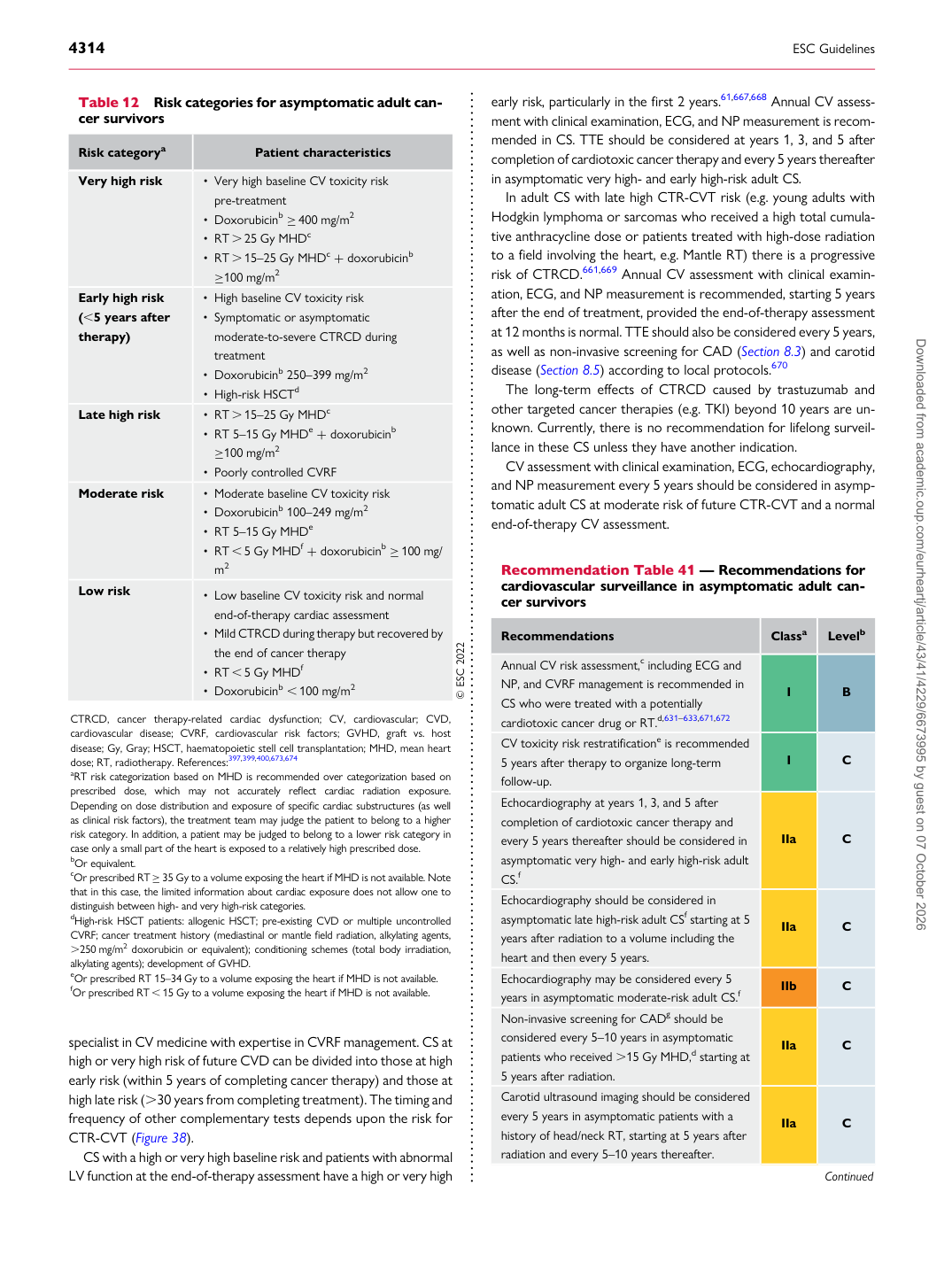
specialist in CV medicine with expertise in CVRF management. CS at high or very high risk of future CVD can be divided into those at high early risk (within 5 years of completing cancer therapy) and those at high late risk (.30 years from completing treatment). The timing and frequency of other complementary tests depends upon the risk for CTR-CVT (Figure 38). CS with a high or very high baseline risk and patients with abnormal LV function at the end-of-therapy assessment have a high or very high early risk, particularly in the first 2 years.61,667,668 Annual CV assessment with clinical examination, ECG, and NP measurement is recommended in CS. TTE should be considered at years 1, 3, and 5 after completion of cardiotoxic cancer therapy and every 5 years thereafter in asymptomatic very high- and early high-risk adult CS.

In adult CS with late high CTR-CVT risk (e.g. young adults with Hodgkin lymphoma or sarcomas who received a high total cumulative anthracycline dose or patients treated with high-dose radiation to a field involving the heart, e.g. Mantle RT) there is a progressive risk of CTRCD.661,669 Annual CV assessment with clinical examination, ECG, and NP measurement is recommended, starting 5 years after the end of treatment, provided the end-of-therapy assessment at 12 months is normal. TTE should also be considered every 5 years, as well as non-invasive screening for CAD (Section 8.3) and carotid disease (Section 8.5) according to local protocols.670 The long-term effects of CTRCD caused by trastuzumab and other targeted cancer therapies (e.g. TKI) beyond 10 years are unknown. Currently, there is no recommendation for lifelong surveillance in these CS unless they have another indication. CV assessment with clinical examination, ECG, echocardiography, and NP measurement every 5 years should be considered in asymptomatic adult CS at moderate risk of future CTR-CVT and a normal end-of-therapy CV assessment.

Table 12 Risk categories for asymptomatic adult cancer survivors

Risk categorya Patient characteristics

Very high risk • Very high baseline CV toxicity risk

pre-treatment • Doxorubicinb ≥400 mg/m2 • RT . 25 Gy MHDc • RT . 15–25 Gy MHDc + doxorubicinb

≥100 mg/m2

Early high risk (,5 years after therapy) • High baseline CV toxicity risk • Symptomatic or asymptomatic

moderate-to-severe CTRCD during treatment • Doxorubicinb 250–399 mg/m2 • High-risk HSCTd

Late high risk • RT . 15–25 Gy MHDc

• RT 5–15 Gy MHDe + doxorubicinb

≥100 mg/m2 • Poorly controlled CVRF

Moderate risk • Moderate baseline CV toxicity risk • Doxorubicinb 100–249 mg/m2

• RT 5–15 Gy MHDe • RT , 5 Gy MHDf + doxorubicinb ≥100 mg/ m2

Low risk • Low baseline CV toxicity risk and normal end-of-therapy cardiac assessment

• Mild CTRCD during therapy but recovered by the end of cancer therapy • RT , 5 Gy MHDf • Doxorubicinb , 100 mg/m2 © ESC 2022

CTRCD, cancer therapy-related cardiac dysfunction; CV, cardiovascular; CVD, cardiovascular disease; CVRF, cardiovascular risk factors; GVHD, graft vs. host disease; Gy, Gray; HSCT, haematopoietic stell cell transplantation; MHD, mean heart dose; RT, radiotherapy. References:397,399,400,673,674 aRT risk categorization based on MHD is recommended over categorization based on prescribed dose, which may not accurately reflect cardiac radiation exposure. Depending on dose distribution and exposure of specific cardiac substructures (as well as clinical risk factors), the treatment team may judge the patient to belong to a higher risk category. In addition, a patient may be judged to belong to a lower risk category in case only a small part of the heart is exposed to a relatively high prescribed dose. bOr equivalent. cOr prescribed RT≥35 Gy to a volume exposing the heart if MHD is not available. Note that in this case, the limited information about cardiac exposure does not allow one to distinguish between high- and very high-risk categories. dHigh-risk HSCT patients: allogenic HSCT; pre-existing CVD or multiple uncontrolled CVRF; cancer treatment history (mediastinal or mantle field radiation, alkylating agents, .250 mg/m2 doxorubicin or equivalent); conditioning schemes (total body irradiation, alkylating agents); development of GVHD. eOr prescribed RT 15–34 Gy to a volume exposing the heart if MHD is not available. fOr prescribed RT , 15 Gy to a volume exposing the heart if MHD is not available. Recommendation Table 41 — Recommendations for cardiovascular surveillance in asymptomatic adult cancer survivors

Recommendations Classa Levelb Annual CV risk assessment,c including ECG and NP, and CVRF management is recommended in CS who were treated with a potentially cardiotoxic cancer drug or RT.d,631–633,671,672 I B CV toxicity risk restratificatione is recommended 5 years after therapy to organize long-term follow-up. I C Echocardiography at years 1, 3, and 5 after completion of cardiotoxic cancer therapy and every 5 years thereafter should be considered in asymptomatic very high- and early high-risk adult CS.f IIa C Echocardiography should be considered in asymptomatic late high-risk adult CSf starting at 5 years after radiation to a volume including the heart and then every 5 years. IIa C Echocardiography may be considered every 5 years in asymptomatic moderate-risk adult CS.f IIb C Non-invasive screening for CADg should be considered every 5–10 years in asymptomatic patients who received .15 Gy MHD,d starting at 5 years after radiation. IIa C Carotid ultrasound imaging should be considered every 5 years in asymptomatic patients with a history of head/neck RT, starting at 5 years after radiation and every 5–10 years thereafter. IIa C

Continued Downloaded from academic.oup.com/eurheartj/article/43/41/4229/6673995 by guest on 07 October 2026