p.85 抽出テキスト
CS risk stratification. A LVEF of 40–49% is associated with an almost eight-fold increased risk for LVEF ,40% at 10-year follow-up compared with patients with a preserved LVEF (≥50%).654 Lifelong surveillance for high-risk survivors is recommended.7 8.1.2 Adult cancer survivors

Long-term cancer survivorship care is an advancing field of research. Many survivors will experience several cancer- and treatment-related late effects throughout their lives, including CTR-CVT. Besides affecting their physical and psychosocial health status, these might reduce life expectancy and quality of life. This is relevant in some cancer types, when CVD risk—especially CTRCD risk—exceeds cancer mortality.658,659 The risk of fatal heart disease is increased more than twofold in survivors of several solid cancers and lymphoma compared with the general population.660–662 CV risk assessment at the end of therapy (Section 7) identifies CS who require long-term cardiology follow-up beyond the first 12 months after completing their cancer treatment. Asymptomatic CS with new or persisting abnormalities at their end-of-therapy assessment will be identified as at high risk for future CV events and require long-term surveillance. Specific cancer treatments carry the highest risk of long-term CV toxicity including anthracycline chemotherapy and RT where the heart is within the RT treatment volume. Progressive RT-related CV toxicity typically develops 5–10 years after the initial treatment, and may cause CAD and HF at an incidence up to six-fold higher than in the general population. An increased CV mortality compared with the general population has been attributed to radiation-associated heart disease in Hodgkin lymphoma, non-Hodgkin lymphoma, BC, and patients with lung cancer.663–665 The incidence and progression of the radiation-related CV complications depends on the dose to the CV tissue and on concomitant cancer therapies and patient characteristics, such as pre-existing CVD, CVRF, and age.389,400 Late CV complications are also observed in CS who required HSCT. The incidence of HF increases up to 14.5% in women 15 years after HSCT. Risk factors for CVD following HSCT include age, anthracycline dose, chest radiation exposure, hypertension, DM, and smoking.666 Long-term follow-up surveillance, based on CV toxicity risks (Table 12), includes patient education and CVRF optimization. An annual clinical CV risk assessment is recommended for all adult CS to optimize CVRF control, promote a healthy lifestyle, and symptom review. This can be done in collaboration with primary care or a

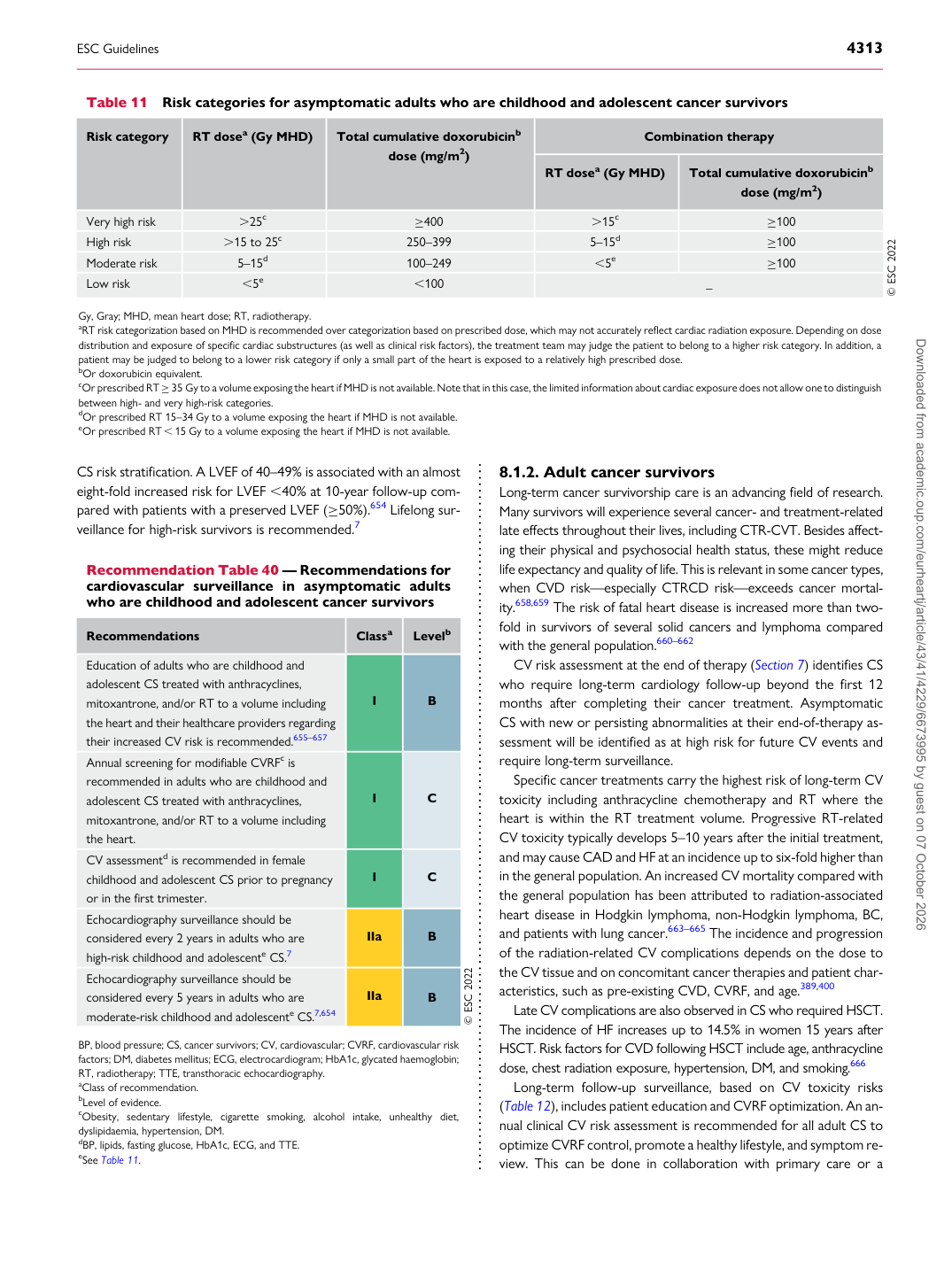
Table 11 Risk categories for asymptomatic adults who are childhood and adolescent cancer survivors Risk category RT dosea (Gy MHD) Total cumulative doxorubicinb

dose (mg/m2) Combination therapy

RT dosea (Gy MHD) Total cumulative doxorubicinb

dose (mg/m2)

Very high risk .25c ≥400 .15c ≥100 High risk .15 to 25c 250–399 5–15d ≥100 Moderate risk 5–15d 100–249 ,5e ≥100 Low risk ,5e ,100 – © ESC 2022

Gy, Gray; MHD, mean heart dose; RT, radiotherapy. aRT risk categorization based on MHD is recommended over categorization based on prescribed dose, which may not accurately reflect cardiac radiation exposure. Depending on dose distribution and exposure of specific cardiac substructures (as well as clinical risk factors), the treatment team may judge the patient to belong to a higher risk category. In addition, a patient may be judged to belong to a lower risk category if only a small part of the heart is exposed to a relatively high prescribed dose. bOr doxorubicin equivalent. cOr prescribed RT ≥35 Gy to a volume exposing the heart if MHD is not available. Note that in this case, the limited information about cardiac exposure does not allow one to distinguish between high- and very high-risk categories. dOr prescribed RT 15–34 Gy to a volume exposing the heart if MHD is not available. eOr prescribed RT , 15 Gy to a volume exposing the heart if MHD is not available.

Recommendation Table 40 — Recommendations for cardiovascular surveillance in asymptomatic adults who are childhood and adolescent cancer survivors

Recommendations Classa Levelb

Education of adults who are childhood and adolescent CS treated with anthracyclines, mitoxantrone, and/or RT to a volume including the heart and their healthcare providers regarding their increased CV risk is recommended.655–657 I B Annual screening for modifiable CVRFc is recommended in adults who are childhood and adolescent CS treated with anthracyclines, mitoxantrone, and/or RT to a volume including the heart. I C CV assessmentd is recommended in female childhood and adolescent CS prior to pregnancy or in the first trimester. I C Echocardiography surveillance should be considered every 2 years in adults who are high-risk childhood and adolescente CS.7 IIa B Echocardiography surveillance should be considered every 5 years in adults who are moderate-risk childhood and adolescente CS.7,654 IIa B © ESC 2022

BP, blood pressure; CS, cancer survivors; CV, cardiovascular; CVRF, cardiovascular risk factors; DM, diabetes mellitus; ECG, electrocardiogram; HbA1c, glycated haemoglobin; RT, radiotherapy; TTE, transthoracic echocardiography. aClass of recommendation. bLevel of evidence. cObesity, sedentary lifestyle, cigarette smoking, alcohol intake, unhealthy diet, dyslipidaemia, hypertension, DM. dBP, lipids, fasting glucose, HbA1c, ECG, and TTE. eSee Table 11. Downloaded from academic.oup.com/eurheartj/article/43/41/4229/6673995 by guest on 07 October 2026