p.84 抽出テキスト
8 Long-term follow-up and

chronic cardiovascular complications in cancer survivors

8.1 Cancer survivors

8.1.1. Adult survivors of childhood and adolescent cancer The survival of children and adolescents with cancer has increased considerably in recent decades, with 5-year survival rates currently exceeding 80%.647 However, the long-term health effects in the growing population of childhood and adolescent CS are a major concern.648 CTR-CVT, as a consequence of treatment with anthracyclines, mitoxantrone, and/or chest-directed RT can manifest as CTRCD but also as VHD, CAD, arrhythmias, autonomic dysfunction, pericardial disease, and premature CV mortality, depending on the type of cardiotoxic treatment.643,649 CTRCD is one of the most frequent late effects in childhood CS who received cardiotoxic cancer treatment and contributes to significant morbidity and non-cancer-related mortality later in life.650 The cumulative incidence of CTRCD varies depending on the diagnostic criteria applied and the population studied and ranges from 4.8% to 10.6% at 40–45 years of age.651 RT to a field involving the heart increases the risk of CTRCD and valvular and vascular complications.652 Follow-up of paediatric CS according to the International Late Effects of Childhood Cancer Guideline Harmonization Group is recommended.653 This includes risk stratification based upon the total cumulative dose of anthracycline chemotherapy and MHD delivered (Table 11). Annual review of CVRF and education to promote a healthy lifestyle is recommended. The frequency of CV review with TTE depends upon risk. A CV review should be considered every 5 years for moderate-risk childhood and adolescent adult CS and every 2 years for high-risk childhood and adolescent adult CS. A recent retrospective analysis has shown that quantification of LVEF .5 years after cancer diagnosis improves long-term childhood

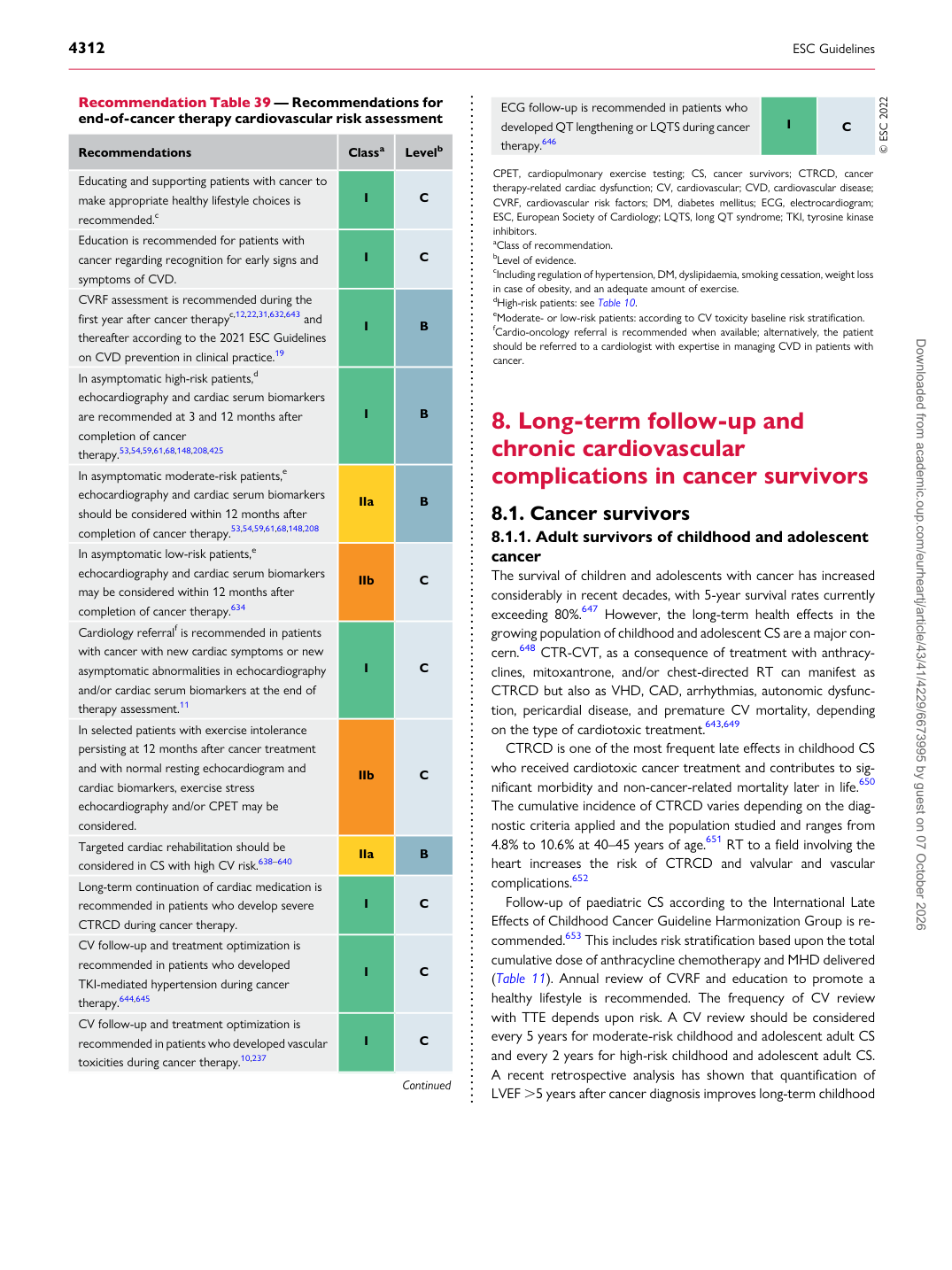
Recommendation Table 39 — Recommendations for end-of-cancer therapy cardiovascular risk assessment

Recommendations Classa Levelb

Educating and supporting patients with cancer to make appropriate healthy lifestyle choices is recommended.c I C Education is recommended for patients with cancer regarding recognition for early signs and symptoms of CVD. I C CVRF assessment is recommended during the first year after cancer therapyc,12,22,31,632,643 and thereafter according to the 2021 ESC Guidelines on CVD prevention in clinical practice.19 I B In asymptomatic high-risk patients,d echocardiography and cardiac serum biomarkers are recommended at 3 and 12 months after completion of cancer therapy.53,54,59,61,68,148,208,425 I B In asymptomatic moderate-risk patients,e echocardiography and cardiac serum biomarkers should be considered within 12 months after completion of cancer therapy.53,54,59,61,68,148,208 IIa B In asymptomatic low-risk patients,e echocardiography and cardiac serum biomarkers may be considered within 12 months after completion of cancer therapy.634 IIb C Cardiology referralf is recommended in patients with cancer with new cardiac symptoms or new asymptomatic abnormalities in echocardiography and/or cardiac serum biomarkers at the end of therapy assessment.11 I C In selected patients with exercise intolerance persisting at 12 months after cancer treatment and with normal resting echocardiogram and cardiac biomarkers, exercise stress echocardiography and/or CPET may be considered. IIb C Targeted cardiac rehabilitation should be considered in CS with high CV risk.638–640 IIa B Long-term continuation of cardiac medication is recommended in patients who develop severe CTRCD during cancer therapy. I C CV follow-up and treatment optimization is recommended in patients who developed TKI-mediated hypertension during cancer therapy.644,645 I C CV follow-up and treatment optimization is recommended in patients who developed vascular toxicities during cancer therapy.10,237 I C

Continued ECG follow-up is recommended in patients who developed QT lengthening or LQTS during cancer

therapy.646 I C © ESC 2022

CPET, cardiopulmonary exercise testing; CS, cancer survivors; CTRCD, cancer therapy-related cardiac dysfunction; CV, cardiovascular; CVD, cardiovascular disease; CVRF, cardiovascular risk factors; DM, diabetes mellitus; ECG, electrocardiogram; ESC, European Society of Cardiology; LQTS, long QT syndrome; TKI, tyrosine kinase inhibitors. aClass of recommendation. bLevel of evidence. cIncluding regulation of hypertension, DM, dyslipidaemia, smoking cessation, weight loss in case of obesity, and an adequate amount of exercise. dHigh-risk patients: see Table 10. eModerate- or low-risk patients: according to CV toxicity baseline risk stratification. fCardio-oncology referral is recommended when available; alternatively, the patient should be referred to a cardiologist with expertise in managing CVD in patients with cancer. Downloaded from academic.oup.com/eurheartj/article/43/41/4229/6673995 by guest on 07 October 2026