p.83 抽出テキスト
with cancer in the pre-, active-, and post-treatment settings. HIIT-related benefits on CRF, physical activity behaviour, fatigue, and quality of life persist months post-intervention.640,641 HIIT may not be feasible in elderly and frail patients.642 Dedicated cardio-oncology rehabilitation programmes are currently under development.11

CTRCD

Mild or moderate

Pa r tial or none a

Full b

High risk d

k k L o w risk e

k k

MDT to consider w eaning HF ther a p y

p p c

Rec o v e r y

Patient risk S e v e r e and v e r y s e v e r e

N

Patients who d e v elop CTRCD during cancer t r eatment and a r e being sta r ted on HF ther a p y

p

p

Y Conti n ue HF ther a p y

p p

(Class I)

Conti n ue HF ther a p y

p p (Class I) Consider w eaning

HF ther a p y

p p (Class IIa)

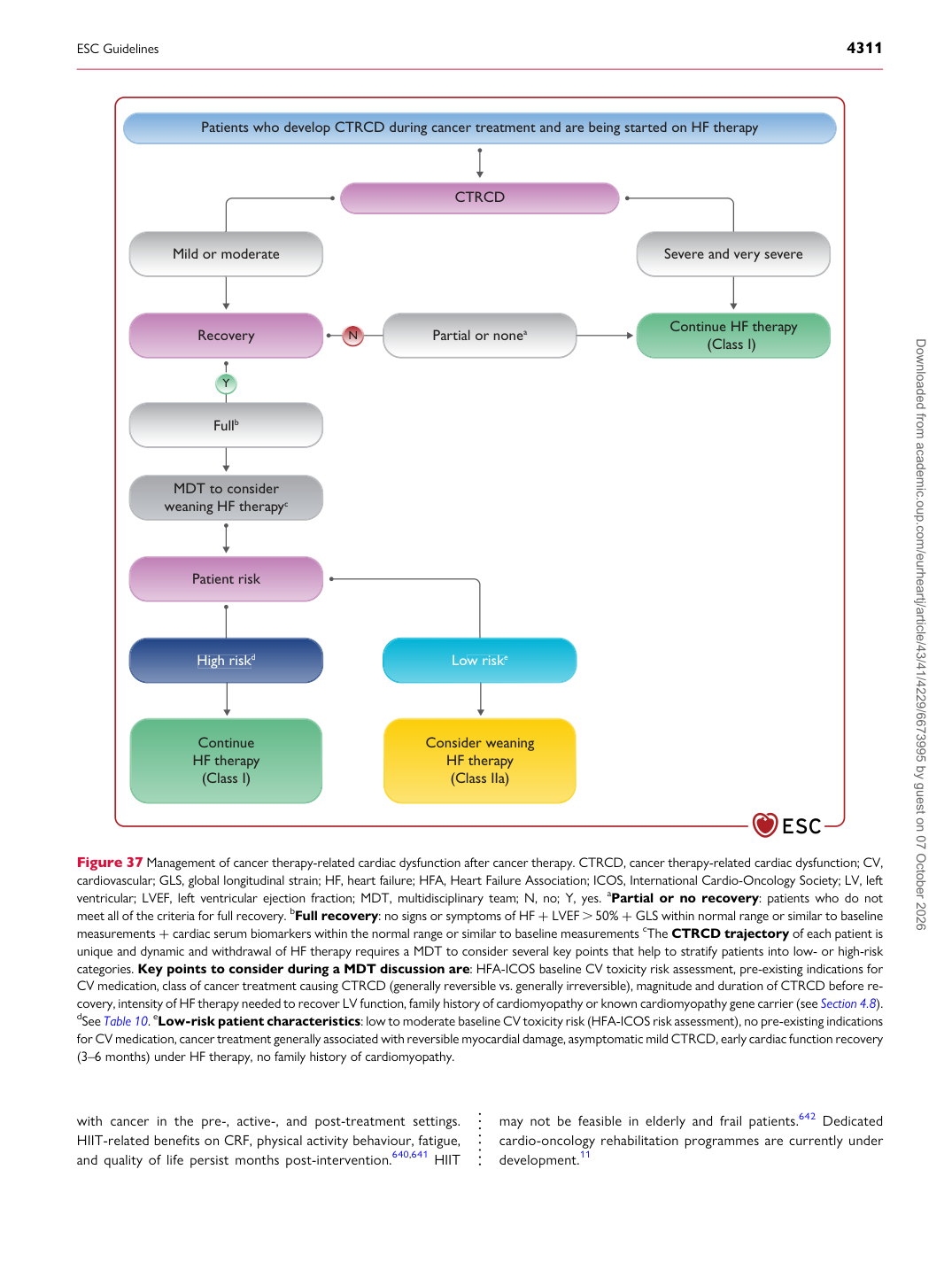
Figure 37 Management of cancer therapy-related cardiac dysfunction after cancer therapy. CTRCD, cancer therapy-related cardiac dysfunction; CV, cardiovascular; GLS, global longitudinal strain; HF, heart failure; HFA, Heart Failure Association; ICOS, International Cardio-Oncology Society; LV, left ventricular; LVEF, left ventricular ejection fraction; MDT, multidisciplinary team; N, no; Y, yes. aPartial or no recovery: patients who do not meet all of the criteria for full recovery. bFull recovery: no signs or symptoms of HF + LVEF . 50% + GLS within normal range or similar to baseline measurements + cardiac serum biomarkers within the normal range or similar to baseline measurements cThe CTRCD trajectory of each patient is unique and dynamic and withdrawal of HF therapy requires a MDT to consider several key points that help to stratify patients into low- or high-risk categories. Key points to consider during a MDT discussion are: HFA-ICOS baseline CV toxicity risk assessment, pre-existing indications for CV medication, class of cancer treatment causing CTRCD (generally reversible vs. generally irreversible), magnitude and duration of CTRCD before recovery, intensity of HF therapy needed to recover LV function, family history of cardiomyopathy or known cardiomyopathy gene carrier (see Section 4.8). dSee Table 10. eLow-risk patient characteristics: low to moderate baseline CV toxicity risk (HFA-ICOS risk assessment), no pre-existing indications for CV medication, cancer treatment generally associated with reversible myocardial damage, asymptomatic mild CTRCD, early cardiac function recovery (3–6 months) under HF therapy, no family history of cardiomyopathy. Downloaded from academic.oup.com/eurheartj/article/43/41/4229/6673995 by guest on 07 October 2026