p.81 抽出テキスト
7 End-of-cancer therapy

cardiovascular risk assessment

7.1 Cardiovascular evaluation during the

first year after cardiotoxic anticancer therapy End-of-cancer therapy CV risk assessment covers the first 12 months after the last cardiotoxic cancer treatment. These recommendations are where cardiotoxic cancer therapy has been successfully completed with good long-term prognosis. These recommendations are not indicated when cancer therapies are discontinued due to cancer progression and prognosis is poor, or where end-of-life care is indicated. Selected patients with cancer continue on long-term oncology therapies, e.g. women with oestrogen receptor-positive early invasive BC. In this example, the end-of-therapy risk assessment refers to the timepoint from the last anthracycline or trastuzumab dose.

High-risk patients can be identified at completion of their cardiotoxic cancer therapies by their clinical characteristics, history of CTR-CVT during treatment, and by elevated cardiac biomarkers and/or abnormal CV imaging at follow up.53,54,92 Cardiac serum biomarkers (NP and cTn) are useful given their high negative predictive value for future CV events.197,631 In a prospective study of 2625 adult patients with cancer that assessed LVEF after anthracycline-based chemotherapy, the overall incidence of CTRCD was 9%; 98% of cases could be detected within 12 months after chemotherapy and the median time from chemotherapy to CTRCD detection was 3.5 months (interquartile range 3–6 months).208 The response to ACE-I treatment declined when the interval between the end of chemotherapy and CTRCD detection lengthened; complete LVEF recovery was not observed in patients where treatment was delayed by .6 months.425 Measurement of cTn after completion of anthracycline chemotherapy during the end-of-treatment assessment should be considered. Rises in cTnI after anthracycline chemotherapy identify patients at risk of future cardiac dysfunction who then benefit from CV protection.4 Educating patients with cancer of their potential increased CVD risk and supporting them to make appropriate healthy lifestyle choices is recommended. CS should also be advised to promptly report early signs and symptoms of possible CVD and inform medical teams of their previous cardiotoxic cancer therapies. CVRF including hypertension, DM, and dyslipidaemia correlate with the probability of future CV events in CS and should be well controlled after completion of cancer therapy.31,632,633

7.2 Which cancer survivors require

cardiovascular surveillance in the first year after cancer treatment? The end-of-treatment risk assessment ideally identifies those high-risk CS, who require long-term CV surveillance, based on the following criteria (Table 10): (1) Baseline high or very high risk based on HFA-ICOS risk assessment tools12 (Section 4). (2) Cardiotoxic cancer therapy with a high risk of long-term CV complications7,21 (Section 8). (3) Moderate or severe CTR-CVT diagnosed during cancer treat-

ment (Table 3).68 (4) New abnormalities in cardiac function detected by echocardiog-

raphy, new elevated cardiac serum biomarkers, or newly CV symptoms detected at the end-of-therapy assessment (3 or 12 months after treatment).68,208

The timing of the first CV assessment after cardiotoxic cancer treatment depends on the risk defined by baseline CV assessment, the type of cancer therapy, and whether CTR-CVT was diagnosed during treatment. In asymptomatic high-risk patients (Table 10), echocardiography and cardiac serum biomarkers are recommended at 3 and 12 months after completion of cancer therapy.53,54,59,61,68,148,208,425 In

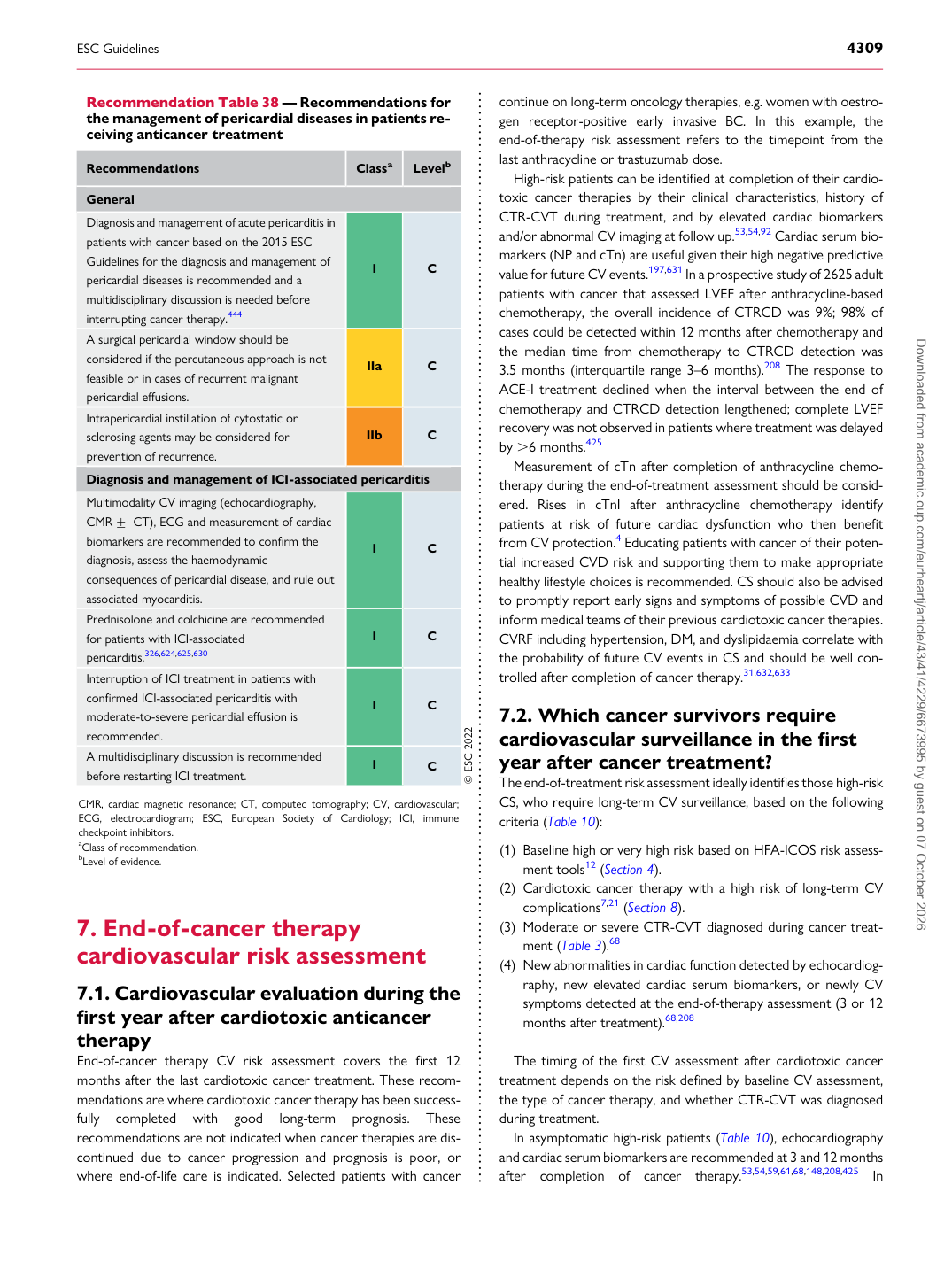
Recommendation Table 38 — Recommendations for the management of pericardial diseases in patients receiving anticancer treatment

Recommendations Classa Levelb

General Diagnosis and management of acute pericarditis in patients with cancer based on the 2015 ESC Guidelines for the diagnosis and management of pericardial diseases is recommended and a multidisciplinary discussion is needed before interrupting cancer therapy.444 I C A surgical pericardial window should be considered if the percutaneous approach is not feasible or in cases of recurrent malignant pericardial effusions. IIa C Intrapericardial instillation of cytostatic or sclerosing agents may be considered for prevention of recurrence. IIb C Diagnosis and management of ICI-associated pericarditis Multimodality CV imaging (echocardiography, CMR + CT), ECG and measurement of cardiac biomarkers are recommended to confirm the diagnosis, assess the haemodynamic consequences of pericardial disease, and rule out associated myocarditis. I C Prednisolone and colchicine are recommended for patients with ICI-associated pericarditis.326,624,625,630 I C Interruption of ICI treatment in patients with confirmed ICI-associated pericarditis with moderate-to-severe pericardial effusion is recommended. I C A multidisciplinary discussion is recommended before restarting ICI treatment. I C © ESC 2022

CMR, cardiac magnetic resonance; CT, computed tomography; CV, cardiovascular; ECG, electrocardiogram; ESC, European Society of Cardiology; ICI, immune checkpoint inhibitors. aClass of recommendation. bLevel of evidence. Downloaded from academic.oup.com/eurheartj/article/43/41/4229/6673995 by guest on 07 October 2026