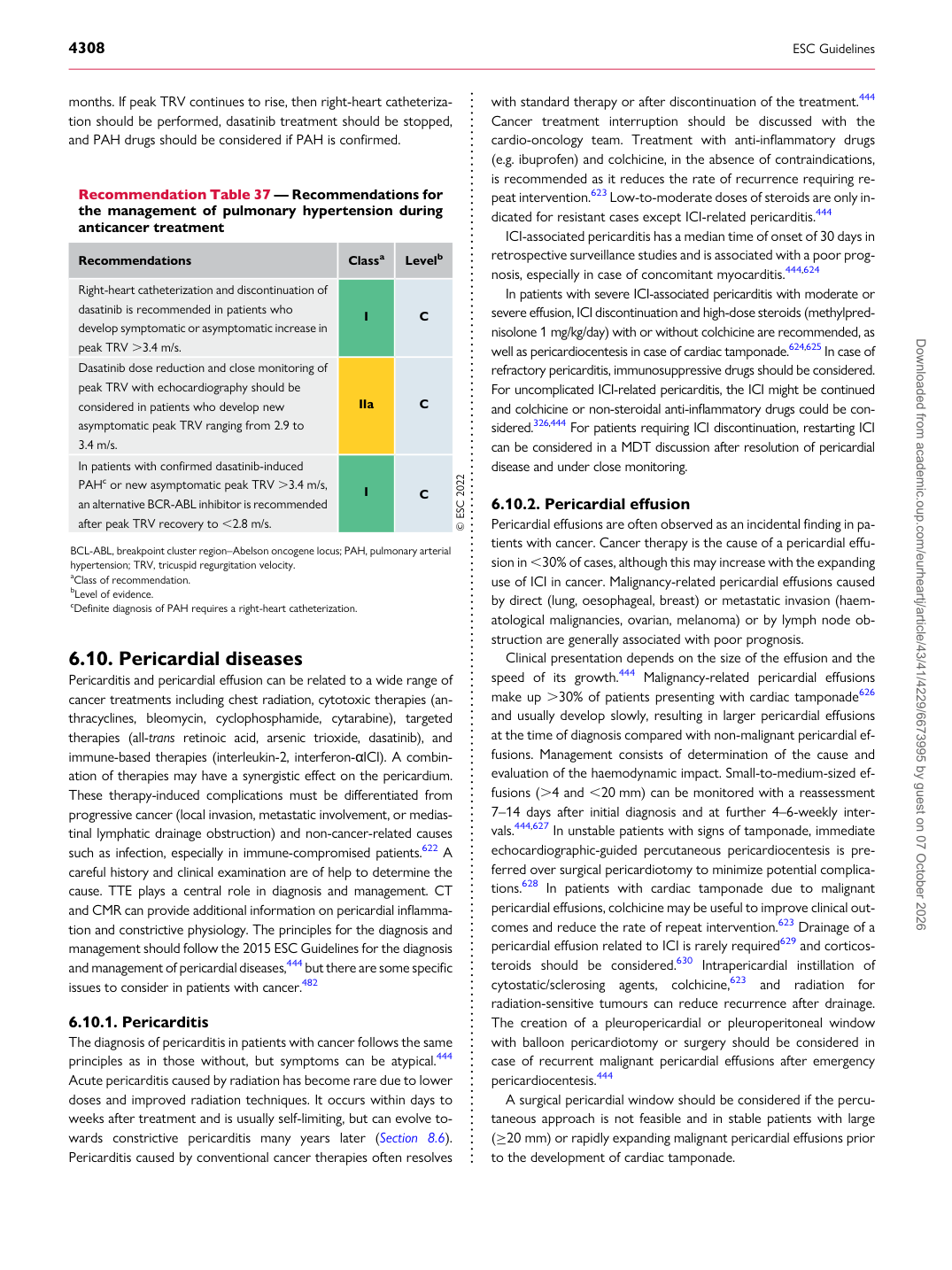
p.80 抽出テキスト
months. If peak TRV continues to rise, then right-heart catheterization should be performed, dasatinib treatment should be stopped, and PAH drugs should be considered if PAH is confirmed.

6.10 Pericardial diseases

Pericarditis and pericardial effusion can be related to a wide range of cancer treatments including chest radiation, cytotoxic therapies (anthracyclines, bleomycin, cyclophosphamide, cytarabine), targeted therapies (all-trans retinoic acid, arsenic trioxide, dasatinib), and immune-based therapies (interleukin-2, interferon-αICI). A combination of therapies may have a synergistic effect on the pericardium. These therapy-induced complications must be differentiated from progressive cancer (local invasion, metastatic involvement, or mediastinal lymphatic drainage obstruction) and non-cancer-related causes such as infection, especially in immune-compromised patients.622 A careful history and clinical examination are of help to determine the cause. TTE plays a central role in diagnosis and management. CT and CMR can provide additional information on pericardial inflammation and constrictive physiology. The principles for the diagnosis and management should follow the 2015 ESC Guidelines for the diagnosis and management of pericardial diseases,444 but there are some specific issues to consider in patients with cancer.482

6.10.1 Pericarditis

The diagnosis of pericarditis in patients with cancer follows the same principles as in those without, but symptoms can be atypical.444 Acute pericarditis caused by radiation has become rare due to lower doses and improved radiation techniques. It occurs within days to weeks after treatment and is usually self-limiting, but can evolve towards constrictive pericarditis many years later (Section 8.6). Pericarditis caused by conventional cancer therapies often resolves with standard therapy or after discontinuation of the treatment.444

Cancer treatment interruption should be discussed with the cardio-oncology team. Treatment with anti-inflammatory drugs (e.g. ibuprofen) and colchicine, in the absence of contraindications, is recommended as it reduces the rate of recurrence requiring repeat intervention.623 Low-to-moderate doses of steroids are only indicated for resistant cases except ICI-related pericarditis.444 ICI-associated pericarditis has a median time of onset of 30 days in retrospective surveillance studies and is associated with a poor prognosis, especially in case of concomitant myocarditis.444,624 In patients with severe ICI-associated pericarditis with moderate or severe effusion, ICI discontinuation and high-dose steroids (methylprednisolone 1 mg/kg/day) with or without colchicine are recommended, as well as pericardiocentesis in case of cardiac tamponade.624,625 In case of refractory pericarditis, immunosuppressive drugs should be considered. For uncomplicated ICI-related pericarditis, the ICI might be continued and colchicine or non-steroidal anti-inflammatory drugs could be considered.326,444 For patients requiring ICI discontinuation, restarting ICI can be considered in a MDT discussion after resolution of pericardial disease and under close monitoring.

6.10.2 Pericardial effusion

Pericardial effusions are often observed as an incidental finding in patients with cancer. Cancer therapy is the cause of a pericardial effusion in ,30% of cases, although this may increase with the expanding use of ICI in cancer. Malignancy-related pericardial effusions caused by direct (lung, oesophageal, breast) or metastatic invasion (haematological malignancies, ovarian, melanoma) or by lymph node obstruction are generally associated with poor prognosis. Clinical presentation depends on the size of the effusion and the speed of its growth.444 Malignancy-related pericardial effusions make up .30% of patients presenting with cardiac tamponade626 and usually develop slowly, resulting in larger pericardial effusions at the time of diagnosis compared with non-malignant pericardial effusions. Management consists of determination of the cause and evaluation of the haemodynamic impact. Small-to-medium-sized effusions (.4 and ,20 mm) can be monitored with a reassessment 7–14 days after initial diagnosis and at further 4–6-weekly intervals.444,627 In unstable patients with signs of tamponade, immediate echocardiographic-guided percutaneous pericardiocentesis is preferred over surgical pericardiotomy to minimize potential complications.628 In patients with cardiac tamponade due to malignant pericardial effusions, colchicine may be useful to improve clinical outcomes and reduce the rate of repeat intervention.623 Drainage of a pericardial effusion related to ICI is rarely required629 and corticosteroids should be considered.630 Intrapericardial instillation of cytostatic/sclerosing agents, colchicine,623 and radiation for radiation-sensitive tumours can reduce recurrence after drainage. The creation of a pleuropericardial or pleuroperitoneal window with balloon pericardiotomy or surgery should be considered in case of recurrent malignant pericardial effusions after emergency pericardiocentesis.444 A surgical pericardial window should be considered if the percutaneous approach is not feasible and in stable patients with large (≥20 mm) or rapidly expanding malignant pericardial effusions prior to the development of cardiac tamponade.

Recommendation Table 37 — Recommendations for the management of pulmonary hypertension during anticancer treatment

Recommendations Classa Levelb

Right-heart catheterization and discontinuation of dasatinib is recommended in patients who develop symptomatic or asymptomatic increase in peak TRV .3.4 m/s. I C Dasatinib dose reduction and close monitoring of peak TRV with echocardiography should be considered in patients who develop new asymptomatic peak TRV ranging from 2.9 to 3.4 m/s. IIa C In patients with confirmed dasatinib-induced PAHc or new asymptomatic peak TRV .3.4 m/s, an alternative BCR-ABL inhibitor is recommended after peak TRV recovery to ,2.8 m/s. I C © ESC 2022

BCL-ABL, breakpoint cluster region–Abelson oncogene locus; PAH, pulmonary arterial hypertension; TRV, tricuspid regurgitation velocity. aClass of recommendation. bLevel of evidence. cDefinite diagnosis of PAH requires a right-heart catheterization. Downloaded from academic.oup.com/eurheartj/article/43/41/4229/6673995 by guest on 07 October 2026