p.79 抽出テキスト
6.8 Peripheral artery disease

There is growing evidence that cancer therapy affects the vasculature. A recent meta-analysis showed a significantly increased arterial stiffness after anthracycline and non-anthracycline treatment.611 Paraneoplastic acral vascular syndrome was described after initiation of nivolumab, with first symptoms 3 weeks after initiation of therapy.612 Raynaud phenomenon has been associated with the use of bleomycin, cyclophosphamide, platinum compounds, vinca alkaloids, and fluoropyrimidines.491 Usual treatment of Raynaud’s includes non-pharmacological measures to help prevent an episode (avoidance of provoking factors such as cold temperature, vasoconstricting drugs) and a long-acting dihydropyridine CCB (amlodipine, modified-release nifedipine). Treatment with nilotinib or ponatinib may be associated with an increased risk of vascular adverse events, including arterial stiffness and PAD development.494 In a subgroup of patients, these events are severe or even life-threatening.613 Although the exact mechanisms remain unknown, we recommend screening for pre-existing PAD and for vascular risk factors such as DM in all patients before and during nilotinib or ponatinib therapy. Pooled data from three clinical trials showed arterial occlusive disease to be related to dose intensity in ponatinib-treated patients,614 but PAD was not addressed separately. If rapidly progressive PAD occurs with secondgeneration TKI, it may be advisable to switch to an alternative lowerrisk TKI (e.g. imatinib). Platelet aggregation inhibitors or anticoagulation and statins should be considered. Despite lack of evidence, all risk factors should be corrected.615

6.9 Pulmonary hypertension

All five groups of the PH classification can be observed in patients with cancer. Several cancer drugs can cause group 1 PH (pulmonary arterial hypertension [PAH]), including carfilzomib, bosutinib, dasatinib,616 ponatinib, interferon alpha, and alkylating agents (e.g. mitomycin C and cyclophosphamide, which mostly cause pulmonary veno-occlusive disease).617 PH associated with left heart disease (group 2) is related to drugs causing HF (e.g. anthracyclines). PH associated with lung disease (group 3) is related to drugs and therapies causing pulmonary fibrosis (e.g. bleomycin, thoracic radiation). The most common pulmonary vascular disease complicating cancer is VTE, which can cause chronic thromboembolic PH (group 4). Of note, central venous catheters are important causes of group 4 PH complicating cancer management. Other group 4 PH due to pulmonary artery obstructions includes angiosarcoma and other malignant tumours (e.g. renal carcinoma, uterine carcinoma, germ cell tumours of the testis).618

PH with unclear and/or multifactorial mechanisms (group 5) includes several conditions that may be complicated by complex and sometimes overlapping pulmonary vascular involvement. Tumoral PH includes pulmonary tumour micro-embolism and pulmonary tumour thrombotic microangiopathy.619 Multiple causes of PH have been described in patients with chronic myeloproliferative disorders. In chronic myelogenous leukaemia, spleen enlargement and anaemia can give rise to hyperkinetic syndrome. In polycythaemia vera and essential thrombocythemia, there is an increased risk of VTE and chronic thromboembolic PH. Moreover, formation of a blood clot within the hepatic veins can lead to Budd–Chiari syndrome and subsequent porto-PH. Pulmonary extramedullary haematopoiesis complicating idiopathic or secondary myelofibrosis may also contribute to dyspnoea and PH.620 Symptoms of PH are non-specific, such as shortness of breath and fatigue. In later stages, symptoms of right-sided HF may develop. An ECG should be performed and examined for RV hypertrophy, but a normal ECG does not exclude PH. Echocardiography is the first choice for assessing PH probability in patients who develop symptoms and/or signs suggestive of PH during cancer treatment. When peak tricuspid regurgitation velocity (TRV) is ≤2.8 m/s (equating to an estimated systolic PAP [sPAP] of ≤35 mmHg) and no other signs of PH are present, then the probability of PH is low. In the absence of a tricuspid regurgitant jet, other echocardiography signs may increase suspicion of PH (e.g. RV/LV basal diameter ratio . 1, RV outflow tract acceleration time , 105 ms, inferior vena cava diameter . 21 mm with decreased inspiratory collapse).620 Baseline TTE should be considered in patients receiving cancer drugs that can cause PH; however, a right-heart catheterization is required for definitive diagnosis of PH and to support PAH treatment decisions. In the DASISION (DASatinib vs. Imatinib Study In treatment-Naïve chronic myeloid leukemia patients) trial, 5% of patients randomized to dasatinib were diagnosed with PH, compared with 0.4% of those randomized to imatinib.621 In patients who develop PH, dasatinib treatment should be interrupted and an alternative TKI should be used.616 Overall management of PH in oncology patients should be based on the 2022 ESC/European Respiratory Society (ERS) Guidelines for the diagnosis and treatment of pulmonary hypertension.620 Referral to a PH centre is recommended for multidisciplinary management with the oncology team. In patients with CML treated with drugs causing PH-induced PAH, discontinuation of the potential culprit therapy is recommended if there is a high probability of new PH (peak TRV . 3.4 m/s, equating to an estimated sPAP of ≥50 mmHg) until the diagnosis is confirmed or ruled out by a rightheart catheterization. In CML patients on dasatinib, an alternative BCR-ABL TKI is recommended if they develop symptomatic PAH or an asymptomatic increase in peak TRV .3.4 m/s. Dasatinib dose reduction and close monitoring of peak TRV with TTE every 4 weeks should be considered in CML patients who develop new asymptomatic peak TRV ranging from 2.9 to 3.4 m/s.620 If peak TRV remains normal or mildly elevated on serial monitoring, then dasatinib can continue, with reduced TTE monitoring to every 3

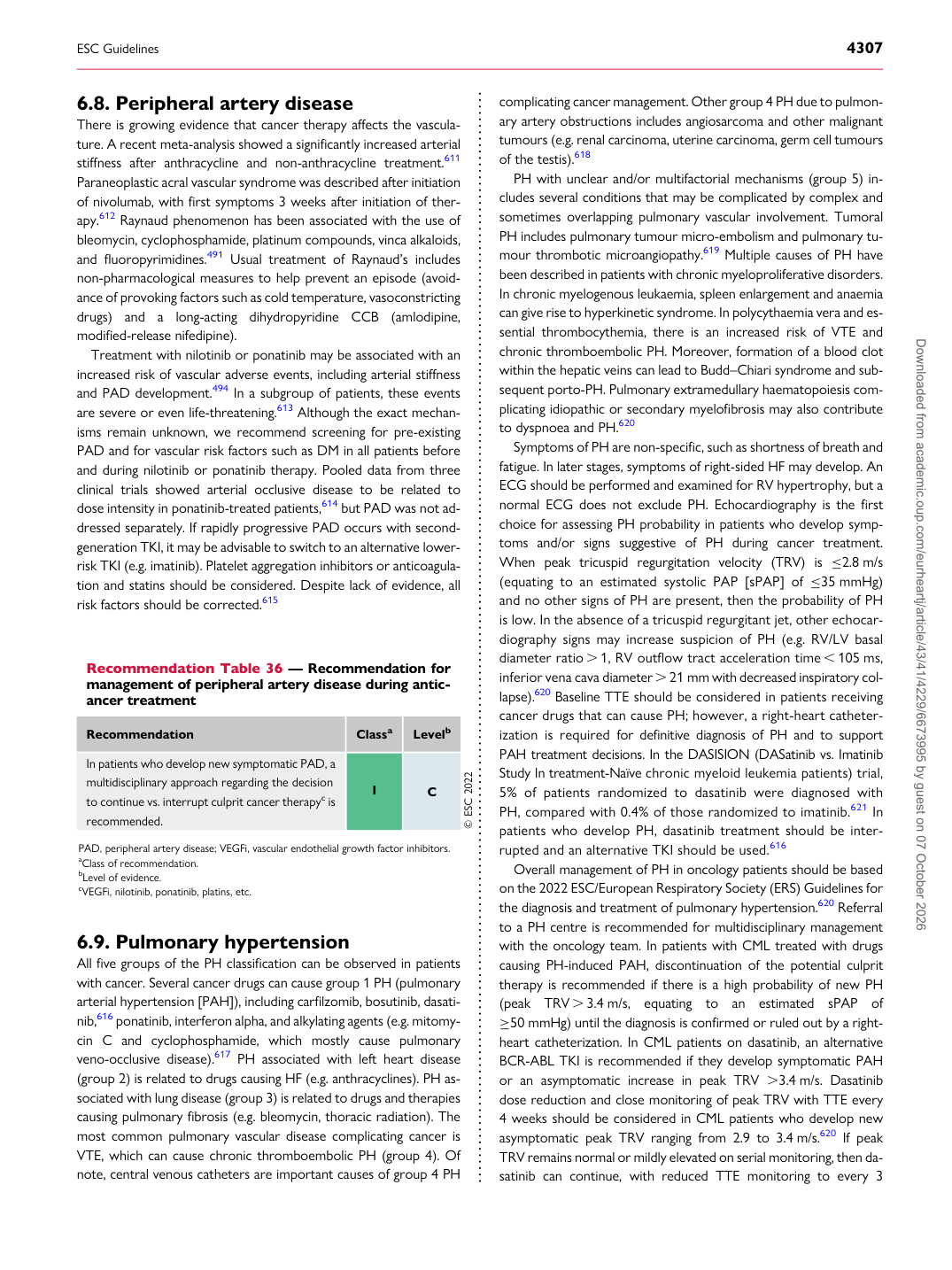
Recommendation Table 36 — Recommendation for management of peripheral artery disease during anticancer treatment

Recommendation Classa Levelb

In patients who develop new symptomatic PAD, a multidisciplinary approach regarding the decision to continue vs. interrupt culprit cancer therapyc is recommended. I C © ESC 2022

PAD, peripheral artery disease; VEGFi, vascular endothelial growth factor inhibitors. aClass of recommendation. bLevel of evidence. cVEGFi, nilotinib, ponatinib, platins, etc. Downloaded from academic.oup.com/eurheartj/article/43/41/4229/6673995 by guest on 07 October 2026