p.78 抽出テキスト
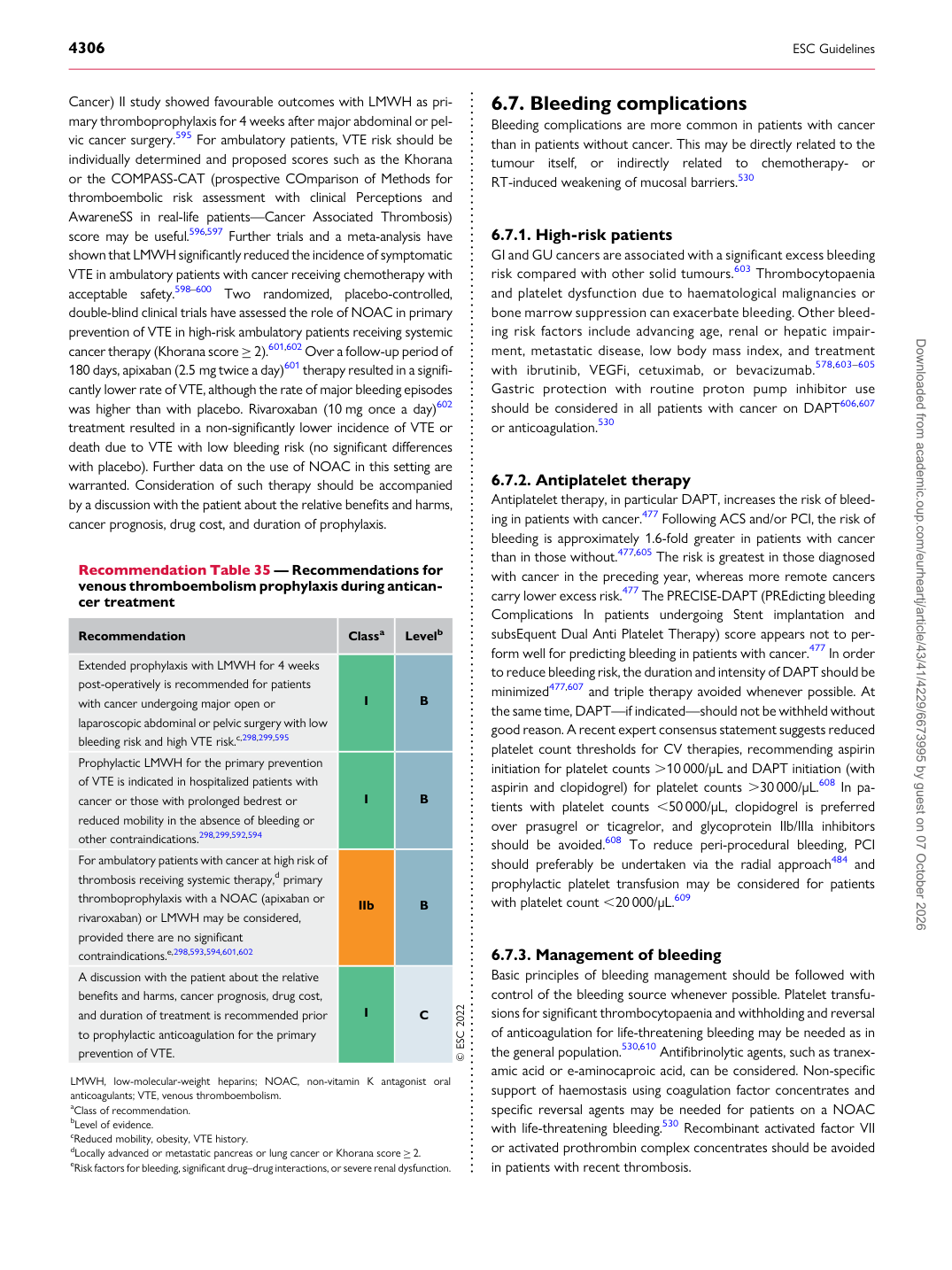
Cancer) II study showed favourable outcomes with LMWH as primary thromboprophylaxis for 4 weeks after major abdominal or pelvic cancer surgery.595 For ambulatory patients, VTE risk should be individually determined and proposed scores such as the Khorana or the COMPASS-CAT (prospective COmparison of Methods for thromboembolic risk assessment with clinical Perceptions and AwareneSS in real-life patients—Cancer Associated Thrombosis) score may be useful.596,597 Further trials and a meta-analysis have shown that LMWH significantly reduced the incidence of symptomatic VTE in ambulatory patients with cancer receiving chemotherapy with acceptable safety.598–600 Two randomized, placebo-controlled, double-blind clinical trials have assessed the role of NOAC in primary prevention of VTE in high-risk ambulatory patients receiving systemic cancer therapy (Khorana score ≥2).601,602 Over a follow-up period of 180 days, apixaban (2.5 mg twice a day)601 therapy resulted in a significantly lower rate of VTE, although the rate of major bleeding episodes was higher than with placebo. Rivaroxaban (10 mg once a day)602 treatment resulted in a non-significantly lower incidence of VTE or death due to VTE with low bleeding risk (no significant differences with placebo). Further data on the use of NOAC in this setting are warranted. Consideration of such therapy should be accompanied by a discussion with the patient about the relative benefits and harms, cancer prognosis, drug cost, and duration of prophylaxis. 6.7 Bleeding complications

Bleeding complications are more common in patients with cancer than in patients without cancer. This may be directly related to the tumour itself, or indirectly related to chemotherapyor RT-induced weakening of mucosal barriers.530

6.7.1 High-risk patients

GI and GU cancers are associated with a significant excess bleeding risk compared with other solid tumours.603 Thrombocytopaenia and platelet dysfunction due to haematological malignancies or bone marrow suppression can exacerbate bleeding. Other bleeding risk factors include advancing age, renal or hepatic impairment, metastatic disease, low body mass index, and treatment with ibrutinib, VEGFi, cetuximab, or bevacizumab.578,603–605 Gastric protection with routine proton pump inhibitor use should be considered in all patients with cancer on DAPT606,607 or anticoagulation.530

6.7.2 Antiplatelet therapy

Antiplatelet therapy, in particular DAPT, increases the risk of bleeding in patients with cancer.477 Following ACS and/or PCI, the risk of bleeding is approximately 1.6-fold greater in patients with cancer than in those without.477,605 The risk is greatest in those diagnosed with cancer in the preceding year, whereas more remote cancers carry lower excess risk.477 The PRECISE-DAPT (PREdicting bleeding Complications In patients undergoing Stent implantation and subsEquent Dual Anti Platelet Therapy) score appears not to perform well for predicting bleeding in patients with cancer.477 In order to reduce bleeding risk, the duration and intensity of DAPT should be minimized477,607 and triple therapy avoided whenever possible. At the same time, DAPT—if indicated—should not be withheld without good reason. A recent expert consensus statement suggests reduced platelet count thresholds for CV therapies, recommending aspirin initiation for platelet counts .10 000/μL and DAPT initiation (with aspirin and clopidogrel) for platelet counts .30 000/μL.608 In patients with platelet counts ,50 000/μL, clopidogrel is preferred over prasugrel or ticagrelor, and glycoprotein IIb/IIIa inhibitors should be avoided.608 To reduce peri-procedural bleeding, PCI should preferably be undertaken via the radial approach484 and prophylactic platelet transfusion may be considered for patients with platelet count ,20 000/μL.609

6.7.3 Management of bleeding

Basic principles of bleeding management should be followed with control of the bleeding source whenever possible. Platelet transfusions for significant thrombocytopaenia and withholding and reversal of anticoagulation for life-threatening bleeding may be needed as in the general population.530,610 Antifibrinolytic agents, such as tranexamic acid or e-aminocaproic acid, can be considered. Non-specific support of haemostasis using coagulation factor concentrates and specific reversal agents may be needed for patients on a NOAC with life-threatening bleeding.530 Recombinant activated factor VII or activated prothrombin complex concentrates should be avoided in patients with recent thrombosis.

Recommendation Table 35 — Recommendations for venous thromboembolism prophylaxis during anticancer treatment

Recommendation Classa Levelb

Extended prophylaxis with LMWH for 4 weeks post-operatively is recommended for patients with cancer undergoing major open or laparoscopic abdominal or pelvic surgery with low bleeding risk and high VTE risk.c,298,299,595 I B Prophylactic LMWH for the primary prevention of VTE is indicated in hospitalized patients with cancer or those with prolonged bedrest or reduced mobility in the absence of bleeding or other contraindications.298,299,592,594 I B For ambulatory patients with cancer at high risk of thrombosis receiving systemic therapy,d primary thromboprophylaxis with a NOAC (apixaban or rivaroxaban) or LMWH may be considered, provided there are no significant contraindications.e,298,593,594,601,602 IIb B A discussion with the patient about the relative benefits and harms, cancer prognosis, drug cost, and duration of treatment is recommended prior to prophylactic anticoagulation for the primary prevention of VTE. I C © ESC 2022

LMWH, low-molecular-weight heparins; NOAC, non-vitamin K antagonist oral anticoagulants; VTE, venous thromboembolism. aClass of recommendation. bLevel of evidence. cReduced mobility, obesity, VTE history. dLocally advanced or metastatic pancreas or lung cancer or Khorana score ≥2. eRisk factors for bleeding, significant drug–drug interactions, or severe renal dysfunction. Downloaded from academic.oup.com/eurheartj/article/43/41/4229/6673995 by guest on 07 October 2026