p.76 抽出テキスト
and the second consensus document on diagnosis and management of acute deep vein thrombosis.567

6.6.2 Arterial thromboembolism

Cancer carries a two-fold higher risk of ATE, including MI and ischaemic stroke.568 ATE risk is higher in men, with advanced age, and in patients with lung or kidney cancer. Pathologies related to ATE in cancer include ischaemic stroke induced by AF or RT-induced carotid artery disease, embolization by tumour cells or non-bacterial thrombotic endocarditis, disseminated intravascular coagulationrelated peripheral microcirculatory thromboembolism, paradoxical cerebral embolism in the course of VTE, and cerebral sinus thrombosis.569 6.6.3 Intracardiac thrombosis

Intracardiac thrombus in patients with malignancies may result from the prothrombotic properties of cancer and its treatment and the use of central venous catheters. Thrombus is the most common intracardiac mass and it can occur within any cardiac chamber. Right atrial thrombi are often related to a venous catheter where the line has inappropriately advanced into the right atrium. Intraventricular thrombi usually occur in the setting of CTRCD. LAA thrombi are most commonly associated with AF, which may also be related to cancer or its therapy. Patients with systemic embolization should be screened for cardiac origin of thrombus initially with TTE and/or transoesophageal echocardiography.528 CMR is more sensitive and specific than TTE

Thrombocytopaenia GI/GU cancer, GI comorbidities, or GI toxicity Recent or evolving intracranial lesions Active bleeding or recent major bleeding Severe renal dysfunction (eGFR <30 mL/min/1.73 m2)

Assess Bleeding risk:

Patient-related factors Cancer-related factors Treatment-related factors

Assess Thromboembolic risk:

Anticancer agents Supportive therapies

Assess drug-drug Interactions (P-glycoprotein, CYP3A4):

Assess Patient preferences

T

B

I

P

Thromboembolic and bleeding risk reassessment

(Class I)

Very high bleeding riska

Conditions favouring LMWH over NOACb

NOAC or LMWH

(Class I)

LMWH (Class I)

No anticoagulation

Patient’s preference

N

N

Structured approach to anticoagulation forVTE in patients with cancer

Y

Y

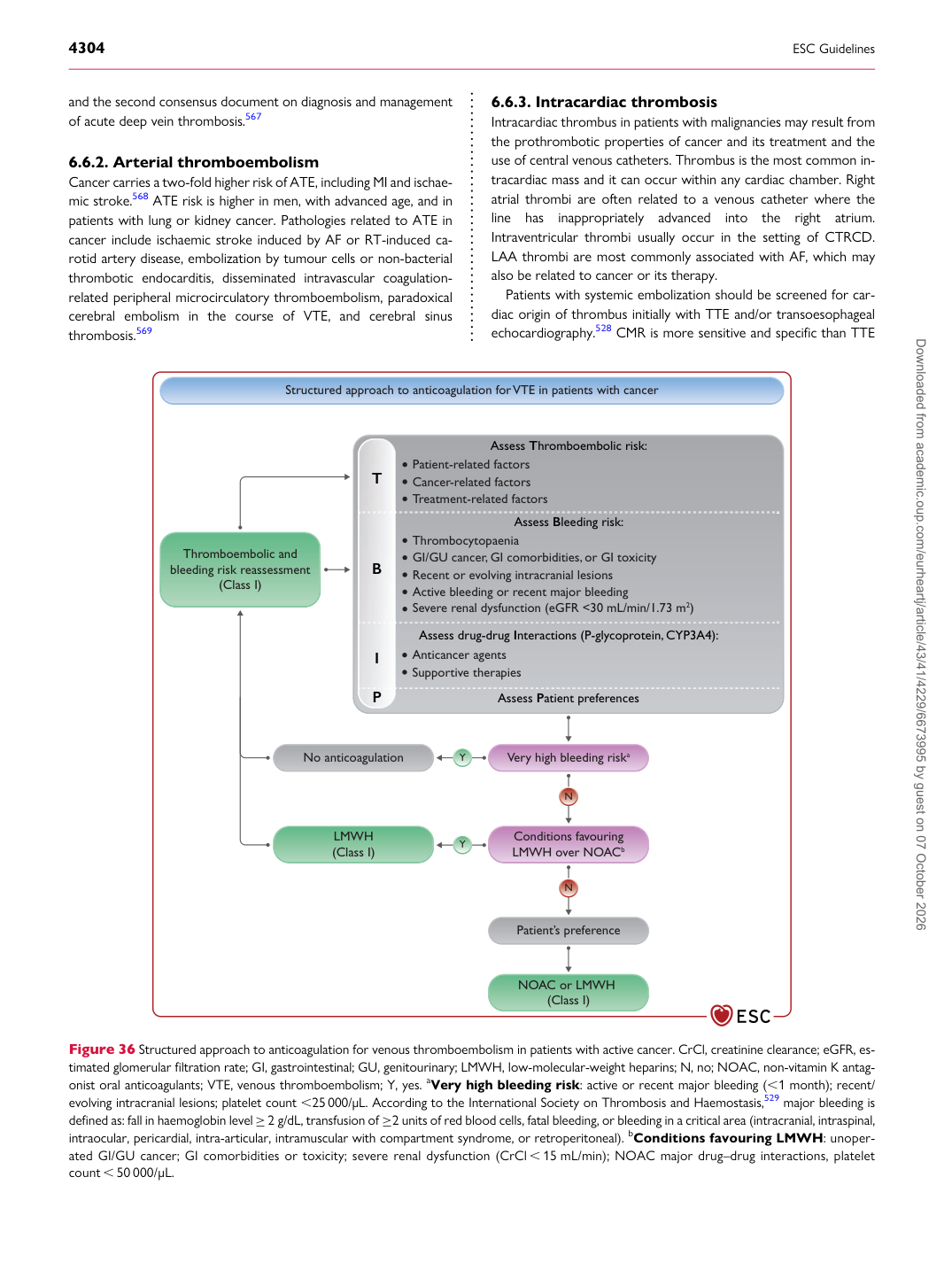
Figure 36 Structured approach to anticoagulation for venous thromboembolism in patients with active cancer. CrCl, creatinine clearance; eGFR, estimated glomerular filtration rate; GI, gastrointestinal; GU, genitourinary; LMWH, low-molecular-weight heparins; N, no; NOAC, non-vitamin K antagonist oral anticoagulants; VTE, venous thromboembolism; Y, yes. aVery high bleeding risk: active or recent major bleeding (,1 month); recent/ evolving intracranial lesions; platelet count ,25 000/μL. According to the International Society on Thrombosis and Haemostasis,529 major bleeding is defined as: fall in haemoglobin level ≥2 g/dL, transfusion of ≥2 units of red blood cells, fatal bleeding, or bleeding in a critical area (intracranial, intraspinal, intraocular, pericardial, intra-articular, intramuscular with compartment syndrome, or retroperitoneal). bConditions favouring LMWH: unoperated GI/GU cancer; GI comorbidities or toxicity; severe renal dysfunction (CrCl , 15 mL/min); NOAC major drug–drug interactions, platelet count , 50 000/μL. Downloaded from academic.oup.com/eurheartj/article/43/41/4229/6673995 by guest on 07 October 2026