p.74 抽出テキスト
BP target during cancer ther a p y

p

Systolic BP ≥ 160 mmHg and diastolic BP ≥ 100 mmHg

Hype r tension caused b y cancer ther a p y

p

A CE-I or ARB

(Class I) A CE-I or ARB

(Class I)

Di h yd r o p yridine CCB

p p as second-line ther a p y

p p

in patients with uncont r olled BP

(Class I)

Di h yd r o p yridine CCB

p p (Class I) BP target <140 mmHg systolic and

<90 mmHg diastolic

(Class I)

BP target <130 mmHg systolic and <80 mmHg

diastolic if w ell tolerated

(Class IIb)

Beta-bloc k ers

k k b Spi r onolactone Oral or transdermal nitrates and/or h ydralazine

(Class IIa)

If r esistant hypertension a : In selected asymptomatic patients with

metastatic cancer systolic BP 140–160 mmHg,

and diastolic BP 90–100 mmHg

(Class IIb)

N

T r

T

T eatment of a r terial h ype r tension in patients with cancer

Y

OR

AND

OR

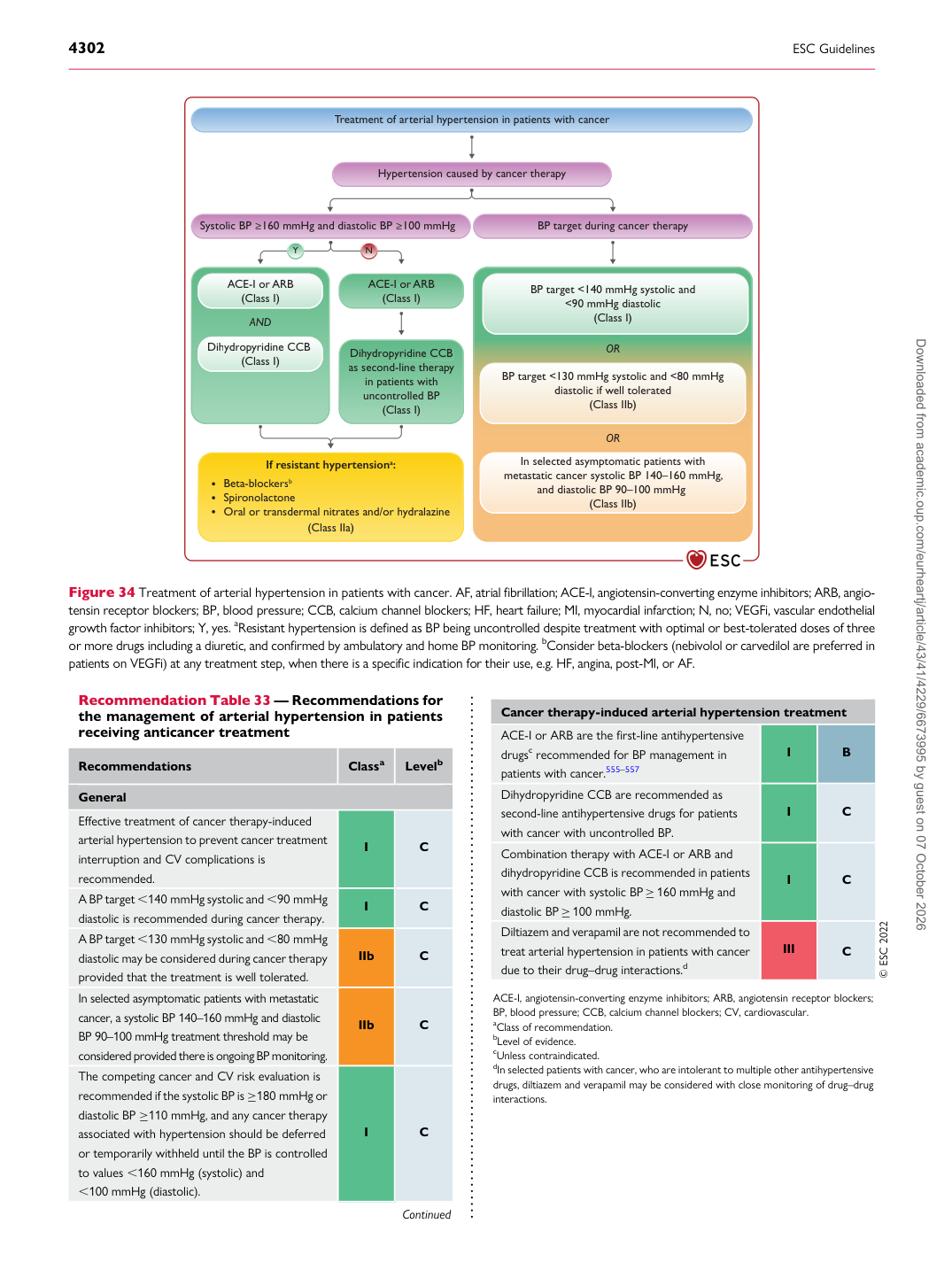
Figure 34 Treatment of arterial hypertension in patients with cancer. AF, atrial fibrillation; ACE-I, angiotensin-converting enzyme inhibitors; ARB, angiotensin receptor blockers; BP, blood pressure; CCB, calcium channel blockers; HF, heart failure; MI, myocardial infarction; N, no; VEGFi, vascular endothelial growth factor inhibitors; Y, yes. aResistant hypertension is defined as BP being uncontrolled despite treatment with optimal or best-tolerated doses of three or more drugs including a diuretic, and confirmed by ambulatory and home BP monitoring. bConsider beta-blockers (nebivolol or carvedilol are preferred in patients on VEGFi) at any treatment step, when there is a specific indication for their use, e.g. HF, angina, post-MI, or AF.

Recommendation Table 33 — Recommendations for the management of arterial hypertension in patients receiving anticancer treatment

Recommendations Classa Levelb

General Effective treatment of cancer therapy-induced arterial hypertension to prevent cancer treatment interruption and CV complications is recommended. I C A BP target ,140 mmHg systolic and ,90 mmHg diastolic is recommended during cancer therapy. I C A BP target ,130 mmHg systolic and ,80 mmHg diastolic may be considered during cancer therapy provided that the treatment is well tolerated. IIb C In selected asymptomatic patients with metastatic cancer, a systolic BP 140–160 mmHg and diastolic BP 90–100 mmHg treatment threshold may be considered provided there is ongoing BP monitoring. IIb C The competing cancer and CV risk evaluation is recommended if the systolic BP is ≥180 mmHg or diastolic BP ≥110 mmHg, and any cancer therapy associated with hypertension should be deferred or temporarily withheld until the BP is controlled to values ,160 mmHg (systolic) and ,100 mmHg (diastolic). I C

Continued Cancer therapy-induced arterial hypertension treatment

ACE-I or ARB are the first-line antihypertensive drugsc recommended for BP management in patients with cancer.555–557 I B Dihydropyridine CCB are recommended as second-line antihypertensive drugs for patients with cancer with uncontrolled BP. I C Combination therapy with ACE-I or ARB and dihydropyridine CCB is recommended in patients with cancer with systolic BP ≥160 mmHg and diastolic BP ≥100 mmHg. I C Diltiazem and verapamil are not recommended to treat arterial hypertension in patients with cancer due to their drug–drug interactions.d III C © ESC 2022

ACE-I, angiotensin-converting enzyme inhibitors; ARB, angiotensin receptor blockers; BP, blood pressure; CCB, calcium channel blockers; CV, cardiovascular. aClass of recommendation. bLevel of evidence. cUnless contraindicated. dIn selected patients with cancer, who are intolerant to multiple other antihypertensive drugs, diltiazem and verapamil may be considered with close monitoring of drug–drug interactions. Downloaded from academic.oup.com/eurheartj/article/43/41/4229/6673995 by guest on 07 October 2026