p.72 抽出テキスト
disorders.4,45,48,442,544 The challenges for the cardio-oncology teams are to identify patients more susceptible to developing VA, determine whether a VA is directly due to CTR-CVT, individualize the treatment strategy, and optimize clinical monitoring during treatment. Figure 32 shows the algorithm for the management of QTc prolongation during cancer therapy. In patients with cancer, the Fridericia formula is recommended and has demonstrated less error than other correction methods such as Bazzett at both high and low heart rates.44 In patients treated with QTc-prolonging drugs, serum electrolytes and other risk factors should be closely monitored and corrected, and concomitant QT-prolonging drugs avoided if possible.4,22,45,369,543 For selected cancer drugs, there are specific manufacturer recommendations for ECG monitoring during treatment, dosage adjustments, or discontinuation of therapy in case of QTc prolongation.548 Although there are no recommendations, patients with cancer with QTc prolongation associated with severe bradycardia or sinus pauses may benefit from isoprenaline infusion or temporary pacing. Despite present restrictions, the improved prognosis for many malignancies is increasing the number of patients with cancer who are candidates for an implantable cardioverter defibrillator (ICD), particularly when life expectancy is .1 year (including patients who experienced resuscitated sudden cardiac death or severe VA from a QTc-prolonging drug with no alternative treatment available). 6.4.3 Bradyarrhythmias

AV conduction disease can be caused by ICI in the presence or absence of myocarditis. If the PR interval increases (new first-degree heart block) in patients treated with ICI, serial ECG monitoring is recommended, and if PR prolongation to .300 ms develops, the patient should be hospitalized under close ECG monitoring and i.v. methylprednisolone is recommended.550 IMiD (thalidomide, pomalidomide)285 and ALK inhibitors (crizotinib, alectinib, brigatinib, or ceritinib)551 are associated with sinus bradycardia. Holter ECG monitoring is recommended to exclude significant sinus pauses in symptomatic patients. In asymptomatic patients with normal LV function, sinus bradycardia is usually well tolerated and treatment can continue. If patients are symptomatic (syncope, pre-syncope of reduced exercise tolerance from chronotropic incompetence) then a trial of cancer drug withdrawal to confirm causation with the symptoms is recommended. A MDT discussion is needed to analyse risks/benefits of alternative cancer therapies vs. restarting the culprit cancer therapy at a lower dose with heart rate monitoring. In selected cases, when no cancer treatment alternative is available, pacing is indicated.

6.5 Arterial hypertension

Arterial hypertension in patients with cancer may be caused by their cancer treatments (e.g. VEGFi, second- and third-generation BCR-ABL TKI, brigatinib, ibrutinib, fluoropyrimidines, cisplatin, abiraterone, bicalutamide, enzalutamide), non-cancer drugs (e.g. corticosteroids, non-steroidal anti-inflammatory drugs), and other factors including stress, pain, excessive alcohol consumption, renal impairment, untreated sleep apnoea, obesity, and reduced exercise.552 In all patients with cancer with new hypertension assessment, correction of these other factors is important before considering interruption of a cancer treatment. Untreated hypertension344 is a confirmed risk factor of HF during treatment with anthracyclines,553 ibrutinib,264 and VEGFi.554 Given that many of the cancer therapies that cause hypertension also cause

Recommendation Table 32 — Recommendations for the management of long corrected QT interval and ventricular arrhythmias in patients receiving anticancer treatment

Recommendations Classa Levelb

How to manage QTc prolongation in patients with cancer Discontinuation of QTc-prolonging cancer therapy is recommended in patients who develop TdP or sustained ventricular tachyarrhythmias during treatment.549 I C Temporary interruption of QTc-prolonging cancer therapy is recommended in patients who develop asymptomatic QTcF ≥500 ms and an ECG should be repeated every 24 h until resolution of the QTcF prolongation.549 I C Immediate withdrawal of any offending drug and correction of electrolyte abnormalities and other risk factorsc is recommended in patients with cancer who develop QTcF ≥500 ms.349,442,546 I C Weekly ECG monitoring is recommended in asymptomatic patients with cancer with QTcF 480–500 ms who are treated with a QTc-prolonging cancer therapy.349,442,546 I C A 12-lead ECG is recommended after any dose increase of QTc-prolonging cancer therapy.270,442,544 I C

Continued Restarting QTc-prolonging cancer therapy

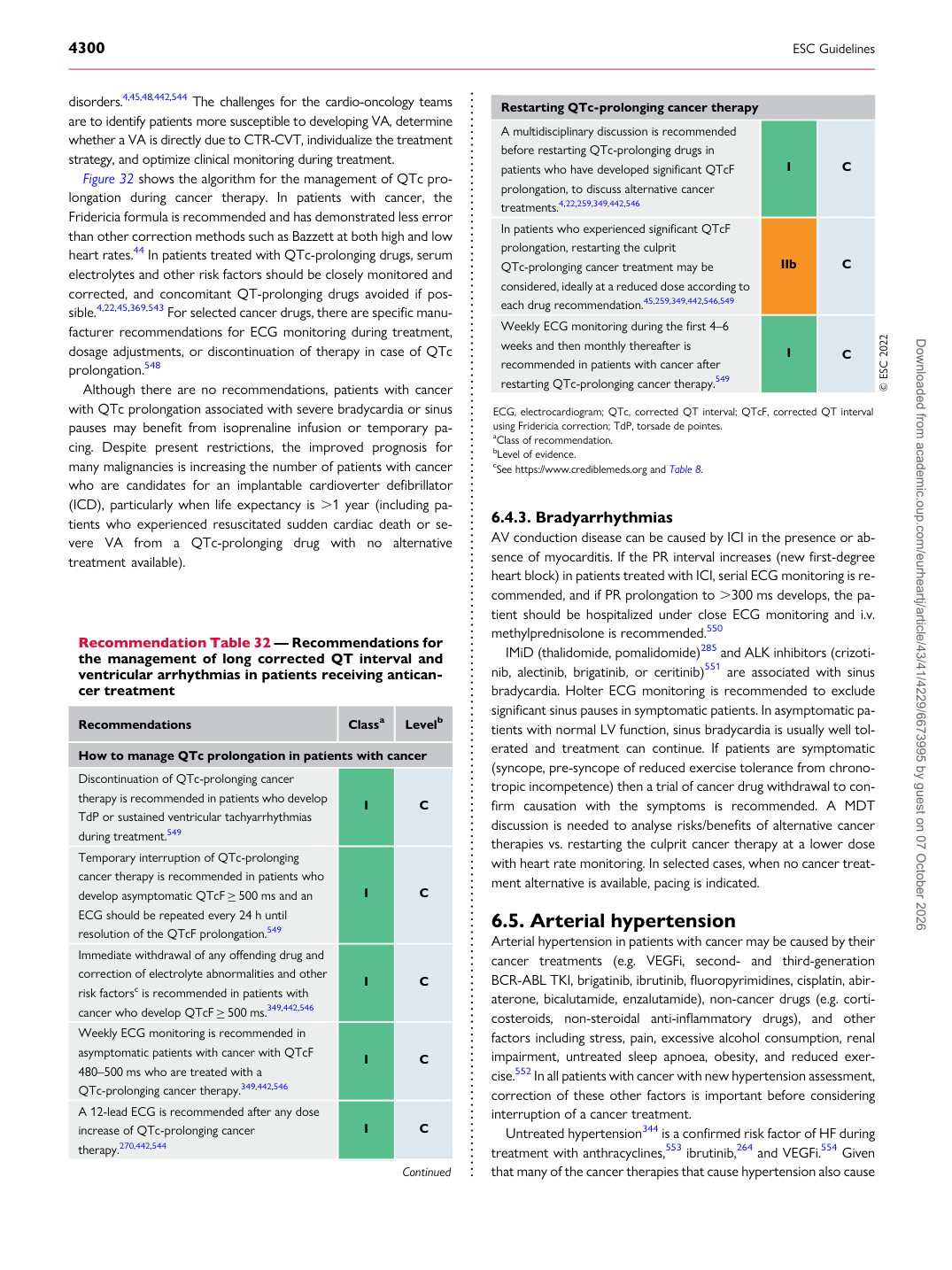
A multidisciplinary discussion is recommended before restarting QTc-prolonging drugs in patients who have developed significant QTcF prolongation, to discuss alternative cancer treatments.4,22,259,349,442,546 I C In patients who experienced significant QTcF prolongation, restarting the culprit QTc-prolonging cancer treatment may be considered, ideally at a reduced dose according to each drug recommendation.45,259,349,442,546,549 IIb C Weekly ECG monitoring during the first 4–6 weeks and then monthly thereafter is recommended in patients with cancer after restarting QTc-prolonging cancer therapy.549 I C © ESC 2022

ECG, electrocardiogram; QTc, corrected QT interval; QTcF, corrected QT interval using Fridericia correction; TdP, torsade de pointes. aClass of recommendation. bLevel of evidence. cSee https://www.crediblemeds.org and Table 8. Downloaded from academic.oup.com/eurheartj/article/43/41/4229/6673995 by guest on 07 October 2026