p.69 抽出テキスト
complications related to the implant—including device-related thrombosis—and the lack of prospective data in the setting of patients with cancer have to be taken into consideration for this option. In a recent retrospective analysis of patients referred to LAA occlusion the risk of in-hospital ischaemic stroke/transient ischaemic attack was higher in patients with active cancer than in those with no cancer or prior history of cancer. The rate of in-hospital composite outcome (in-hospital death, ischaemic stroke/transient ischaemic attack, systemic embolism, bleeding requiring blood transfusion, pericardial effusion/cardiac tamponade treated with pericardiocentesis or surgically, and removal of embolized device) and 30-day/180-day readmission outcomes were not significantly different between the groups.539 The onset of AF may be related to transient factors, such as the peri-operative period or the effect of drugs known to facilitate AF onset. The traditional assumption that in these cases, AF may occur as an isolated event without recurrence may not be valid as the occurrence of AF may often be related to a pre-existing atrial substrate with vulnerability to AF.540 Post-operative AF has been associated with a four- to five-fold risk of AF recurrence in the following 5 years, along with a comparable long-term thromboembolic risk with AF not related to surgery.273,540,541 Anticoagulation therapy yielded a similarly lower risk of thromboembolic events and all-cause death in both groups.541 In the absence of direct evidence, anticoagulation to prevent thromboembolic events should be considered in patients at risk for stroke with AF after cancer surgery considering the anticipated net clinical benefit and informed patient preferences.273 Similarly, in patients with AF apparently related to transient factors —such as chemotherapy, other drugs, or electrolyte disturbances —a careful clinical assessment of the propensity to further develop AF is recommended, with need to revisit the risk/benefit ratio of long-term prescription of anticoagulation after a period of 3 months. In patients with cancer and newly detected or recurrence of AF, decision making on anticancer treatment requires a cardio-oncology MDT management,5 taking into account that neither the presence nor the risk of AF constitutes contraindications to anticancer treatment.508,517

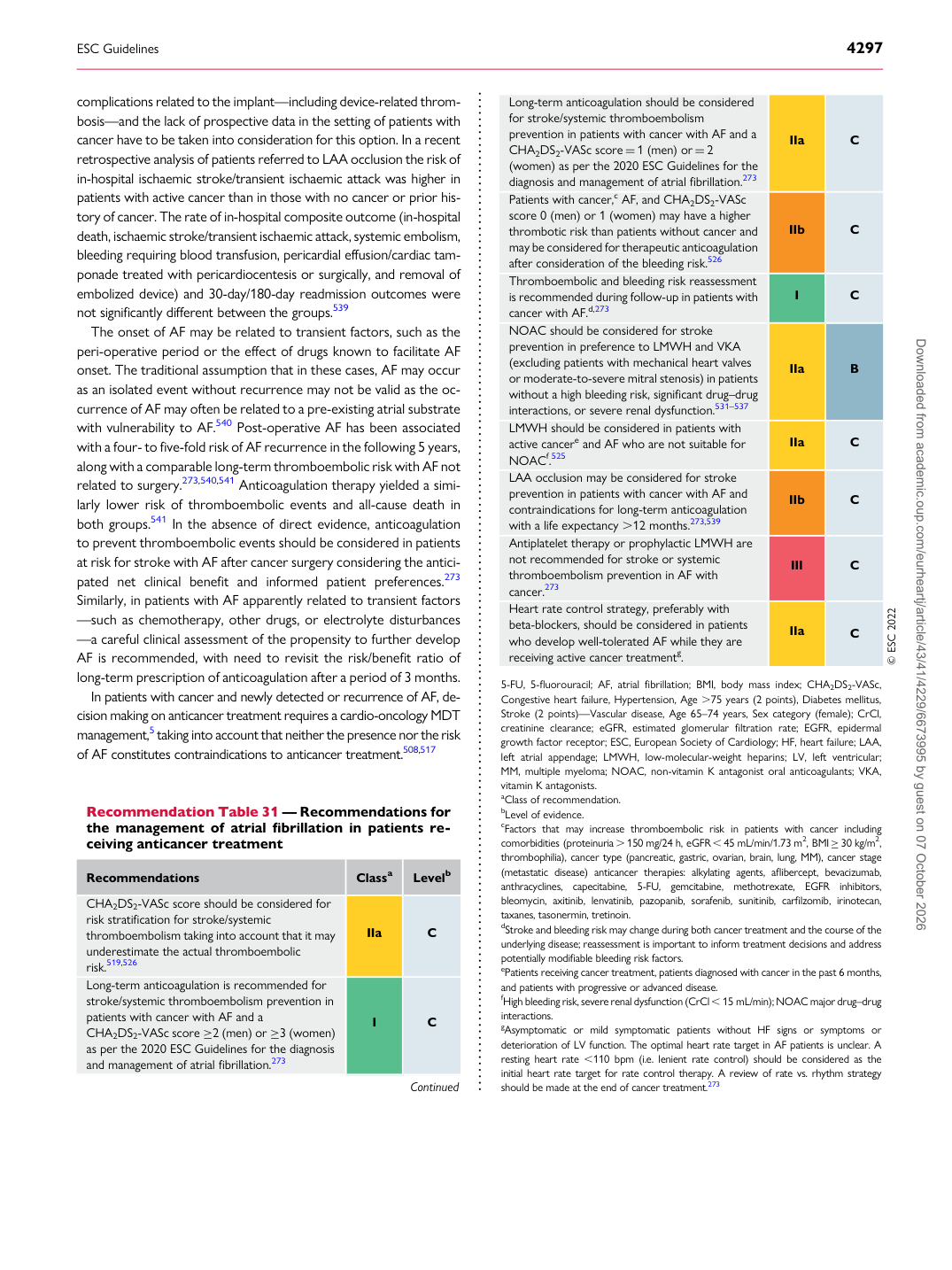
Recommendation Table 31 — Recommendations for the management of atrial fibrillation in patients receiving anticancer treatment

Recommendations Classa Levelb CHA2DS2-VASc score should be considered for risk stratification for stroke/systemic thromboembolism taking into account that it may underestimate the actual thromboembolic risk.519,526 IIa C Long-term anticoagulation is recommended for stroke/systemic thromboembolism prevention in patients with cancer with AF and a CHA2DS2-VASc score ≥2 (men) or ≥3 (women) as per the 2020 ESC Guidelines for the diagnosis and management of atrial fibrillation.273 I C

Continued Long-term anticoagulation should be considered for stroke/systemic thromboembolism prevention in patients with cancer with AF and a CHA2DS2-VASc score = 1 (men) or = 2 (women) as per the 2020 ESC Guidelines for the diagnosis and management of atrial fibrillation.273 IIa C

Patients with cancer,c AF, and CHA2DS2-VASc score 0 (men) or 1 (women) may have a higher thrombotic risk than patients without cancer and may be considered for therapeutic anticoagulation after consideration of the bleeding risk.526 IIb C Thromboembolic and bleeding risk reassessment is recommended during follow-up in patients with cancer with AF.d,273 I C NOAC should be considered for stroke prevention in preference to LMWH and VKA (excluding patients with mechanical heart valves or moderate-to-severe mitral stenosis) in patients without a high bleeding risk, significant drug–drug interactions, or severe renal dysfunction.531–537 IIa B LMWH should be considered in patients with active cancere and AF who are not suitable for NOACf.525 IIa C LAA occlusion may be considered for stroke prevention in patients with cancer with AF and contraindications for long-term anticoagulation with a life expectancy .12 months.273,539 IIb C Antiplatelet therapy or prophylactic LMWH are not recommended for stroke or systemic thromboembolism prevention in AF with cancer.273 III C Heart rate control strategy, preferably with beta-blockers, should be considered in patients who develop well-tolerated AF while they are receiving active cancer treatmentg. IIa C © ESC 2022

5-FU, 5-fluorouracil; AF, atrial fibrillation; BMI, body mass index; CHA2DS2-VASc, Congestive heart failure, Hypertension, Age .75 years (2 points), Diabetes mellitus, Stroke (2 points)—Vascular disease, Age 65–74 years, Sex category (female); CrCl, creatinine clearance; eGFR, estimated glomerular filtration rate; EGFR, epidermal growth factor receptor; ESC, European Society of Cardiology; HF, heart failure; LAA, left atrial appendage; LMWH, low-molecular-weight heparins; LV, left ventricular; MM, multiple myeloma; NOAC, non-vitamin K antagonist oral anticoagulants; VKA, vitamin K antagonists. aClass of recommendation. bLevel of evidence. cFactors that may increase thromboembolic risk in patients with cancer including comorbidities (proteinuria . 150 mg/24 h, eGFR, 45 mL/min/1.73 m2, BMI ≥30 kg/m2, thrombophilia), cancer type (pancreatic, gastric, ovarian, brain, lung, MM), cancer stage (metastatic disease) anticancer therapies: alkylating agents, aflibercept, bevacizumab, anthracyclines, capecitabine, 5-FU, gemcitabine, methotrexate, EGFR inhibitors, bleomycin, axitinib, lenvatinib, pazopanib, sorafenib, sunitinib, carfilzomib, irinotecan, taxanes, tasonermin, tretinoin. dStroke and bleeding risk may change during both cancer treatment and the course of the underlying disease; reassessment is important to inform treatment decisions and address potentially modifiable bleeding risk factors. ePatients receiving cancer treatment, patients diagnosed with cancer in the past 6 months, and patients with progressive or advanced disease. fHigh bleeding risk, severe renal dysfunction (CrCl, 15 mL/min); NOAC major drug–drug interactions. gAsymptomatic or mild symptomatic patients without HF signs or symptoms or deterioration of LV function. The optimal heart rate target in AF patients is unclear. A resting heart rate ,110 bpm (i.e. lenient rate control) should be considered as the initial heart rate target for rate control therapy. A review of rate vs. rhythm strategy should be made at the end of cancer treatment.273 Downloaded from academic.oup.com/eurheartj/article/43/41/4229/6673995 by guest on 07 October 2026