p.68 抽出テキスト
Thrombocytopaenia GI/GU cancer, GI comorbidities, or GI toxicity Recent or evolving intracranial lesions Active bleeding or recent major bleeding Severe renal dysfunction (eGFR <30 mL/min/1.73 m 2) Bleeding risk scores (e.g., HAS-BLED)

Assess Bleeding risk:

Cancer-related risk (cancer type and stage, cancer treatment) CHA2DS2-VASc score for risk stratification (Class IIa) a

Assess Thromboembolic risk:

Anticancer agents Supportive therapies

Assess drug-drug Interactions (P-glycoprotein, CYP3A4):

Assess Patient preferences and drug availability

T

B

I

P

Thromboembolic and bleeding risk reassessment

(Class I) Very high bleeding riskb

Type of anticoagulant

treatment LAA oclusionc

(Class IIb)

LMWH (Class IIa)

Moderate/severe mitral stenosis or mechanical prosthetic valve

Patients suitable

for NOACd

N

N Structured approach to anticoagulation for AF in patients with cancer

No anticoagulation

Y

VKA (Class IIa)

Y

NOAC (Class IIa)

Y Long-term anticoagulation according to CHA2DS2-VASc score

≥2 (men) or ≥3 (women) (Class I) 1 (men) or 2 (women) (Class IIa) 0 (men) or 1 (women) (Class IIb)

N

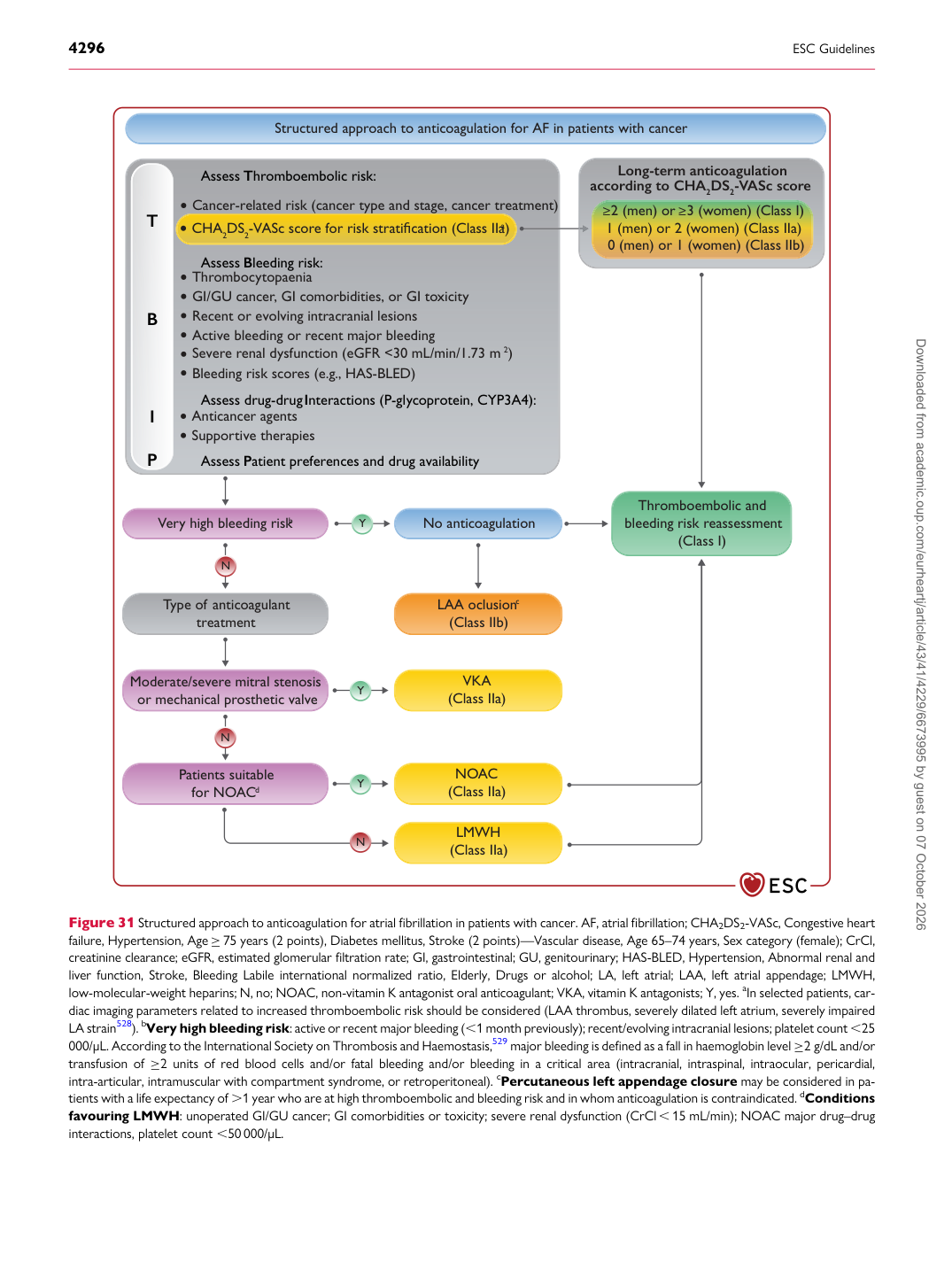
Figure 31 Structured approach to anticoagulation for atrial fibrillation in patients with cancer. AF, atrial fibrillation; CHA2DS2-VASc, Congestive heart failure, Hypertension, Age ≥75 years (2 points), Diabetes mellitus, Stroke (2 points)—Vascular disease, Age 65–74 years, Sex category (female); CrCl, creatinine clearance; eGFR, estimated glomerular filtration rate; GI, gastrointestinal; GU, genitourinary; HAS-BLED, Hypertension, Abnormal renal and liver function, Stroke, Bleeding Labile international normalized ratio, Elderly, Drugs or alcohol; LA, left atrial; LAA, left atrial appendage; LMWH, low-molecular-weight heparins; N, no; NOAC, non-vitamin K antagonist oral anticoagulant; VKA, vitamin K antagonists; Y, yes. aIn selected patients, cardiac imaging parameters related to increased thromboembolic risk should be considered (LAA thrombus, severely dilated left atrium, severely impaired LA strain528). bVery high bleeding risk: active or recent major bleeding (,1 month previously); recent/evolving intracranial lesions; platelet count ,25 000/μL. According to the International Society on Thrombosis and Haemostasis,529 major bleeding is defined as a fall in haemoglobin level ≥2 g/dL and/or transfusion of ≥2 units of red blood cells and/or fatal bleeding and/or bleeding in a critical area (intracranial, intraspinal, intraocular, pericardial, intra-articular, intramuscular with compartment syndrome, or retroperitoneal). cPercutaneous left appendage closure may be considered in patients with a life expectancy of .1 year who are at high thromboembolic and bleeding risk and in whom anticoagulation is contraindicated. dConditions favouring LMWH: unoperated GI/GU cancer; GI comorbidities or toxicity; severe renal dysfunction (CrCl , 15 mL/min); NOAC major drug–drug interactions, platelet count ,50 000/μL. Downloaded from academic.oup.com/eurheartj/article/43/41/4229/6673995 by guest on 07 October 2026