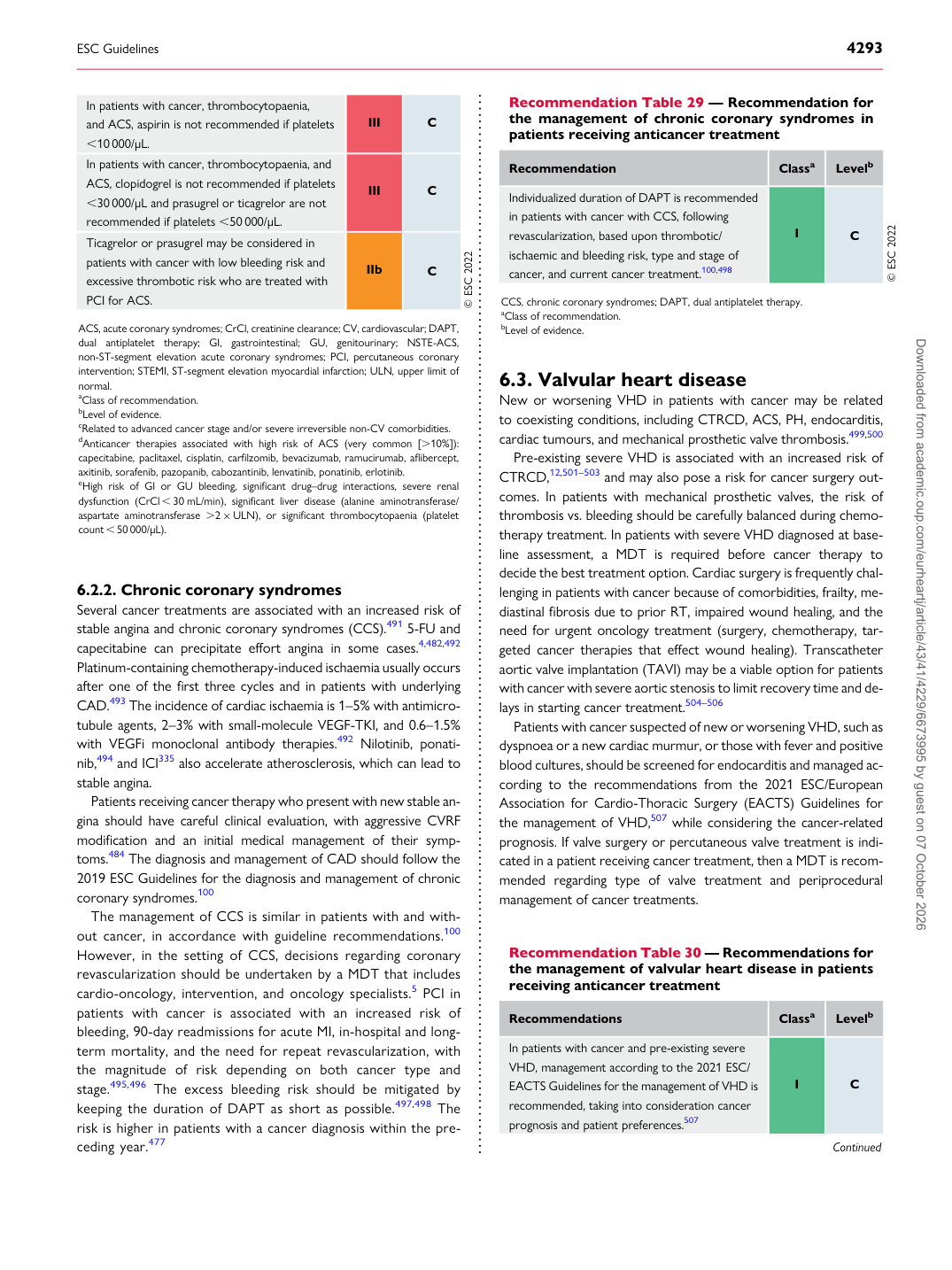
p.65 抽出テキスト
6.2.2 Chronic coronary syndromes

Several cancer treatments are associated with an increased risk of stable angina and chronic coronary syndromes (CCS).491 5-FU and capecitabine can precipitate effort angina in some cases.4,482,492 Platinum-containing chemotherapy-induced ischaemia usually occurs after one of the first three cycles and in patients with underlying CAD.493 The incidence of cardiac ischaemia is 1–5% with antimicrotubule agents, 2–3% with small-molecule VEGF-TKI, and 0.6–1.5% with VEGFi monoclonal antibody therapies.492 Nilotinib, ponatinib,494 and ICI335 also accelerate atherosclerosis, which can lead to stable angina. Patients receiving cancer therapy who present with new stable angina should have careful clinical evaluation, with aggressive CVRF modification and an initial medical management of their symptoms.484 The diagnosis and management of CAD should follow the 2019 ESC Guidelines for the diagnosis and management of chronic coronary syndromes.100 The management of CCS is similar in patients with and without cancer, in accordance with guideline recommendations.100 However, in the setting of CCS, decisions regarding coronary revascularization should be undertaken by a MDT that includes cardio-oncology, intervention, and oncology specialists.5 PCI in patients with cancer is associated with an increased risk of bleeding, 90-day readmissions for acute MI, in-hospital and longterm mortality, and the need for repeat revascularization, with the magnitude of risk depending on both cancer type and stage.495,496 The excess bleeding risk should be mitigated by keeping the duration of DAPT as short as possible.497,498 The risk is higher in patients with a cancer diagnosis within the preceding year.477 6.3 Valvular heart disease

New or worsening VHD in patients with cancer may be related to coexisting conditions, including CTRCD, ACS, PH, endocarditis, cardiac tumours, and mechanical prosthetic valve thrombosis.499,500 Pre-existing severe VHD is associated with an increased risk of CTRCD,12,501–503 and may also pose a risk for cancer surgery outcomes. In patients with mechanical prosthetic valves, the risk of thrombosis vs. bleeding should be carefully balanced during chemotherapy treatment. In patients with severe VHD diagnosed at baseline assessment, a MDT is required before cancer therapy to decide the best treatment option. Cardiac surgery is frequently challenging in patients with cancer because of comorbidities, frailty, mediastinal fibrosis due to prior RT, impaired wound healing, and the need for urgent oncology treatment (surgery, chemotherapy, targeted cancer therapies that effect wound healing). Transcatheter aortic valve implantation (TAVI) may be a viable option for patients with cancer with severe aortic stenosis to limit recovery time and delays in starting cancer treatment.504–506 Patients with cancer suspected of new or worsening VHD, such as dyspnoea or a new cardiac murmur, or those with fever and positive blood cultures, should be screened for endocarditis and managed according to the recommendations from the 2021 ESC/European Association for Cardio-Thoracic Surgery (EACTS) Guidelines for the management of VHD,507 while considering the cancer-related prognosis. If valve surgery or percutaneous valve treatment is indicated in a patient receiving cancer treatment, then a MDT is recommended regarding type of valve treatment and periprocedural management of cancer treatments.

In patients with cancer, thrombocytopaenia, and ACS, aspirin is not recommended if platelets ,10 000/μL. III C In patients with cancer, thrombocytopaenia, and ACS, clopidogrel is not recommended if platelets ,30 000/μL and prasugrel or ticagrelor are not recommended if platelets ,50 000/μL. III C Ticagrelor or prasugrel may be considered in patients with cancer with low bleeding risk and excessive thrombotic risk who are treated with PCI for ACS. IIb C © ESC 2022

ACS, acute coronary syndromes; CrCl, creatinine clearance; CV, cardiovascular; DAPT, dual antiplatelet therapy; GI, gastrointestinal; GU, genitourinary; NSTE-ACS, non-ST-segment elevation acute coronary syndromes; PCI, percutaneous coronary intervention; STEMI, ST-segment elevation myocardial infarction; ULN, upper limit of normal. aClass of recommendation. bLevel of evidence. cRelated to advanced cancer stage and/or severe irreversible non-CV comorbidities. dAnticancer therapies associated with high risk of ACS (very common [.10%]): capecitabine, paclitaxel, cisplatin, carfilzomib, bevacizumab, ramucirumab, aflibercept, axitinib, sorafenib, pazopanib, cabozantinib, lenvatinib, ponatinib, erlotinib. eHigh risk of GI or GU bleeding, significant drug–drug interactions, severe renal dysfunction (CrCl , 30 mL/min), significant liver disease (alanine aminotransferase/ aspartate aminotransferase .2 × ULN), or significant thrombocytopaenia (platelet count , 50 000/μL). Recommendation Table 29 — Recommendation for the management of chronic coronary syndromes in patients receiving anticancer treatment

Recommendation Classa Levelb

Individualized duration of DAPT is recommended in patients with cancer with CCS, following revascularization, based upon thrombotic/ ischaemic and bleeding risk, type and stage of cancer, and current cancer treatment.100,498 I C © ESC 2022

CCS, chronic coronary syndromes; DAPT, dual antiplatelet therapy. aClass of recommendation. bLevel of evidence.

Recommendation Table 30 — Recommendations for the management of valvular heart disease in patients receiving anticancer treatment

Recommendations Classa Levelb

In patients with cancer and pre-existing severe VHD, management according to the 2021 ESC/ EACTS Guidelines for the management of VHD is recommended, taking into consideration cancer prognosis and patient preferences.507 I C

Continued Downloaded from academic.oup.com/eurheartj/article/43/41/4229/6673995 by guest on 07 October 2026