p.64 抽出テキスト
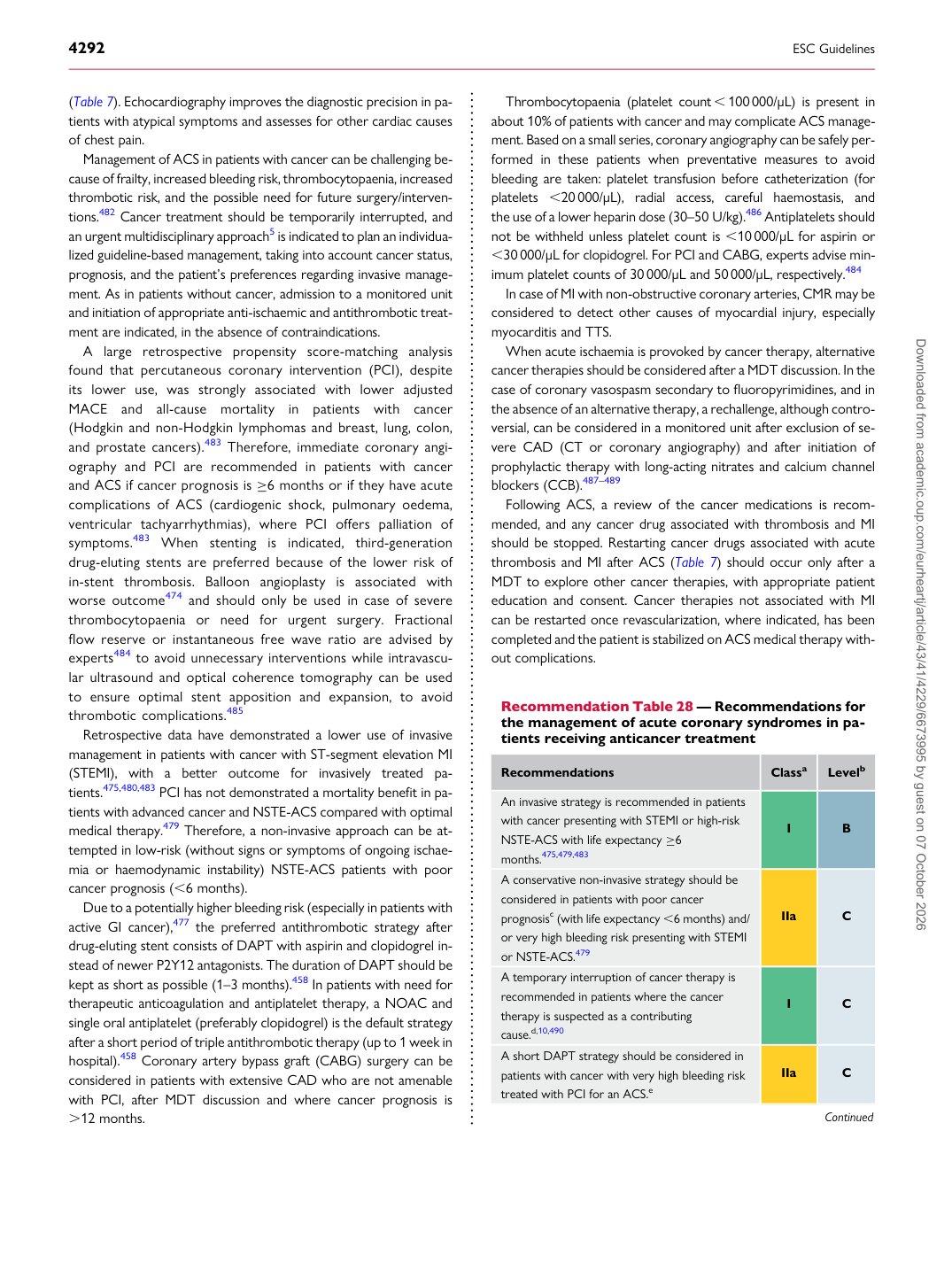
(Table 7). Echocardiography improves the diagnostic precision in patients with atypical symptoms and assesses for other cardiac causes of chest pain. Management of ACS in patients with cancer can be challenging because of frailty, increased bleeding risk, thrombocytopaenia, increased thrombotic risk, and the possible need for future surgery/interventions.482 Cancer treatment should be temporarily interrupted, and an urgent multidisciplinary approach5 is indicated to plan an individualized guideline-based management, taking into account cancer status, prognosis, and the patient’s preferences regarding invasive management. As in patients without cancer, admission to a monitored unit and initiation of appropriate anti-ischaemic and antithrombotic treatment are indicated, in the absence of contraindications. A large retrospective propensity score-matching analysis found that percutaneous coronary intervention (PCI), despite its lower use, was strongly associated with lower adjusted MACE and all-cause mortality in patients with cancer (Hodgkin and non-Hodgkin lymphomas and breast, lung, colon, and prostate cancers).483 Therefore, immediate coronary angiography and PCI are recommended in patients with cancer and ACS if cancer prognosis is ≥6 months or if they have acute complications of ACS (cardiogenic shock, pulmonary oedema, ventricular tachyarrhythmias), where PCI offers palliation of symptoms.483 When stenting is indicated, third-generation drug-eluting stents are preferred because of the lower risk of in-stent thrombosis. Balloon angioplasty is associated with worse outcome474 and should only be used in case of severe thrombocytopaenia or need for urgent surgery. Fractional flow reserve or instantaneous free wave ratio are advised by experts484 to avoid unnecessary interventions while intravascular ultrasound and optical coherence tomography can be used to ensure optimal stent apposition and expansion, to avoid thrombotic complications.485 Retrospective data have demonstrated a lower use of invasive management in patients with cancer with ST-segment elevation MI (STEMI), with a better outcome for invasively treated patients.475,480,483 PCI has not demonstrated a mortality benefit in patients with advanced cancer and NSTE-ACS compared with optimal medical therapy.479 Therefore, a non-invasive approach can be attempted in low-risk (without signs or symptoms of ongoing ischaemia or haemodynamic instability) NSTE-ACS patients with poor cancer prognosis (,6 months). Due to a potentially higher bleeding risk (especially in patients with active GI cancer),477 the preferred antithrombotic strategy after drug-eluting stent consists of DAPT with aspirin and clopidogrel instead of newer P2Y12 antagonists. The duration of DAPT should be kept as short as possible (1–3 months).458 In patients with need for therapeutic anticoagulation and antiplatelet therapy, a NOAC and single oral antiplatelet (preferably clopidogrel) is the default strategy after a short period of triple antithrombotic therapy (up to 1 week in hospital).458 Coronary artery bypass graft (CABG) surgery can be considered in patients with extensive CAD who are not amenable with PCI, after MDT discussion and where cancer prognosis is .12 months. Thrombocytopaenia (platelet count , 100 000/μL) is present in about 10% of patients with cancer and may complicate ACS management. Based on a small series, coronary angiography can be safely performed in these patients when preventative measures to avoid bleeding are taken: platelet transfusion before catheterization (for platelets ,20 000/μL), radial access, careful haemostasis, and the use of a lower heparin dose (30–50 U/kg).486 Antiplatelets should not be withheld unless platelet count is ,10 000/μL for aspirin or ,30 000/μL for clopidogrel. For PCI and CABG, experts advise minimum platelet counts of 30 000/μL and 50 000/μL, respectively.484

In case of MI with non-obstructive coronary arteries, CMR may be considered to detect other causes of myocardial injury, especially myocarditis and TTS. When acute ischaemia is provoked by cancer therapy, alternative cancer therapies should be considered after a MDT discussion. In the case of coronary vasospasm secondary to fluoropyrimidines, and in the absence of an alternative therapy, a rechallenge, although controversial, can be considered in a monitored unit after exclusion of severe CAD (CT or coronary angiography) and after initiation of prophylactic therapy with long-acting nitrates and calcium channel blockers (CCB).487–489 Following ACS, a review of the cancer medications is recommended, and any cancer drug associated with thrombosis and MI should be stopped. Restarting cancer drugs associated with acute thrombosis and MI after ACS (Table 7) should occur only after a MDT to explore other cancer therapies, with appropriate patient education and consent. Cancer therapies not associated with MI can be restarted once revascularization, where indicated, has been completed and the patient is stabilized on ACS medical therapy without complications.

Recommendation Table 28 — Recommendations for the management of acute coronary syndromes in patients receiving anticancer treatment

Recommendations Classa Levelb

An invasive strategy is recommended in patients with cancer presenting with STEMI or high-risk NSTE-ACS with life expectancy ≥6 months.475,479,483 I B A conservative non-invasive strategy should be considered in patients with poor cancer prognosisc (with life expectancy ,6 months) and/ or very high bleeding risk presenting with STEMI or NSTE-ACS.479 IIa C A temporary interruption of cancer therapy is recommended in patients where the cancer therapy is suspected as a contributing cause.d,10,490 I C A short DAPT strategy should be considered in patients with cancer with very high bleeding risk treated with PCI for an ACS.e IIa C

Continued Downloaded from academic.oup.com/eurheartj/article/43/41/4229/6673995 by guest on 07 October 2026