p.63 抽出テキスト
Although CV complications are common with TIL therapies, survival does not appear to be significantly affected. The most frequent CV events are hypotension that may require treatment with i.v. fluids and pressors, AF, and to a lesser extent, cTn elevation suggestive of myocardial damage.380 Further research is needed to define mechanisms and potential prevention strategies to help clinicians with the management of these CV events.

6.1.5 Heart failure during haematopoietic stem cell

transplantation CV complications during HSCT, including congestive HF,456 arterial events, tamponade, and rhythm disturbances (AF, atrial flutter, and supraventricular tachycardia),457 are uncommon but clinically relevant, and should be treated as per specific ESC Guidelines (HF,14 tachyarrhythmias,273,441 pericardial effusion,444 or acute coronary syndrome458). Studies of treatments during HSCT to prevent both acute and late CV toxicity are limited.145 ACE-I and beta-blockers may be effective, but this requires further confirmation. Outpatient and home-based exercise and education programmes instituted after HSCT can improve exercise capacity and quality of life,459 and the role of exercise pre-habilitation prior to HSCT is being investigated.460,461

6.1.6 Takotsubo syndrome and cancer

The prevalence of malignant diseases is high in patients with TTS and is a risk factor for worse outcomes. Malignancy itself, some cancer treatments (5-FU, ICI, VEGFi), and the stress associated with the diagnosis, investigations, and treatment are recognized triggers or predisposing factors for TTS.462–466 Diagnosis using general TTS criteria is recommended.467,468 Investigations in a patient with cancer with suspected TTS should include clinical examination, ECG, TTE, cardiac biomarkers (cTn and NP), and CMR (Figure 29).468,469 Most patients require invasive coronary angiography to exclude acute MI. In patients with advanced malignancy or significant thrombocytopaenia where invasive coronary angiography is contraindicated, a CCTA is recommended. Cardiac imaging studies should be performed as early as possible when the diagnosis is suspected as LVD can be transient, and if significant LVD is detected then repeat imaging to confirm recovery is recommended. Interruption of the culprit cancer drug in patients with TTS is recommended. QT-prolonging drugs should be avoided.467 In cases of ICI-associated TTS, the role of immunosuppression is unknown and if myocardial inflammation is present in a TTS pattern on CMR then i.v. methylprednisolone is recommended given the overlap between ICI-induced TTS and ICI-induced myocarditis. Limited information exists regarding the feasibility of ICI rechallenge following TTS and after recovery of LV function. A MDT discussion is recommended after recovery from the acute phase of TTS and, if restarting the culprit cancer drug is required from an oncology perspective, regular cardiac biomarker monitoring is recommended (e.g. cTn and NP measured before every ICI cycle, and TTE if a new rise in cardiac biomarkers occurs) (Figure 29). 6.2 Coronary artery disease

6.2.1. Acute coronary syndromes Patients with cancer are at increased risk of CAD because of shared CVRFs34 and CV toxicity of cancer therapy12 compounded by a cancer-induced pro-inflammatory and prothrombotic state (Table 7).467,468,470–473 Current knowledge on ACS in patients with cancer is based on observational data and registries demonstrating that, especially when diagnosed within 1 year, they are at increased risk for major CV events, bleeding, and cardiac and non-cardiac mortality.474–480 The proportion of ACS patients with a diagnosis of cancer is rising and constitutes about 3% of large series.475 Diagnosis of ACS is based on the same principles as in patients without cancer, including symptoms, an early 12-lead ECG, and serial measurements of hs-cTn for patients presenting with possible non-ST-segment elevation ACS (NSTE-ACS).458 Clinical presentation can be atypical481 or masked by cancer or therapy-related side effects; therefore, diagnostic suspicion should be increased in patients at high CV risk or treated with vascular cardiotoxic therapies

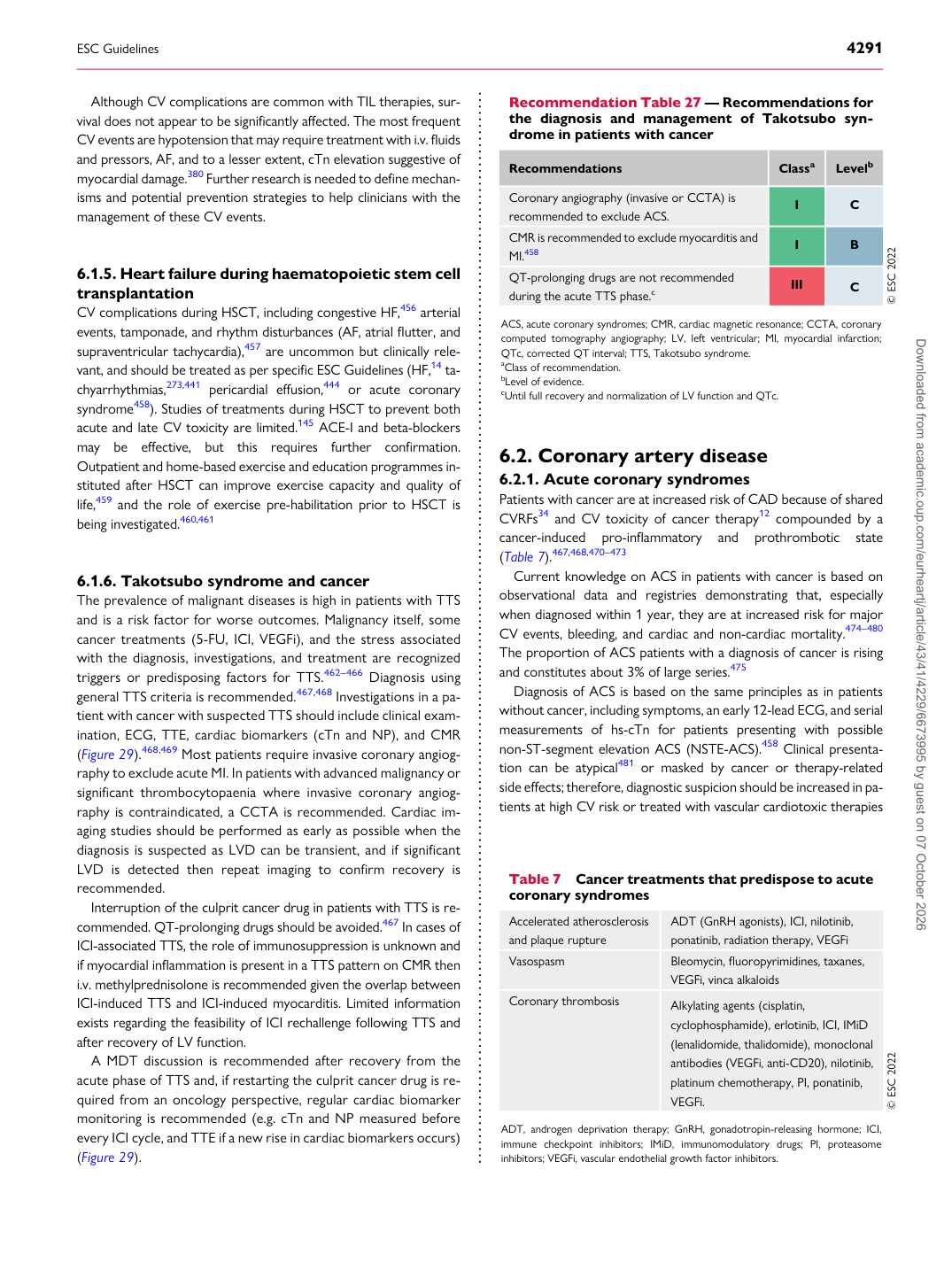
Recommendation Table 27 — Recommendations for the diagnosis and management of Takotsubo syndrome in patients with cancer

Recommendations Classa Levelb

Coronary angiography (invasive or CCTA) is recommended to exclude ACS. I C CMR is recommended to exclude myocarditis and MI.458 I B QT-prolonging drugs are not recommended during the acute TTS phase.c III C © ESC 2022

ACS, acute coronary syndromes; CMR, cardiac magnetic resonance; CCTA, coronary computed tomography angiography; LV, left ventricular; MI, myocardial infarction; QTc, corrected QT interval; TTS, Takotsubo syndrome. aClass of recommendation. bLevel of evidence. cUntil full recovery and normalization of LV function and QTc.

Table 7 Cancer treatments that predispose to acute coronary syndromes Accelerated atherosclerosis and plaque rupture ADT (GnRH agonists), ICI, nilotinib,

ponatinib, radiation therapy, VEGFi

Vasospasm Bleomycin, fluoropyrimidines, taxanes,

VEGFi, vinca alkaloids

Coronary thrombosis Alkylating agents (cisplatin,

cyclophosphamide), erlotinib, ICI, IMiD (lenalidomide, thalidomide), monoclonal antibodies (VEGFi, anti-CD20), nilotinib, platinum chemotherapy, PI, ponatinib, VEGFi. © ESC 2022

ADT, androgen deprivation therapy; GnRH, gonadotropin-releasing hormone; ICI, immune checkpoint inhibitors; IMiD, immunomodulatory drugs; PI, proteasome inhibitors; VEGFi, vascular endothelial growth factor inhibitors. Downloaded from academic.oup.com/eurheartj/article/43/41/4229/6673995 by guest on 07 October 2026