p.61 抽出テキスト
There is a lack of data to recommend a specific second-line immunosuppression regimen and MDT discussion is recommended. Several agents are currently being investigated with promising results from case series including i.v. mycophenolate mofetil, anti-thymocyte globulin (anti-CD3 antibody), i.v. immunoglobulin, plasma exchange, tocilizumab, abatacept (CTLA-4 agonist), alemtuzumab (anti-CD52 antibody), and tofacitinib. Caution is advised against the use of infliximab for steroid-refractory myocarditis and HF.447,448 Patients with fulminant ICI-associated myocarditis, complicated by haemodynamic and/or electrical instability, require admission to the intensive care unit (ICU) and cardiogenic shock should be managed according to the 2021 ESC Guidelines for the diagnosis and treatment of acute and chronic HF.14 A single dose of i.v. methylprednisolone should be considered in clinically unstable patients with cancer where ICI-induced myocarditis is suspected at presentation but before definitive diagnosis can be confirmed. Following recovery from ICI-associated myocarditis and weaning of oral steroid therapy, MDT discussion is recommended to review the decision on whether to restart ICI treatment. This depends on various factors including the severity of the ICI-associated myocarditis (fulminant vs. non-fulminant vs. asymptomatic), alternative oncology treatment options, metastatic vs. adjuvant/neoadjuvant indication, and reducing from dual ICI to single ICI treatment if triggered by combination ICI treatment.449 Non-inflammatory HF syndromes have also been observed in patients treated with ICI. These include TTS, non-inflammatory HF or LVD,450 and post-MI HF.451,452 Non-inflammatory HF is generally a late event and the diagnostic workflow should be based on defining the HF phenotype and excluding myocarditis, TTS, and ACS.14 There is also evidence that vasculitis and CAD can occur after ICI treatment.335 HF treatment as per the 2021 ESC Guidelines for the diagnosis and treatment of acute and chronic HF is indicated,14 but there is no indication for immunosuppression if myocarditis has been excluded. Interruption vs. continuing ICI therapy depends on the severity of the HF syndrome and each case should be reviewed by a MDT. Arrhythmias, such as AF, can be seen in patients with ICI therapy without myocarditis (e.g. ICI-associated thyroiditis with thyrotoxicosis, ICI-associated pericarditis, or ICI-associated severe systemic inflammatory syndromes). ICI treatment can be continued after excluding myocarditis.

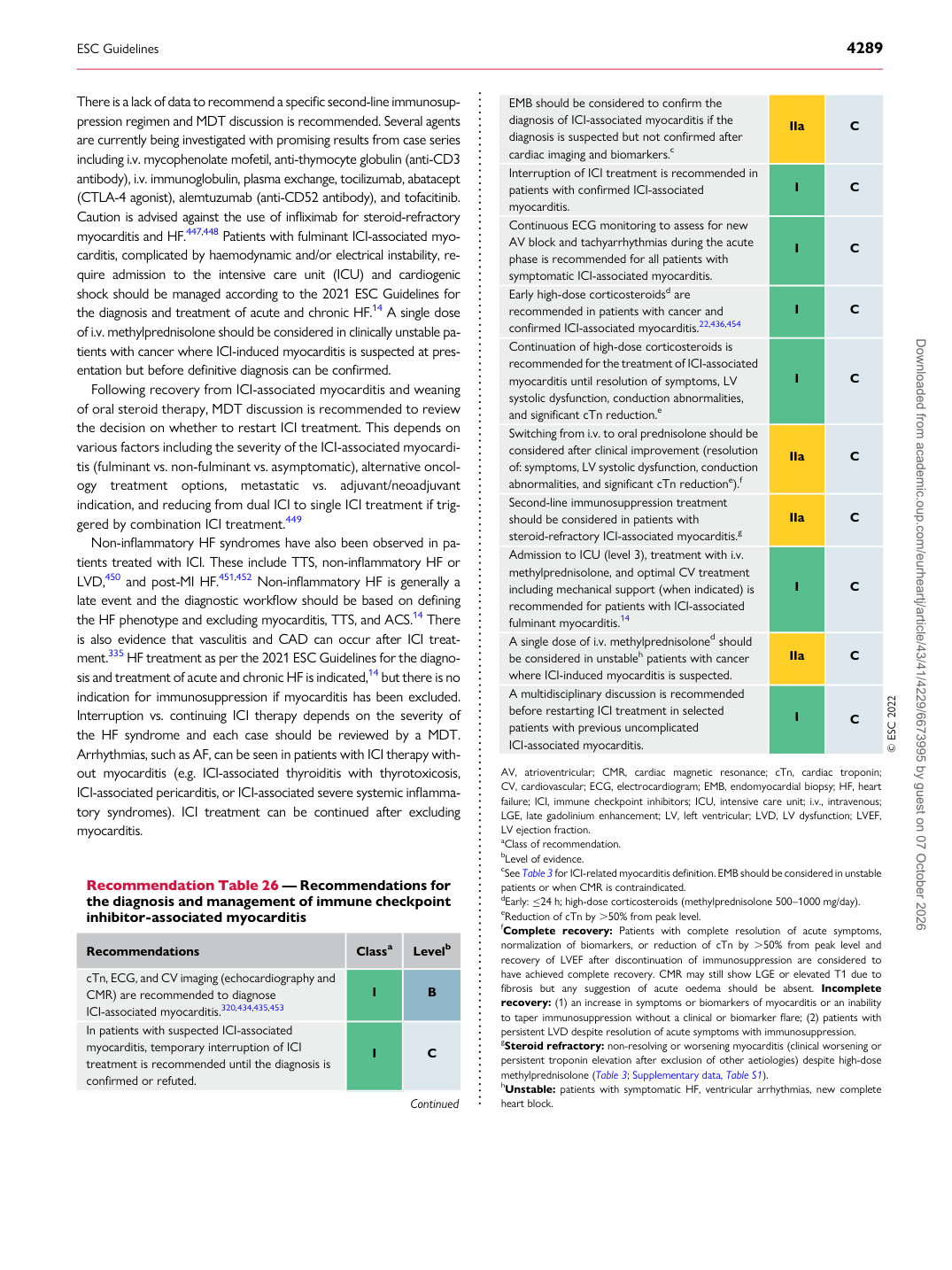
Recommendation Table 26 — Recommendations for the diagnosis and management of immune checkpoint inhibitor-associated myocarditis

Recommendations Classa Levelb cTn, ECG, and CV imaging (echocardiography and CMR) are recommended to diagnose ICI-associated myocarditis.320,434,435,453 I B In patients with suspected ICI-associated myocarditis, temporary interruption of ICI treatment is recommended until the diagnosis is confirmed or refuted. I C

Continued EMB should be considered to confirm the diagnosis of ICI-associated myocarditis if the diagnosis is suspected but not confirmed after cardiac imaging and biomarkers.c IIa C

Interruption of ICI treatment is recommended in patients with confirmed ICI-associated myocarditis. I C Continuous ECG monitoring to assess for new AV block and tachyarrhythmias during the acute phase is recommended for all patients with symptomatic ICI-associated myocarditis. I C Early high-dose corticosteroidsd are recommended in patients with cancer and confirmed ICI-associated myocarditis.22,436,454 I C Continuation of high-dose corticosteroids is recommended for the treatment of ICI-associated myocarditis until resolution of symptoms, LV systolic dysfunction, conduction abnormalities, and significant cTn reduction.e I C Switching from i.v. to oral prednisolone should be considered after clinical improvement (resolution of: symptoms, LV systolic dysfunction, conduction abnormalities, and significant cTn reductione).f IIa C Second-line immunosuppression treatment should be considered in patients with steroid-refractory ICI-associated myocarditis.g IIa C Admission to ICU (level 3), treatment with i.v. methylprednisolone, and optimal CV treatment including mechanical support (when indicated) is recommended for patients with ICI-associated fulminant myocarditis.14 I C A single dose of i.v. methylprednisoloned should be considered in unstableh patients with cancer where ICI-induced myocarditis is suspected. IIa C A multidisciplinary discussion is recommended before restarting ICI treatment in selected patients with previous uncomplicated ICI-associated myocarditis. I C © ESC 2022

AV, atrioventricular; CMR, cardiac magnetic resonance; cTn, cardiac troponin; CV, cardiovascular; ECG, electrocardiogram; EMB, endomyocardial biopsy; HF, heart failure; ICI, immune checkpoint inhibitors; ICU, intensive care unit; i.v., intravenous; LGE, late gadolinium enhancement; LV, left ventricular; LVD, LV dysfunction; LVEF, LV ejection fraction. aClass of recommendation. bLevel of evidence. cSee Table 3 for ICI-related myocarditis definition. EMB should be considered in unstable patients or when CMR is contraindicated. dEarly: ≤24 h; high-dose corticosteroids (methylprednisolone 500–1000 mg/day). eReduction of cTn by .50% from peak level. fComplete recovery: Patients with complete resolution of acute symptoms, normalization of biomarkers, or reduction of cTn by .50% from peak level and recovery of LVEF after discontinuation of immunosuppression are considered to have achieved complete recovery. CMR may still show LGE or elevated T1 due to fibrosis but any suggestion of acute oedema should be absent. Incomplete recovery: (1) an increase in symptoms or biomarkers of myocarditis or an inability to taper immunosuppression without a clinical or biomarker flare; (2) patients with persistent LVD despite resolution of acute symptoms with immunosuppression. gSteroid refractory: non-resolving or worsening myocarditis (clinical worsening or persistent troponin elevation after exclusion of other aetiologies) despite high-dose methylprednisolone (Table 3; Supplementary data, Table S1). hUnstable: patients with symptomatic HF, ventricular arrhythmias, new complete heart block. Downloaded from academic.oup.com/eurheartj/article/43/41/4229/6673995 by guest on 07 October 2026