p.60 抽出テキスト
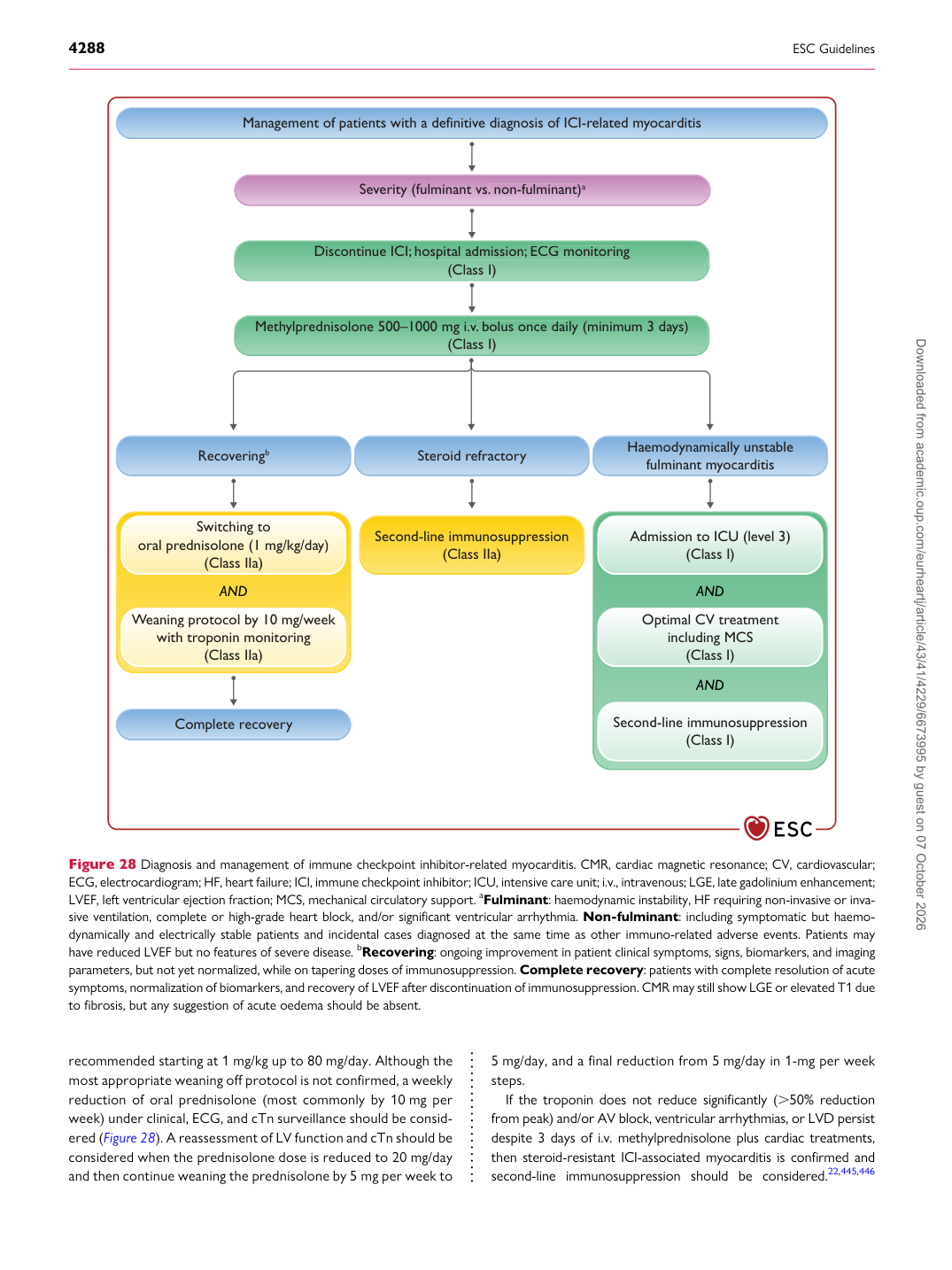
recommended starting at 1 mg/kg up to 80 mg/day. Although the most appropriate weaning off protocol is not confirmed, a weekly reduction of oral prednisolone (most commonly by 10 mg per week) under clinical, ECG, and cTn surveillance should be considered (Figure 28). A reassessment of LV function and cTn should be considered when the prednisolone dose is reduced to 20 mg/day and then continue weaning the prednisolone by 5 mg per week to 5 mg/day, and a final reduction from 5 mg/day in 1-mg per week steps.

If the troponin does not reduce significantly (.50% reduction from peak) and/or AV block, ventricular arrhythmias, or LVD persist despite 3 days of i.v. methylprednisolone plus cardiac treatments, then steroid-resistant ICI-associated myocarditis is confirmed and second-line immunosuppression should be considered.22,445,446

Complete r ec o v e r y

Rec o v ering b Ste r oid r efracto r y Haemodynamical l y unstable

fulminant m y oca r ditis

Switching to oral p r ednisolone (1 mg/kg/d a y)

a a

(Class IIa) Second-line im m unosupp r ession

(Class IIa)

Met h ylp r ednisolone 500–1000 mg i. v .

v

v bolus once dai

. l y (mini m um 3 d a ys)

a a

(Class I)

Disconti n ue ICI ; hospital admission

; ; ECG monitoring

;

(Class I)

S e v erity (fulminant vs . non-fulminant)

. a

Admission to ICU (l e v el 3)

(Class I)

Optimal CV t r eatment

including MCS

(Class I)

W eaning p W W r otocol b y 10 mg/ w eek

with t r oponin monitoring

(Class IIa)

Management of patients with a definiti v e diagnosis of ICI- r elated m y oca r ditis

AND AND

Second-line im m unosupp r ession

(Class I)

AND

Figure 28 Diagnosis and management of immune checkpoint inhibitor-related myocarditis. CMR, cardiac magnetic resonance; CV, cardiovascular; ECG, electrocardiogram; HF, heart failure; ICI, immune checkpoint inhibitor; ICU, intensive care unit; i.v., intravenous; LGE, late gadolinium enhancement; LVEF, left ventricular ejection fraction; MCS, mechanical circulatory support. aFulminant: haemodynamic instability, HF requiring non-invasive or invasive ventilation, complete or high-grade heart block, and/or significant ventricular arrhythmia. Non-fulminant: including symptomatic but haemodynamically and electrically stable patients and incidental cases diagnosed at the same time as other immuno-related adverse events. Patients may have reduced LVEF but no features of severe disease. bRecovering: ongoing improvement in patient clinical symptoms, signs, biomarkers, and imaging parameters, but not yet normalized, while on tapering doses of immunosuppression. Complete recovery: patients with complete resolution of acute symptoms, normalization of biomarkers, and recovery of LVEF after discontinuation of immunosuppression. CMR may still show LGE or elevated T1 due to fibrosis, but any suggestion of acute oedema should be absent. Downloaded from academic.oup.com/eurheartj/article/43/41/4229/6673995 by guest on 07 October 2026