p.58 抽出テキスト
6.1.3 Immune checkpoint inhibitor-associated

myocarditis and non-inflammatory heart failure Myocarditis is a severe complication of ICI with a high fatality rate that most frequently develops during the first 12 weeks of treatment, although late cases (after week 20) may occur.386 Other ICI-related CV toxicities include dyslipidaemia, ACS, vasculitis, AV block, supraventricular and ventricular arrhythmias, sudden death, TTS, non-inflammatory LVD, pericarditis, pericardial effusion, and ischaemic stroke, with higher risks for myocarditis (odds ratio 4.42) and dyslipidaemia (odds ratio 3.68) (Figure 27).323,325 The diagnosis of ICI-associated myocarditis is initially based on the presence of symptoms, a new increase in troponin (associated with either CV symptoms or non-CV immuno-related adverse events), and new ECG abnormalities (AV or intraventricular conduction disorders, bradycardia, tachyarrhythmias) (see Section 3; Table 3).17,434,435 Any abnormal finding should prompt urgent CV imaging and other causes of myocardial injury (e.g. ACS, acute infectious myocarditis) should be excluded. Treatment with high-dose methylprednisolone should be promptly initiated in haemodynamically unstable patients (including those with ventricular arrhythmias [VA] or complete AV block) while awaiting further confirmatory testing.436 TTE and CMR are recommended in all patients with suspected ICI-associated myocarditis. Currently, specific CMR features for ICI-induced myocarditis are not well described and modified Lake Louise criteria are recommended (Table 3).18 Cardiac fluorodeoxyglucose positron emission tomography (PET) may be considered437,438 if CMR is not available or contraindicated, although PET sensitivity is low and requires a strict 18-h carbohydrate-free fast.439 Endomyocardial biopsy (EMB) should be considered in cases where the diagnosis is suspected but not confirmed non-invasively (e.g. conflicting results of cardiac imaging and biomarkers or clinically unstable patients).440 All cases of ICI-associated myocarditis should be classified according to the severity of the myocarditis (fulminant

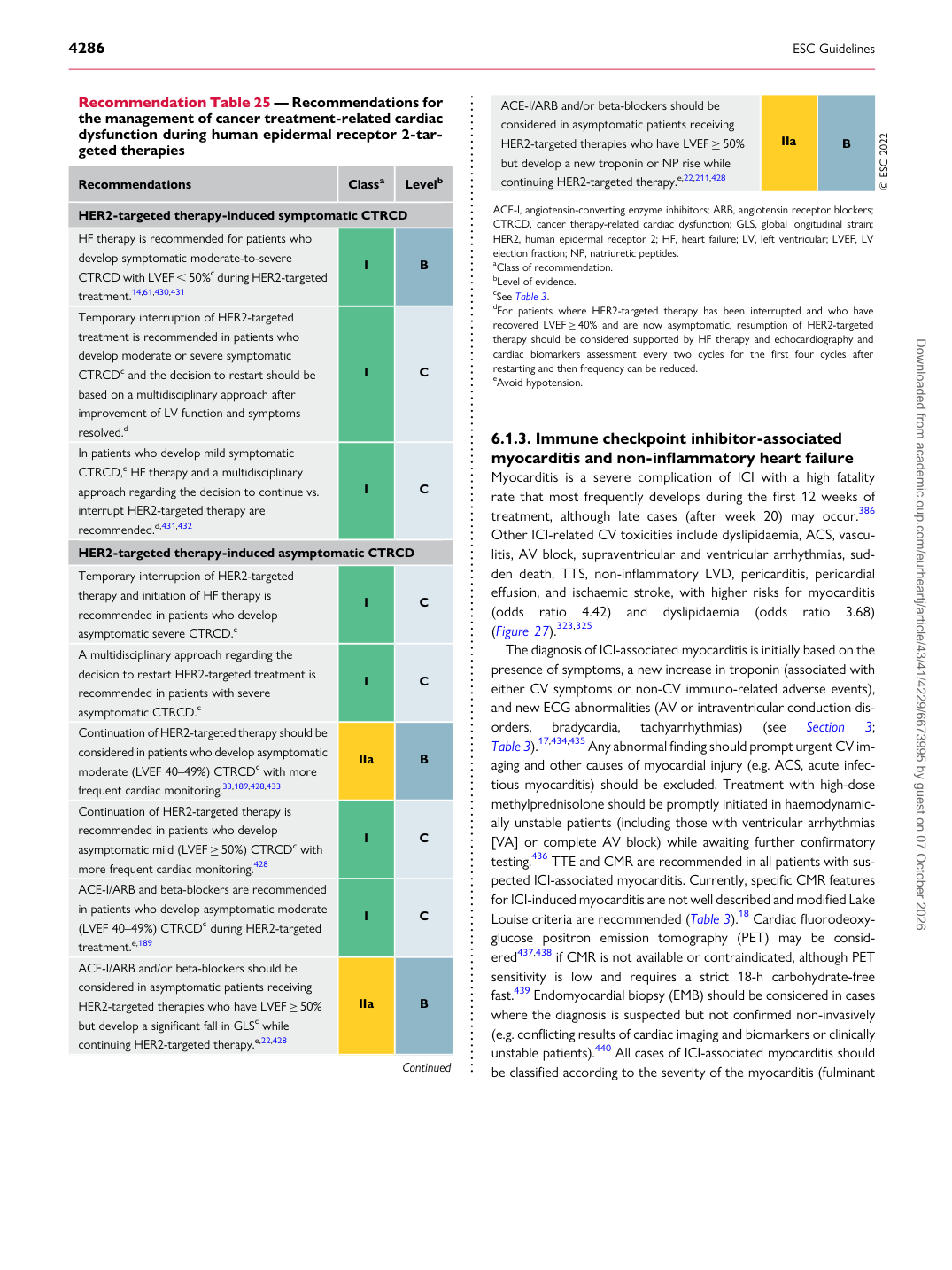
Recommendation Table 25 — Recommendations for the management of cancer treatment-related cardiac dysfunction during human epidermal receptor 2-targeted therapies

Recommendations Classa Levelb

HER2-targeted therapy-induced symptomatic CTRCD HF therapy is recommended for patients who develop symptomatic moderate-to-severe CTRCD with LVEF , 50%c during HER2-targeted treatment.14,61,430,431 I B Temporary interruption of HER2-targeted treatment is recommended in patients who develop moderate or severe symptomatic CTRCDc and the decision to restart should be based on a multidisciplinary approach after improvement of LV function and symptoms resolved.d I C In patients who develop mild symptomatic CTRCD,c HF therapy and a multidisciplinary approach regarding the decision to continue vs. interrupt HER2-targeted therapy are recommended.d,431,432 I C HER2-targeted therapy-induced asymptomatic CTRCD Temporary interruption of HER2-targeted therapy and initiation of HF therapy is recommended in patients who develop asymptomatic severe CTRCD.c I C A multidisciplinary approach regarding the decision to restart HER2-targeted treatment is recommended in patients with severe asymptomatic CTRCD.c I C Continuation of HER2-targeted therapy should be considered in patients who develop asymptomatic moderate (LVEF 40–49%) CTRCDc with more frequent cardiac monitoring.33,189,428,433 IIa B Continuation of HER2-targeted therapy is recommended in patients who develop asymptomatic mild (LVEF ≥50%) CTRCDc with more frequent cardiac monitoring.428 I C ACE-I/ARB and beta-blockers are recommended in patients who develop asymptomatic moderate (LVEF 40–49%) CTRCDc during HER2-targeted treatment.e,189 I C ACE-I/ARB and/or beta-blockers should be considered in asymptomatic patients receiving HER2-targeted therapies who have LVEF ≥50% but develop a significant fall in GLSc while continuing HER2-targeted therapy.e,22,428 IIa B

Continued ACE-I/ARB and/or beta-blockers should be

considered in asymptomatic patients receiving HER2-targeted therapies who have LVEF ≥50% but develop a new troponin or NP rise while continuing HER2-targeted therapy.e,22,211,428 IIa B © ESC 2022

ACE-I, angiotensin-converting enzyme inhibitors; ARB, angiotensin receptor blockers; CTRCD, cancer therapy-related cardiac dysfunction; GLS, global longitudinal strain; HER2, human epidermal receptor 2; HF, heart failure; LV, left ventricular; LVEF, LV ejection fraction; NP, natriuretic peptides. aClass of recommendation. bLevel of evidence. cSee Table 3. dFor patients where HER2-targeted therapy has been interrupted and who have recovered LVEF ≥40% and are now asymptomatic, resumption of HER2-targeted therapy should be considered supported by HF therapy and echocardiography and cardiac biomarkers assessment every two cycles for the first four cycles after restarting and then frequency can be reduced. eAvoid hypotension. Downloaded from academic.oup.com/eurheartj/article/43/41/4229/6673995 by guest on 07 October 2026