p.56 抽出テキスト
with dexrazoxane before each further cycle of anthracycline chemotherapy (Section 5.2.1). Close cardiac monitoring every 1–2 cycles is recommended in patients who restart anthracycline chemotherapy following an episode of CTRCD and in patients with mild asymptomatic CTRCD while they continue anthracycline chemotherapy.

6.1.2 Human epidermal receptor 2-targeted

therapy-related cardiac dysfunction The diagnosis of HER2-targeted therapy-related CTRCD can be made using the combination of new CV symptoms, imaging, and biomarkers. Patients may present with symptomatic CTRCD or may be asymptomatic.426 Early treatment of symptomatic and asymptomatic severe CTRCD (LVEF , 40%), according to the 2021 ESC Guidelines for the diagnosis and treatment of acute and chronic HF,14 is recommended to prevent worsening HF,425 particularly when targeted cancer therapy is continued.427 In patients who develop CTRCD, a MDT is recommended to guide clinical decisions. Temporary interruption is recommended in patients who develop moderate or severe symptomatic CTRCD or severe asymptomatic CTRCD (LVEF , 40%) during HER2-targeted therapy. In patients with mild symptomatic CTRCD, a MDT approach is recommended to continue vs. interrupt HER2-targeted therapy. In patients with asymptomatic moderate CTRCD (LVEF 40–49%), HER2-targeted treatment should be continued, and cardioprotective therapy (ACE-I/ARB and betablockers) is recommended with frequent cardiac monitoring.22,33,189 In patients with asymptomatic mild CTRCD (LVEF ≥ 50% with a significant new GLS reduction and/or cardiac biomarker increase), continuing HER2-targeted treatment is recommended and cardioprotective therapy (ACE-I/ARB and/or beta-blockers) should be considered.22,211,428,429 Frequent cardiac surveillance with cardiac imaging and cardiac serum biomarkers is recommended in all patients with CTRCD

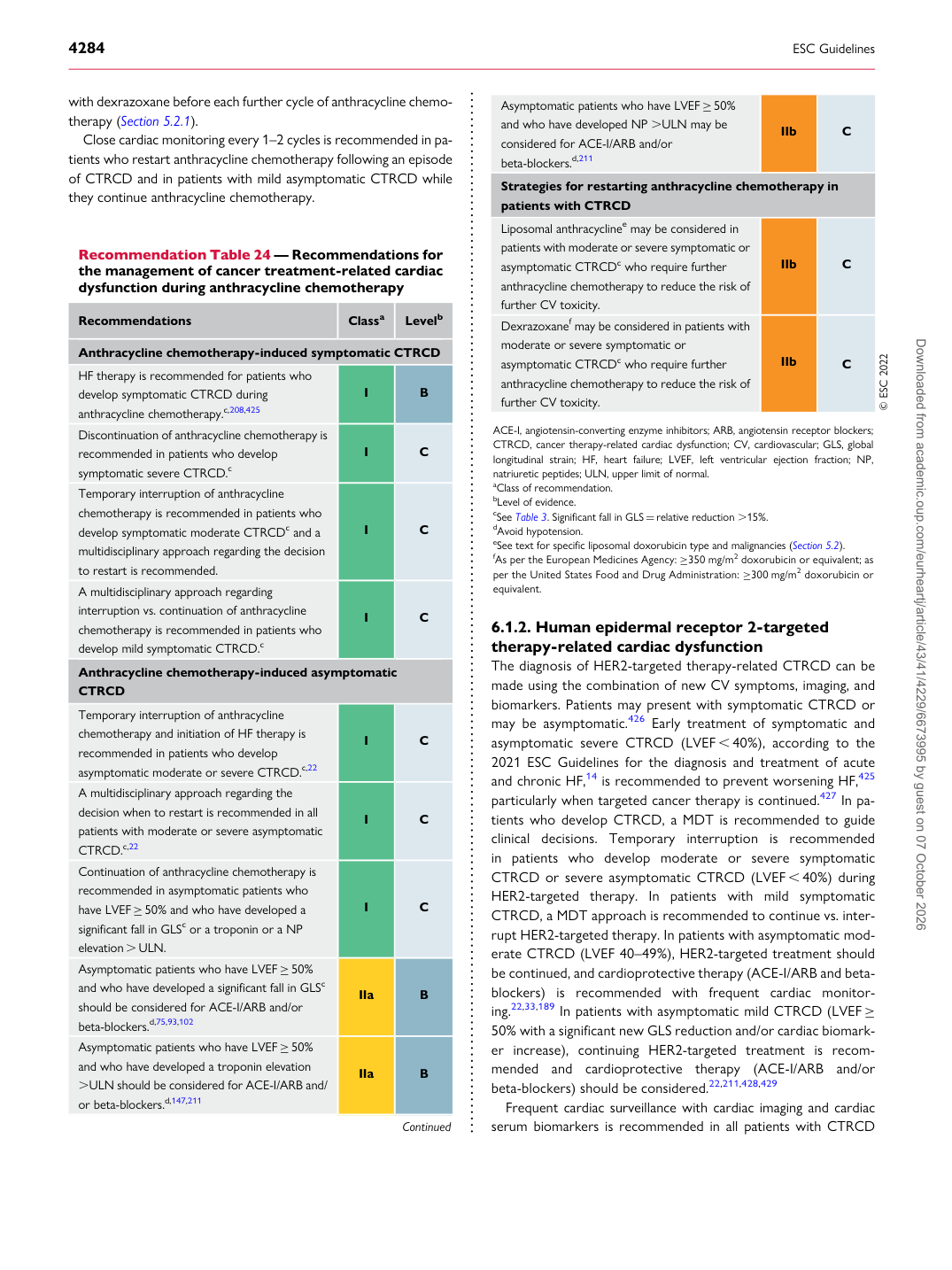
Recommendation Table 24 — Recommendations for the management of cancer treatment-related cardiac dysfunction during anthracycline chemotherapy

Recommendations Classa Levelb

Anthracycline chemotherapy-induced symptomatic CTRCD HF therapy is recommended for patients who develop symptomatic CTRCD during anthracycline chemotherapy.c,208,425 I B Discontinuation of anthracycline chemotherapy is recommended in patients who develop symptomatic severe CTRCD.c I C Temporary interruption of anthracycline chemotherapy is recommended in patients who develop symptomatic moderate CTRCDc and a multidisciplinary approach regarding the decision to restart is recommended. I C A multidisciplinary approach regarding interruption vs. continuation of anthracycline chemotherapy is recommended in patients who develop mild symptomatic CTRCD.c I C Anthracycline chemotherapy-induced asymptomatic CTRCD Temporary interruption of anthracycline chemotherapy and initiation of HF therapy is recommended in patients who develop asymptomatic moderate or severe CTRCD.c,22 I C A multidisciplinary approach regarding the decision when to restart is recommended in all patients with moderate or severe asymptomatic CTRCD.c,22 I C Continuation of anthracycline chemotherapy is recommended in asymptomatic patients who have LVEF ≥50% and who have developed a significant fall in GLSc or a troponin or a NP elevation . ULN. I C Asymptomatic patients who have LVEF ≥50% and who have developed a significant fall in GLSc should be considered for ACE-I/ARB and/or beta-blockers.d,75,93,102 IIa B Asymptomatic patients who have LVEF ≥50% and who have developed a troponin elevation .ULN should be considered for ACE-I/ARB and/ or beta-blockers.d,147,211 IIa B

Continued Asymptomatic patients who have LVEF ≥50%

and who have developed NP .ULN may be considered for ACE-I/ARB and/or beta-blockers.d,211 IIb C Strategies for restarting anthracycline chemotherapy in patients with CTRCD Liposomal anthracyclinee may be considered in patients with moderate or severe symptomatic or asymptomatic CTRCDc who require further anthracycline chemotherapy to reduce the risk of further CV toxicity. IIb C Dexrazoxanef may be considered in patients with moderate or severe symptomatic or asymptomatic CTRCDc who require further anthracycline chemotherapy to reduce the risk of further CV toxicity. IIb C © ESC 2022

ACE-I, angiotensin-converting enzyme inhibitors; ARB, angiotensin receptor blockers; CTRCD, cancer therapy-related cardiac dysfunction; CV, cardiovascular; GLS, global longitudinal strain; HF, heart failure; LVEF, left ventricular ejection fraction; NP, natriuretic peptides; ULN, upper limit of normal. aClass of recommendation. bLevel of evidence. cSee Table 3. Significant fall in GLS = relative reduction .15%. dAvoid hypotension. eSee text for specific liposomal doxorubicin type and malignancies (Section 5.2). fAs per the European Medicines Agency: ≥350 mg/m2 doxorubicin or equivalent; as per the United States Food and Drug Administration: ≥300 mg/m2 doxorubicin or equivalent. Downloaded from academic.oup.com/eurheartj/article/43/41/4229/6673995 by guest on 07 October 2026