p.49 抽出テキスト
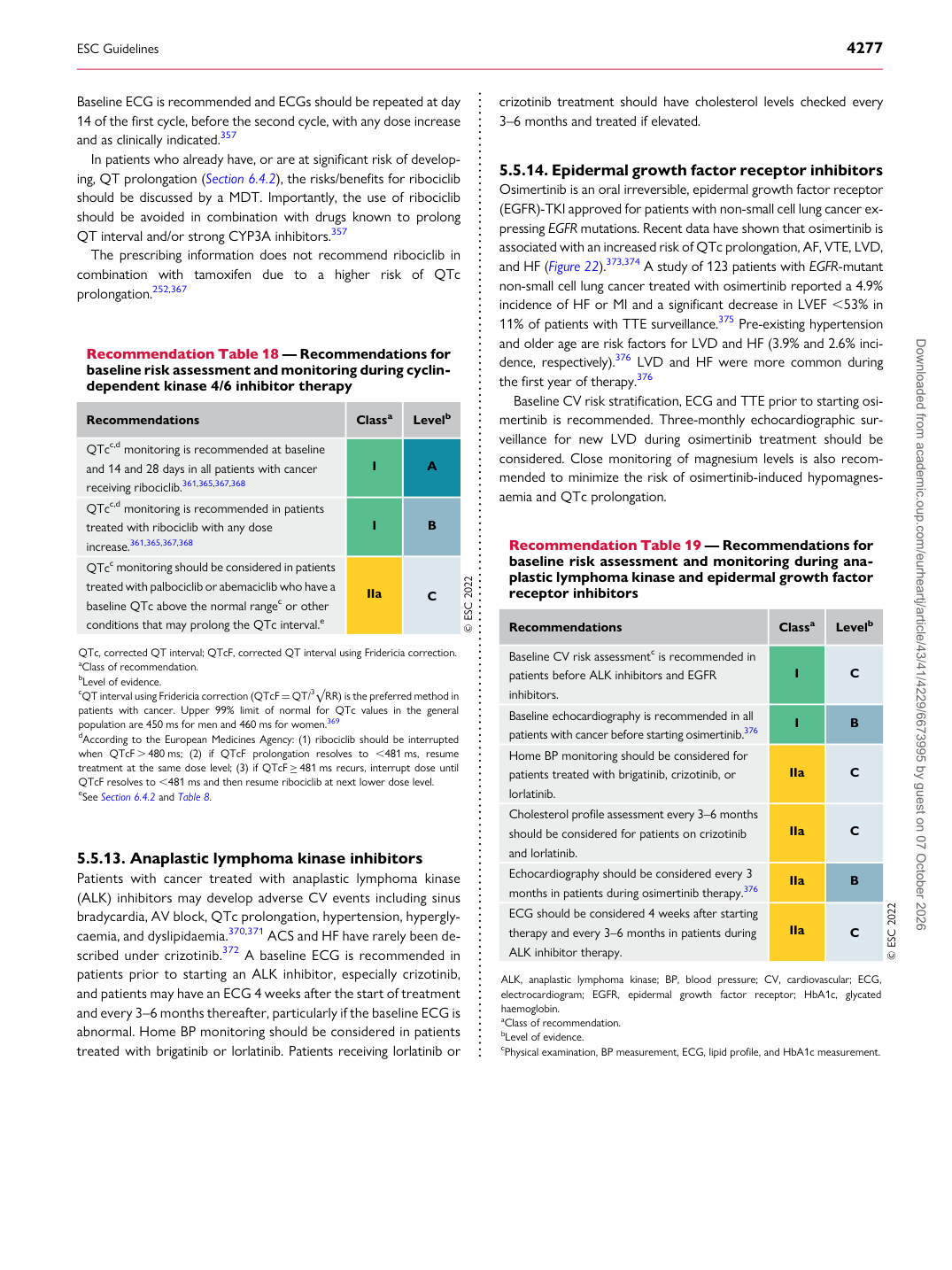
Baseline ECG is recommended and ECGs should be repeated at day 14 of the first cycle, before the second cycle, with any dose increase and as clinically indicated.357 In patients who already have, or are at significant risk of developing, QT prolongation (Section 6.4.2), the risks/benefits for ribociclib should be discussed by a MDT. Importantly, the use of ribociclib should be avoided in combination with drugs known to prolong QT interval and/or strong CYP3A inhibitors.357 The prescribing information does not recommend ribociclib in combination with tamoxifen due to a higher risk of QTc prolongation.252,367

5.5.13 Anaplastic lymphoma kinase inhibitors

Patients with cancer treated with anaplastic lymphoma kinase (ALK) inhibitors may develop adverse CV events including sinus bradycardia, AV block, QTc prolongation, hypertension, hyperglycaemia, and dyslipidaemia.370,371 ACS and HF have rarely been described under crizotinib.372 A baseline ECG is recommended in patients prior to starting an ALK inhibitor, especially crizotinib, and patients may have an ECG 4 weeks after the start of treatment and every 3–6 months thereafter, particularly if the baseline ECG is abnormal. Home BP monitoring should be considered in patients treated with brigatinib or lorlatinib. Patients receiving lorlatinib or crizotinib treatment should have cholesterol levels checked every 3–6 months and treated if elevated.

5.5.14 Epidermal growth factor receptor inhibitors

Osimertinib is an oral irreversible, epidermal growth factor receptor (EGFR)-TKI approved for patients with non-small cell lung cancer expressing EGFR mutations. Recent data have shown that osimertinib is associated with an increased risk of QTc prolongation, AF, VTE, LVD, and HF (Figure 22).373,374 A study of 123 patients with EGFR-mutant non-small cell lung cancer treated with osimertinib reported a 4.9% incidence of HF or MI and a significant decrease in LVEF ,53% in 11% of patients with TTE surveillance.375 Pre-existing hypertension and older age are risk factors for LVD and HF (3.9% and 2.6% incidence, respectively).376 LVD and HF were more common during the first year of therapy.376 Baseline CV risk stratification, ECG and TTE prior to starting osimertinib is recommended. Three-monthly echocardiographic surveillance for new LVD during osimertinib treatment should be considered. Close monitoring of magnesium levels is also recommended to minimize the risk of osimertinib-induced hypomagnesaemia and QTc prolongation.

Recommendation Table 18 — Recommendations for baseline risk assessment and monitoring during cyclindependent kinase 4/6 inhibitor therapy

Recommendations Classa Levelb QTcc,d monitoring is recommended at baseline and 14 and 28 days in all patients with cancer receiving ribociclib.361,365,367,368 I A QTcc,d monitoring is recommended in patients treated with ribociclib with any dose increase.361,365,367,368 I B QTcc monitoring should be considered in patients treated with palbociclib or abemaciclib who have a baseline QTc above the normal rangec or other conditions that may prolong the QTc interval.e IIa C © ESC 2022

QTc, corrected QT interval; QTcF, corrected QT interval using Fridericia correction. aClass of recommendation. bLevel of evidence. cQT interval using Fridericia correction (QTcF = QT/3√RR) is the preferred method in patients with cancer. Upper 99% limit of normal for QTc values in the general population are 450 ms for men and 460 ms for women.369 dAccording to the European Medicines Agency: (1) ribociclib should be interrupted when QTcF . 480 ms; (2) if QTcF prolongation resolves to ,481 ms, resume treatment at the same dose level; (3) if QTcF ≥481 ms recurs, interrupt dose until QTcF resolves to ,481 ms and then resume ribociclib at next lower dose level. eSee Section 6.4.2 and Table 8. Recommendation Table 19 — Recommendations for baseline risk assessment and monitoring during anaplastic lymphoma kinase and epidermal growth factor receptor inhibitors

Recommendations Classa Levelb Baseline CV risk assessmentc is recommended in patients before ALK inhibitors and EGFR inhibitors. I C Baseline echocardiography is recommended in all patients with cancer before starting osimertinib.376 I B Home BP monitoring should be considered for patients treated with brigatinib, crizotinib, or lorlatinib. IIa C Cholesterol profile assessment every 3–6 months should be considered for patients on crizotinib and lorlatinib. IIa C Echocardiography should be considered every 3 months in patients during osimertinib therapy.376 IIa B ECG should be considered 4 weeks after starting therapy and every 3–6 months in patients during ALK inhibitor therapy. IIa C © ESC 2022

ALK, anaplastic lymphoma kinase; BP, blood pressure; CV, cardiovascular; ECG, electrocardiogram; EGFR, epidermal growth factor receptor; HbA1c, glycated haemoglobin. aClass of recommendation. bLevel of evidence. cPhysical examination, BP measurement, ECG, lipid profile, and HbA1c measurement. Downloaded from academic.oup.com/eurheartj/article/43/41/4229/6673995 by guest on 07 October 2026