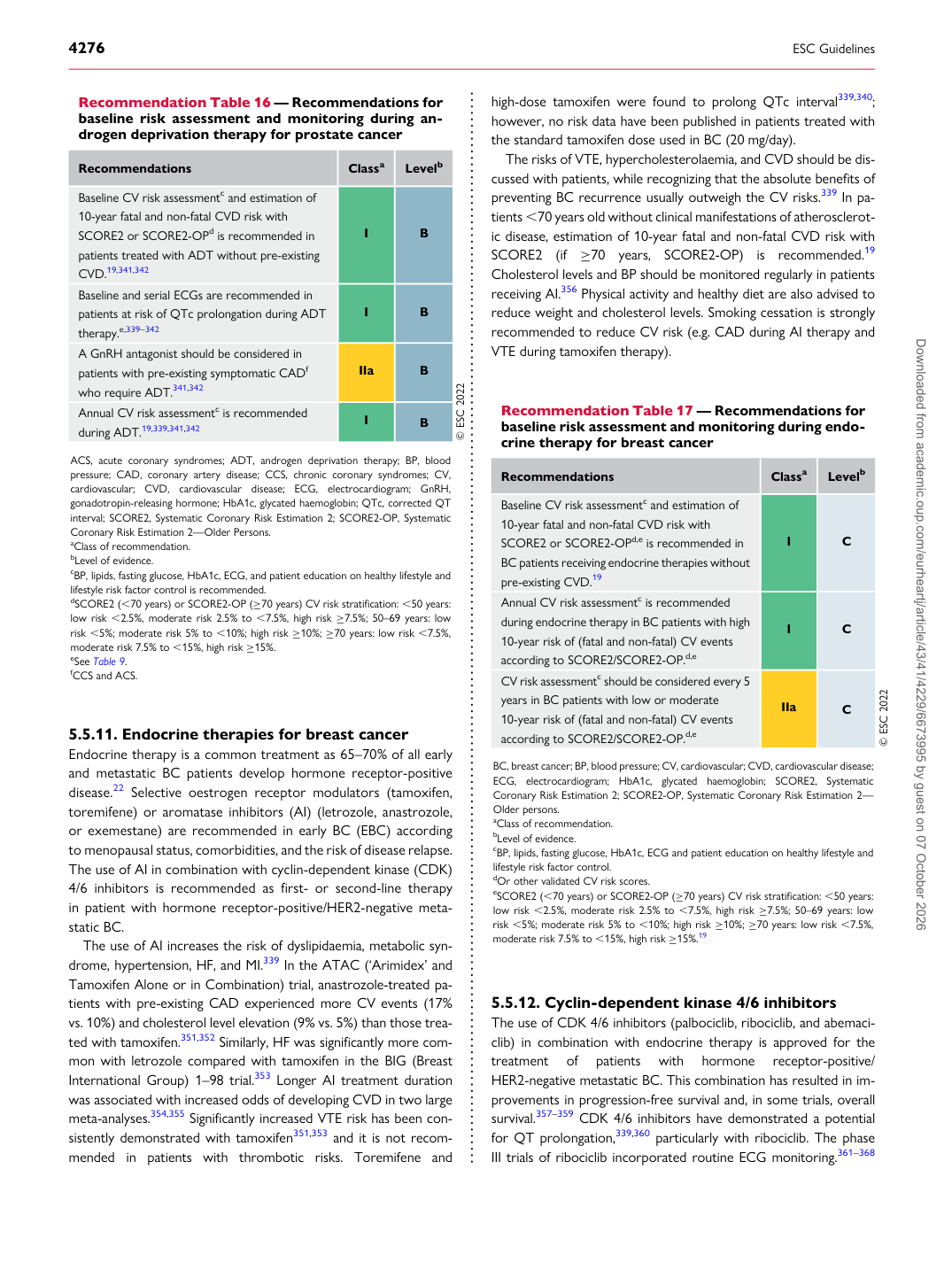
p.48 抽出テキスト
5.5.11 Endocrine therapies for breast cancer

Endocrine therapy is a common treatment as 65–70% of all early and metastatic BC patients develop hormone receptor-positive disease.22 Selective oestrogen receptor modulators (tamoxifen, toremifene) or aromatase inhibitors (AI) (letrozole, anastrozole, or exemestane) are recommended in early BC (EBC) according to menopausal status, comorbidities, and the risk of disease relapse. The use of AI in combination with cyclin-dependent kinase (CDK) 4/6 inhibitors is recommended as first- or second-line therapy in patient with hormone receptor-positive/HER2-negative metastatic BC. The use of AI increases the risk of dyslipidaemia, metabolic syndrome, hypertension, HF, and MI.339 In the ATAC (‘Arimidex’ and Tamoxifen Alone or in Combination) trial, anastrozole-treated patients with pre-existing CAD experienced more CV events (17% vs. 10%) and cholesterol level elevation (9% vs. 5%) than those treated with tamoxifen.351,352 Similarly, HF was significantly more common with letrozole compared with tamoxifen in the BIG (Breast International Group) 1–98 trial.353 Longer AI treatment duration was associated with increased odds of developing CVD in two large meta-analyses.354,355 Significantly increased VTE risk has been consistently demonstrated with tamoxifen351,353 and it is not recommended in patients with thrombotic risks. Toremifene and high-dose tamoxifen were found to prolong QTc interval339,340; however, no risk data have been published in patients treated with the standard tamoxifen dose used in BC (20 mg/day).

The risks of VTE, hypercholesterolaemia, and CVD should be discussed with patients, while recognizing that the absolute benefits of preventing BC recurrence usually outweigh the CV risks.339 In patients ,70 years old without clinical manifestations of atherosclerotic disease, estimation of 10-year fatal and non-fatal CVD risk with SCORE2 (if ≥70 years, SCORE2-OP) is recommended.19 Cholesterol levels and BP should be monitored regularly in patients receiving AI.356 Physical activity and healthy diet are also advised to reduce weight and cholesterol levels. Smoking cessation is strongly recommended to reduce CV risk (e.g. CAD during AI therapy and VTE during tamoxifen therapy).

5.5.12 Cyclin-dependent kinase 4/6 inhibitors

The use of CDK 4/6 inhibitors (palbociclib, ribociclib, and abemaciclib) in combination with endocrine therapy is approved for the treatment of patients with hormone receptor-positive/ HER2-negative metastatic BC. This combination has resulted in improvements in progression-free survival and, in some trials, overall survival.357–359 CDK 4/6 inhibitors have demonstrated a potential for QT prolongation,339,360 particularly with ribociclib. The phase III trials of ribociclib incorporated routine ECG monitoring.361–368

Recommendation Table 16 — Recommendations for baseline risk assessment and monitoring during androgen deprivation therapy for prostate cancer

Recommendations Classa Levelb Baseline CV risk assessmentc and estimation of 10-year fatal and non-fatal CVD risk with SCORE2 or SCORE2-OPd is recommended in patients treated with ADT without pre-existing CVD.19,341,342 I B Baseline and serial ECGs are recommended in patients at risk of QTc prolongation during ADT therapy.e,339–342 I B A GnRH antagonist should be considered in patients with pre-existing symptomatic CADf who require ADT.341,342 IIa B Annual CV risk assessmentc is recommended during ADT.19,339,341,342 I B © ESC 2022

ACS, acute coronary syndromes; ADT, androgen deprivation therapy; BP, blood pressure; CAD, coronary artery disease; CCS, chronic coronary syndromes; CV, cardiovascular; CVD, cardiovascular disease; ECG, electrocardiogram; GnRH, gonadotropin-releasing hormone; HbA1c, glycated haemoglobin; QTc, corrected QT interval; SCORE2, Systematic Coronary Risk Estimation 2; SCORE2-OP, Systematic Coronary Risk Estimation 2—Older Persons. aClass of recommendation. bLevel of evidence. cBP, lipids, fasting glucose, HbA1c, ECG, and patient education on healthy lifestyle and lifestyle risk factor control is recommended. dSCORE2 (,70 years) or SCORE2-OP (≥70 years) CV risk stratification: ,50 years: low risk ,2.5%, moderate risk 2.5% to ,7.5%, high risk ≥7.5%; 50–69 years: low risk ,5%; moderate risk 5% to ,10%; high risk ≥10%; ≥70 years: low risk ,7.5%, moderate risk 7.5% to ,15%, high risk ≥15%. eSee Table 9. fCCS and ACS. Recommendation Table 17 — Recommendations for baseline risk assessment and monitoring during endocrine therapy for breast cancer

Recommendations Classa Levelb Baseline CV risk assessmentc and estimation of 10-year fatal and non-fatal CVD risk with SCORE2 or SCORE2-OPd,e is recommended in BC patients receiving endocrine therapies without pre-existing CVD.19 I C Annual CV risk assessmentc is recommended during endocrine therapy in BC patients with high 10-year risk of (fatal and non-fatal) CV events according to SCORE2/SCORE2-OP.d,e I C CV risk assessmentc should be considered every 5 years in BC patients with low or moderate 10-year risk of (fatal and non-fatal) CV events according to SCORE2/SCORE2-OP.d,e IIa C © ESC 2022

BC, breast cancer; BP, blood pressure; CV, cardiovascular; CVD, cardiovascular disease; ECG, electrocardiogram; HbA1c, glycated haemoglobin; SCORE2, Systematic Coronary Risk Estimation 2; SCORE2-OP, Systematic Coronary Risk Estimation 2— Older persons. aClass of recommendation. bLevel of evidence. cBP, lipids, fasting glucose, HbA1c, ECG and patient education on healthy lifestyle and lifestyle risk factor control. dOr other validated CV risk scores. eSCORE2 (,70 years) or SCORE2-OP (≥70 years) CV risk stratification: ,50 years: low risk ,2.5%, moderate risk 2.5% to ,7.5%, high risk ≥7.5%; 50–69 years: low risk ,5%; moderate risk 5% to ,10%; high risk ≥10%; ≥70 years: low risk ,7.5%, moderate risk 7.5% to ,15%, high risk ≥15%.19 Downloaded from academic.oup.com/eurheartj/article/43/41/4229/6673995 by guest on 07 October 2026