p.46 抽出テキスト
overactivation of T cells against non-cancerous tissues, leading to immune-related adverse events.317 Immune-related CV side effects may lead to life-threatening CV complications such as fulminant myocarditis, myopericarditis, cardiac dysfunction, arrhythmias, or MI, which often results in the discontinuation of ICI.318,319 The largest case series of 122 patients with ICI-associated myocarditis had early onset of symptoms (median of 30 days after initial exposure to ICI), and up to 50% died.320 Late CV events (.90 days) are less well characterized but generally exhibit a higher risk of non-inflammatory HF, progressive atherosclerosis, hypertension, and mortality rates.321 Other CV toxicities described during ICI therapy are MI, AV block, supraventricular and ventricular arrhythmias, sudden death, Takotsubo-like syndrome, non-inflammatory HF, hypercholesterolaemia, pericarditis, pericardial effusion, ischaemic stroke, and VTE.322 A meta-analysis including 32 518 patients receiving ICI treatment reported an increased risk of myocarditis, pericardial diseases, HF, dyslipidaemia, MI, and cerebral arterial ischaemia.323 Conditions related with high baseline ICI-related CV toxicity risk include dual ICI therapy (e.g. ipilimumab and nivolumab), combination ICI therapy with other cardiotoxic therapies, and patients with ICI-related non-CV events or prior CTRCD or CVD (Figure 20).324,325 All patients on ICI treatment should have an ECG and troponin assay at baseline (Figure 20).326–329 High-risk patients should additionally have a TTE evaluation at baseline. Due to the lack of evidence-based recommendations, the monitoring of ICI therapy is challenging. Once started on therapy, ECG, cTn, and NP should be checked.330–332 In the JAVELIN trial, which assessed avelumab plus axitinib vs. sunitinib, no clinical value was observed for ontreatment routine TTE monitoring in asymptomatic patients.333 However, in high-risk patients, and in those with high baseline cTn levels, TTE monitoring may be considered. In patients who develop ECG abnormalities, new biomarker changes, or new cardiac symptoms at any time, prompt cardio-oncology evaluation is strongly recommended, including TTE for the evaluation of LVEF and GLS, and CMR when myocarditis is suspected (Table 3).334 5.5.10 Androgen deprivation therapies for

prostate cancer Androgen deprivation therapy (ADT) is prescribed in 40% of men with prostate cancer as neoadjuvant and/or adjuvant therapy to RT or for biochemical relapse following prostate cancer surgery. Gonadotropin-releasing hormone (GnRH) agonists are the most frequently prescribed ADT. However, GnRH agonists are associated with an increased CV risk and mortality, particularly in patients with prostate cancer aged .60 years.337,338 Baseline risk stratification in patients requiring GnRH agonists depends on vascular disease risk (Figure 21).339,340 No dedicated CV toxicity risk calculators have been developed for patients receiving ADT. It was the consensus of the authors to recommend SCORE2 or SCORE2-OP to stratify CV risk in patients receiving ADT without previous CVD.19 The use of GnRH antagonists represents an alternative in the treatment of prostate cancer, and preclinical and clinical (HERO trial)341 data suggest that GnRH antagonist use is associated with significantly lower overall mortality and CV events compared with agonists.342 However, more research is needed in this field. In the PRONOUNCE trial, no difference in MACE at 1 year was observed between degarelix (a GnRH antagonist) and leuprolide (a GnRH agonist), although the trial was stopped early.343 Lower CV event rates were detected compared with previous studies and all patients were reviewed by a cardiologist at enrolment (leading to optimal CVRF management).343 The main CV effects to be considered are hypertension, DM, ischaemic heart disease (IHD) and CTRCD.339,344 ADT is uncommonly associated with QTc prolongation and rarely causes torsade de pointes (TdP) through blockade of testosterone effects on ventricular repolarization.345,346 ECG monitoring and correction of QT prolongation precipitant factors (see Section 6.4.2; Table 9; Supplementary data, Table S13) is recommended340,347,348 during prostate cancer treatment if the baseline QTc interval is prolonged.49,339,340,347,349,350

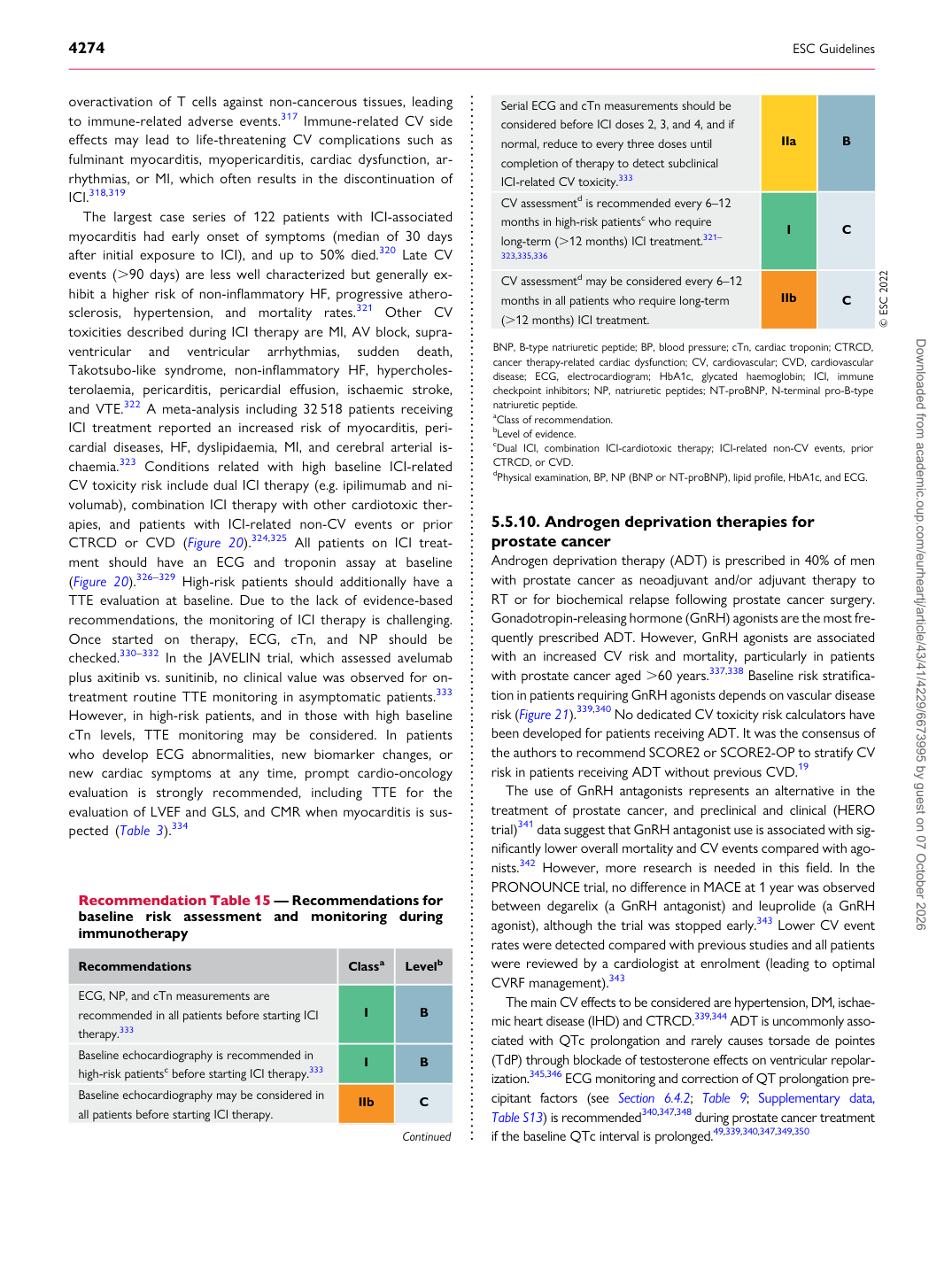
Recommendation Table 15 — Recommendations for baseline risk assessment and monitoring during immunotherapy

Recommendations Classa Levelb

ECG, NP, and cTn measurements are recommended in all patients before starting ICI therapy.333 I B Baseline echocardiography is recommended in high-risk patientsc before starting ICI therapy.333 I B Baseline echocardiography may be considered in all patients before starting ICI therapy. IIb C

Continued Serial ECG and cTn measurements should be

considered before ICI doses 2, 3, and 4, and if normal, reduce to every three doses until completion of therapy to detect subclinical ICI-related CV toxicity.333 IIa B CV assessmentd is recommended every 6–12 months in high-risk patientsc who require long-term (.12 months) ICI treatment.321– 323,335,336 I C CV assessmentd may be considered every 6–12 months in all patients who require long-term (.12 months) ICI treatment. IIb C © ESC 2022

BNP, B-type natriuretic peptide; BP, blood pressure; cTn, cardiac troponin; CTRCD, cancer therapy-related cardiac dysfunction; CV, cardiovascular; CVD, cardiovascular disease; ECG, electrocardiogram; HbA1c, glycated haemoglobin; ICI, immune checkpoint inhibitors; NP, natriuretic peptides; NT-proBNP, N-terminal pro-B-type natriuretic peptide. aClass of recommendation. bLevel of evidence. cDual ICI, combination ICI-cardiotoxic therapy; ICI-related non-CV events, prior CTRCD, or CVD. dPhysical examination, BP, NP (BNP or NT-proBNP), lipid profile, HbA1c, and ECG. Downloaded from academic.oup.com/eurheartj/article/43/41/4229/6673995 by guest on 07 October 2026