p.44 抽出テキスト
and beta-blockers) have not been evaluated in patients treated with MEK and RAF inhibitors but, from a mechanistic perspective, beta-blockers might prevent CTRCD induced by MEK inhibitors. The MEK/ERK pathway has a cardiac protective effect, regulated by beta-adrenergic signalling, which also controls the p38 mitogen-activated protein kinases pathway, associated with cardiotoxic effects. Beta-blockers might exert their cardioprotective effects by reducing p38 signalling.315

Dabrafenib

Encorafenib

RAF inhibitors

Vemurafenibb

Binimetinib

Cobimetinib

MEK inhibitors

Trametinibb HTN SVT/SBra HG/DM HF BLEED VTE/PE

RAF inhibitor- and MEK inhibitor-related cardiovascular toxicities

Very common: ≥10% incidence

Common: 1% to <10% incidence Uncommon: 0.1% to < 1% incidence

Rare: <0.1% incidence QTc

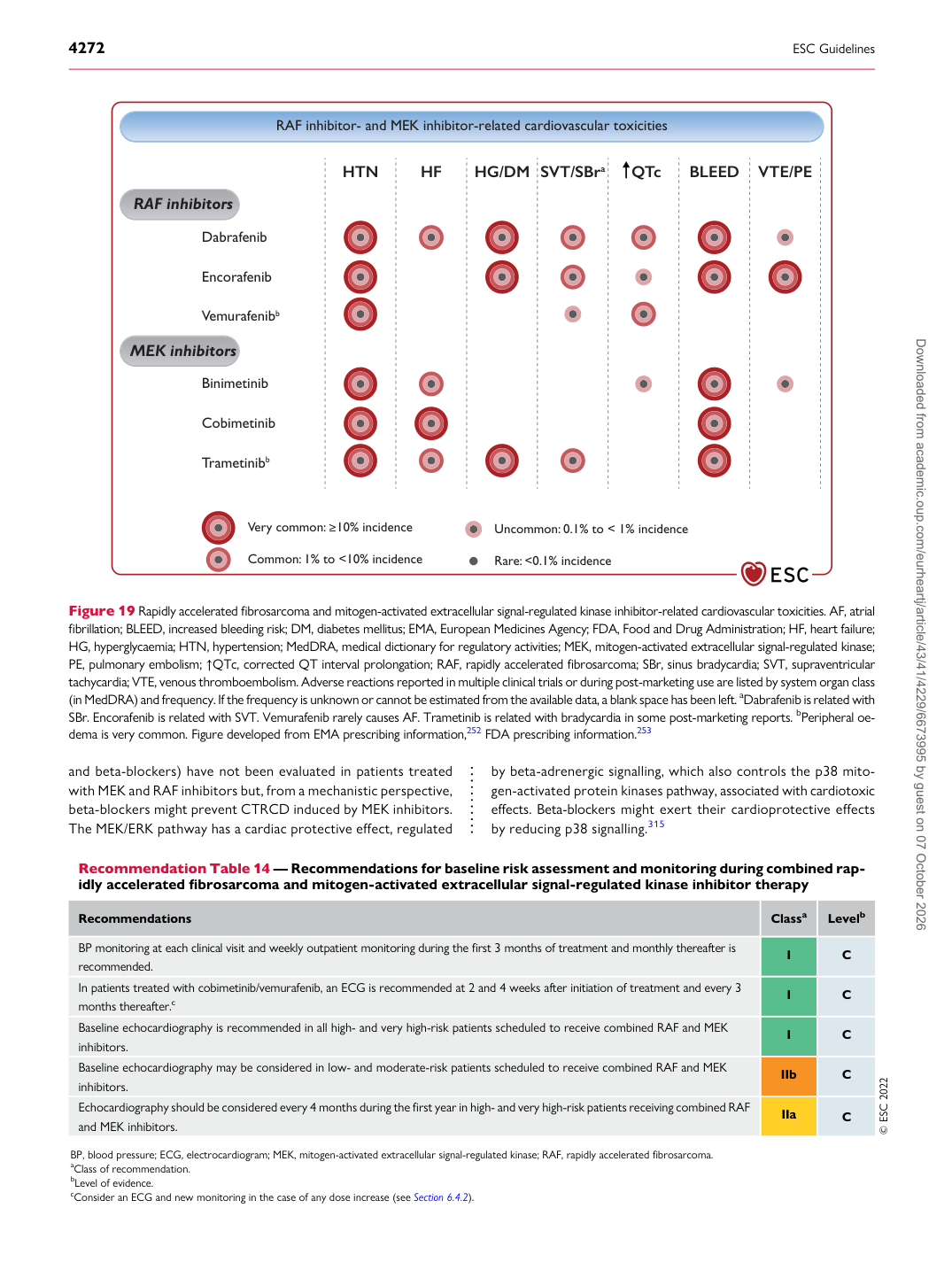
Figure 19 Rapidly accelerated fibrosarcoma and mitogen-activated extracellular signal-regulated kinase inhibitor-related cardiovascular toxicities. AF, atrial fibrillation; BLEED, increased bleeding risk; DM, diabetes mellitus; EMA, European Medicines Agency; FDA, Food and Drug Administration; HF, heart failure; HG, hyperglycaemia; HTN, hypertension; MedDRA, medical dictionary for regulatory activities; MEK, mitogen-activated extracellular signal-regulated kinase; PE, pulmonary embolism; ↑QTc, corrected QT interval prolongation; RAF, rapidly accelerated fibrosarcoma; SBr, sinus bradycardia; SVT, supraventricular tachycardia; VTE, venous thromboembolism. Adverse reactions reported in multiple clinical trials or during post-marketing use are listed by system organ class (in MedDRA) and frequency. If the frequency is unknown or cannot be estimated from the available data, a blank space has been left. aDabrafenib is related with SBr. Encorafenib is related with SVT. Vemurafenib rarely causes AF. Trametinib is related with bradycardia in some post-marketing reports. bPeripheral oedema is very common. Figure developed from EMA prescribing information,252 FDA prescribing information.253

Recommendation Table 14 — Recommendations for baseline risk assessment and monitoring during combined rapidly accelerated fibrosarcoma and mitogen-activated extracellular signal-regulated kinase inhibitor therapy

Recommendations Classa Levelb

BP monitoring at each clinical visit and weekly outpatient monitoring during the first 3 months of treatment and monthly thereafter is recommended. I C In patients treated with cobimetinib/vemurafenib, an ECG is recommended at 2 and 4 weeks after initiation of treatment and every 3 months thereafter.c I C Baseline echocardiography is recommended in all high- and very high-risk patients scheduled to receive combined RAF and MEK inhibitors. I C Baseline echocardiography may be considered in low- and moderate-risk patients scheduled to receive combined RAF and MEK inhibitors. IIb C Echocardiography should be considered every 4 months during the first year in high- and very high-risk patients receiving combined RAF and MEK inhibitors. IIa C © ESC 2022

BP, blood pressure; ECG, electrocardiogram; MEK, mitogen-activated extracellular signal-regulated kinase; RAF, rapidly accelerated fibrosarcoma. aClass of recommendation. bLevel of evidence. cConsider an ECG and new monitoring in the case of any dose increase (see Section 6.4.2). Downloaded from academic.oup.com/eurheartj/article/43/41/4229/6673995 by guest on 07 October 2026