p.43 抽出テキスト
5.5.8 Rapidly accelerated fibrosarcoma and

mitogen-activated extracellular signal-regulated kinase inhibitor treatment The rapidly accelerated fibrosarcoma (RAF) inhibitors—vemurafenib, dabrafenib, and encorafenib—are approved for the treatment of metastatic melanoma with a BRAF V600 mutation. The mitogenactivated extracellular signal-regulated kinase (MEK) inhibitors— trametinib, cobimetinib, binimetinib, and selumetinib—have also shown significant clinical activity in melanoma patients whose tumour contains a BRAF V600 mutation, and are now largely used in combination with RAF inhibitors. The main CV effects to be considered are hypertension, PE, and CTRCD, which are associated with all combinations of RAF and MEK inhibitors, and QTc prolongation, associated solely with the coadministration of cobimetinib and vemurafenib (Figure 19).12,308,309 RAF inhibitor treatment alone or in combination with a MEK inhibitor is associated with an increased risk of MI and AF.308 Patients with cancer with pre-existing CVD have an increased frequency of CV adverse events during treatment with MEK and RAF inhibitors, and therefore baseline risk stratification is recommended.12 Most cardiac complications induced by administration of MEK and RAF inhibitors seem to be attributable to the MEK inhibitor, with the RAF inhibitor enhancing the toxic effects of the MEK inhibitor.310–313 Hypertension and LVD were twice as frequent when MEK and RAF inhibitors were coadministered compared with single therapy with RAF inhibitor alone.314 CTRCD can manifest any time from the first month of therapy to 2 years after the end of the oncological treatment.315 Baseline TTE is recommended in patients at moderate to high risk of CTR-CVT. During treatment, it is necessary to monitor BP at each visit and promote weekly outpatient monitoring during the first 3 months and monthly thereafter. In patients treated with cobimetinib/vemurafenib, an ECG is recommended at 2 and 4 weeks after initiation of treatment and every 3 months thereafter. In high-risk patients, periodic monitoring of ventricular function with echocardiography should be considered every 6–12 months. CV protective medications (such as angiotensin-converting enzyme inhibitors [ACE-I], angiotensin receptor blockers [ARB],

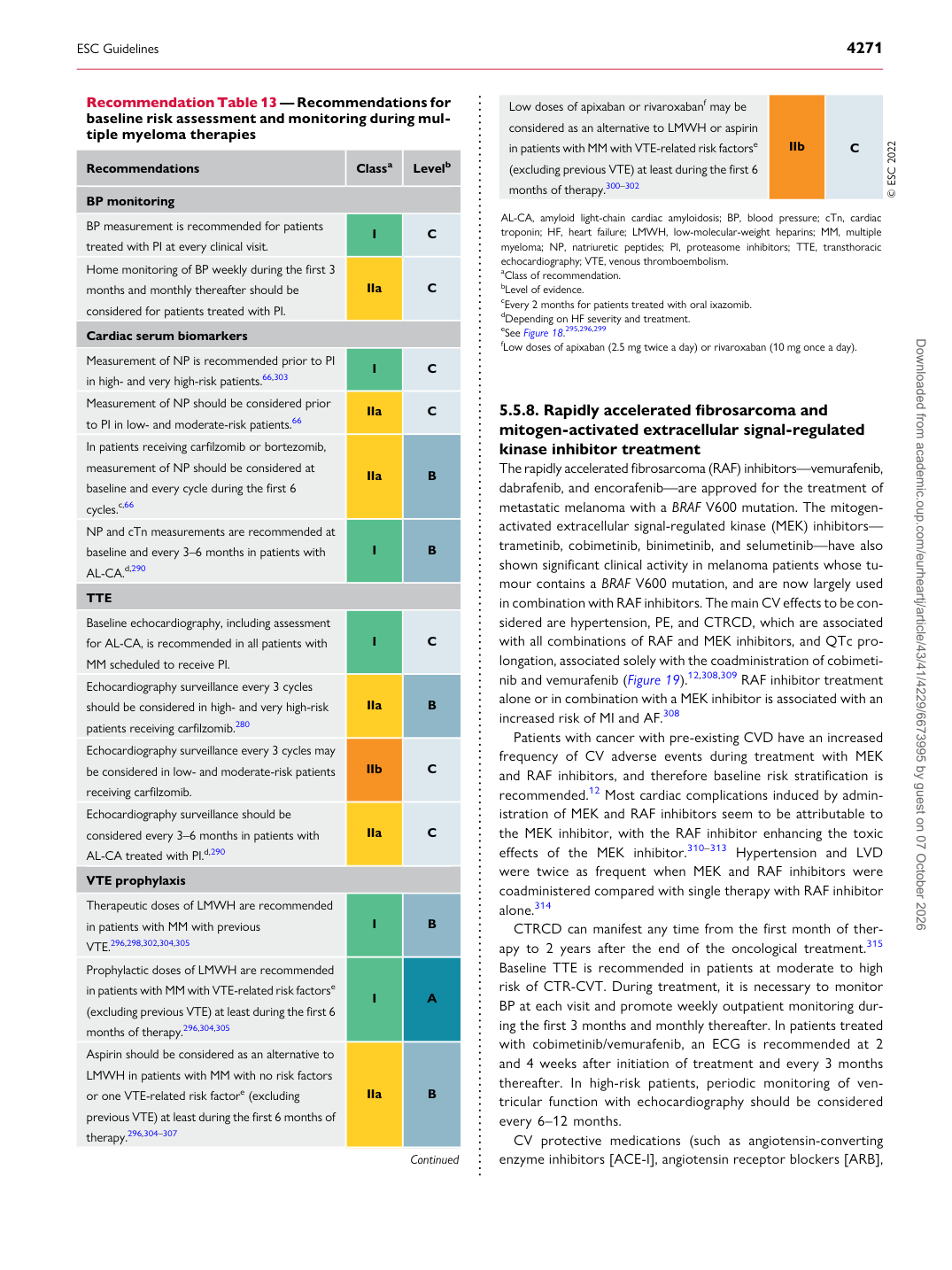
Recommendation Table 13 — Recommendations for baseline risk assessment and monitoring during multiple myeloma therapies

Recommendations Classa Levelb

BP monitoring BP measurement is recommended for patients treated with PI at every clinical visit. I C Home monitoring of BP weekly during the first 3 months and monthly thereafter should be considered for patients treated with PI. IIa C Cardiac serum biomarkers Measurement of NP is recommended prior to PI in high- and very high-risk patients.66,303 I C Measurement of NP should be considered prior to PI in low- and moderate-risk patients.66 IIa C In patients receiving carfilzomib or bortezomib, measurement of NP should be considered at baseline and every cycle during the first 6 cycles.c,66 IIa B NP and cTn measurements are recommended at baseline and every 3–6 months in patients with AL-CA.d,290 I B TTE Baseline echocardiography, including assessment for AL-CA, is recommended in all patients with MM scheduled to receive PI. I C Echocardiography surveillance every 3 cycles should be considered in high- and very high-risk patients receiving carfilzomib.280 IIa B Echocardiography surveillance every 3 cycles may be considered in low- and moderate-risk patients receiving carfilzomib. IIb C Echocardiography surveillance should be considered every 3–6 months in patients with AL-CA treated with PI.d,290 IIa C VTE prophylaxis Therapeutic doses of LMWH are recommended in patients with MM with previous VTE.296,298,302,304,305 I B Prophylactic doses of LMWH are recommended in patients with MM with VTE-related risk factorse (excluding previous VTE) at least during the first 6 months of therapy.296,304,305 I A Aspirin should be considered as an alternative to LMWH in patients with MM with no risk factors or one VTE-related risk factore (excluding previous VTE) at least during the first 6 months of therapy.296,304–307 IIa B

Continued Low doses of apixaban or rivaroxabanf may be

considered as an alternative to LMWH or aspirin in patients with MM with VTE-related risk factorse (excluding previous VTE) at least during the first 6 months of therapy.300–302 IIb C © ESC 2022

AL-CA, amyloid light-chain cardiac amyloidosis; BP, blood pressure; cTn, cardiac troponin; HF, heart failure; LMWH, low-molecular-weight heparins; MM, multiple myeloma; NP, natriuretic peptides; PI, proteasome inhibitors; TTE, transthoracic echocardiography; VTE, venous thromboembolism. aClass of recommendation. bLevel of evidence. cEvery 2 months for patients treated with oral ixazomib. dDepending on HF severity and treatment. eSee Figure 18.295,296,299 fLow doses of apixaban (2.5 mg twice a day) or rivaroxaban (10 mg once a day). Downloaded from academic.oup.com/eurheartj/article/43/41/4229/6673995 by guest on 07 October 2026