p.39 抽出テキスト
Baseline ECG is recommended in all patients and QTc monitoring in patients treated with second-generation BCR-ABL TKI. Depending on the type of therapy used, specific CV assessments should be performed after drug initiation (Figure 15).256

5.5.6 Bruton tyrosine kinase inhibitors

Bruton tyrosine kinase (BTK) inhibitors are increasingly used to treat lymphoid malignancies. Ibrutinib, a first-in-class irreversible oral inhibitor of BTK, has proven highly effective in chronic lymphocytic leukaemia and related B-cell malignancies including mantle cell lymphoma, Waldenström macroglobulinemia, and marginal zone lymphomas.262 These disorders are usually diagnosed in elderly patients in whom frequent comorbidities coexist at diagnosis that increase the risk of CTR-CVT.263,264 Ibrutinib has been associated with bleeding diathesis, infections, and an increased risk of hypertension, AF, and HF.265–267 Ibrutinib may also cause ventricular arrhythmias without prolonging QT.267,268 Acalabrutinib is a secondgeneration BTK inhibitor with greater BTK selectivity. In a recent phase III, randomized, multicentre, open-label, non-inferiority study, acalabrutinib demonstrated a non-inferior progression-free survival compared to ibrutinib in patients with previously treated chronic lymphocytic leukaemia with a lower incidence of symptomatic CV events.269 However, grade ≥3 AF (symptomatic AF where urgent intervention is indicated)270 and AF in patients ≥75 years old or with previous AF history were comparable between groups, as was the risk of CV events in patients with pre-existing CVRFs or CVD.271

Therefore, we currently do not have enough data to establish different monitoring strategies in patients treated with these drugs. Due to the lack of evidence-based recommendations, the management of these CV events is challenging.264 Antihypertensive initiation has been associated with a lower risk of a major adverse CV events (MACE).264 Opportunistic screening for AF by pulse-taking or ECG rhythm strip is recommended at every clinical visit during BTK inhibitor therapy.272 Due to a higher bleeding risk, ibrutinib should be temporarily interrupted in patients requiring dual antiplatelet therapy (DAPT) and 3–7 days before invasive procedures. In case of emergency interventions, platelet transfusion should be considered to minimize bleeding risks.262

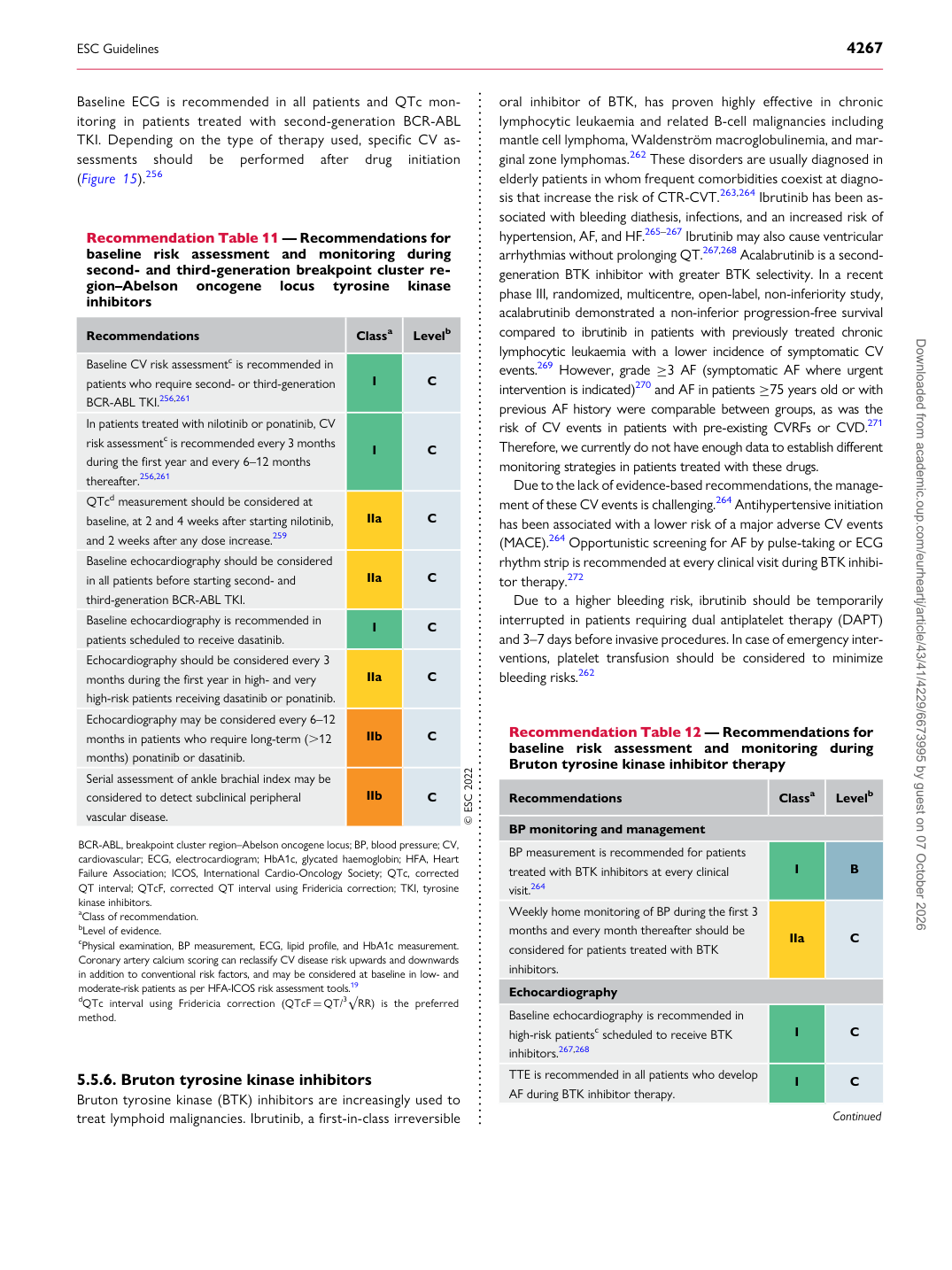
Recommendation Table 11 — Recommendations for baseline risk assessment and monitoring during second- and third-generation breakpoint cluster region–Abelson oncogene locus tyrosine kinase inhibitors

Recommendations Classa Levelb Baseline CV risk assessmentc is recommended in patients who require second- or third-generation BCR-ABL TKI.256,261 I C In patients treated with nilotinib or ponatinib, CV risk assessmentc is recommended every 3 months during the first year and every 6–12 months thereafter.256,261 I C QTcd measurement should be considered at baseline, at 2 and 4 weeks after starting nilotinib, and 2 weeks after any dose increase.259 IIa C Baseline echocardiography should be considered in all patients before starting second- and third-generation BCR-ABL TKI. IIa C Baseline echocardiography is recommended in patients scheduled to receive dasatinib. I C Echocardiography should be considered every 3 months during the first year in high- and very high-risk patients receiving dasatinib or ponatinib. IIa C Echocardiography may be considered every 6–12 months in patients who require long-term (.12 months) ponatinib or dasatinib. IIb C Serial assessment of ankle brachial index may be considered to detect subclinical peripheral vascular disease. IIb C © ESC 2022

BCR-ABL, breakpoint cluster region–Abelson oncogene locus; BP, blood pressure; CV, cardiovascular; ECG, electrocardiogram; HbA1c, glycated haemoglobin; HFA, Heart Failure Association; ICOS, International Cardio-Oncology Society; QTc, corrected QT interval; QTcF, corrected QT interval using Fridericia correction; TKI, tyrosine kinase inhibitors. aClass of recommendation. bLevel of evidence. cPhysical examination, BP measurement, ECG, lipid profile, and HbA1c measurement. Coronary artery calcium scoring can reclassify CV disease risk upwards and downwards in addition to conventional risk factors, and may be considered at baseline in low- and moderate-risk patients as per HFA-ICOS risk assessment tools.19 dQTc interval using Fridericia correction (QTcF = QT/3√RR) is the preferred method. Recommendation Table 12 — Recommendations for baseline risk assessment and monitoring during Bruton tyrosine kinase inhibitor therapy

Recommendations Classa Levelb

BP monitoring and management BP measurement is recommended for patients treated with BTK inhibitors at every clinical visit.264 I B Weekly home monitoring of BP during the first 3 months and every month thereafter should be considered for patients treated with BTK inhibitors. IIa C Echocardiography Baseline echocardiography is recommended in high-risk patientsc scheduled to receive BTK inhibitors.267,268 I C TTE is recommended in all patients who develop AF during BTK inhibitor therapy. I C

Continued Downloaded from academic.oup.com/eurheartj/article/43/41/4229/6673995 by guest on 07 October 2026