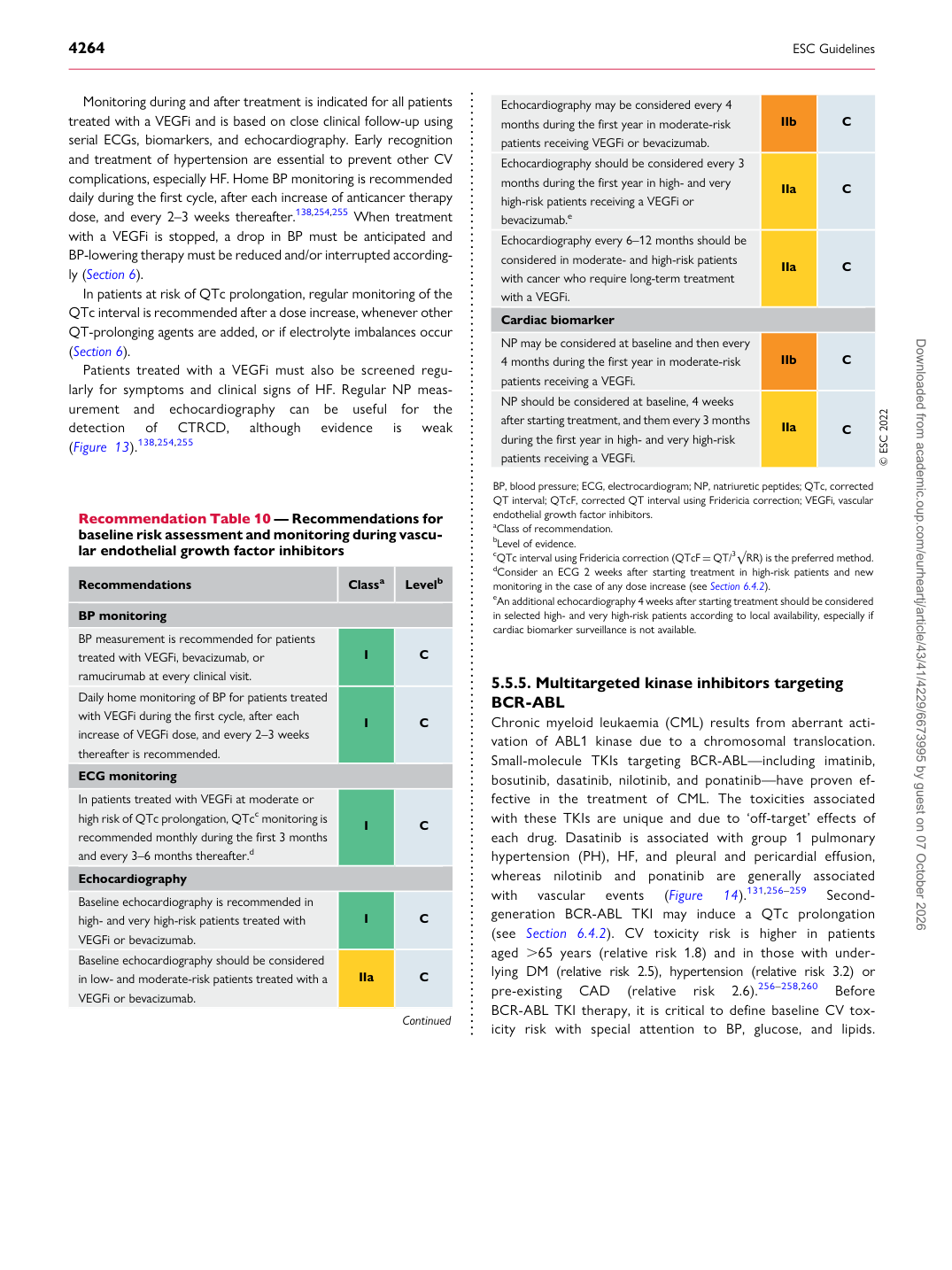
p.36 抽出テキスト
Monitoring during and after treatment is indicated for all patients treated with a VEGFi and is based on close clinical follow-up using serial ECGs, biomarkers, and echocardiography. Early recognition and treatment of hypertension are essential to prevent other CV complications, especially HF. Home BP monitoring is recommended daily during the first cycle, after each increase of anticancer therapy dose, and every 2–3 weeks thereafter.138,254,255 When treatment with a VEGFi is stopped, a drop in BP must be anticipated and BP-lowering therapy must be reduced and/or interrupted accordingly (Section 6). In patients at risk of QTc prolongation, regular monitoring of the QTc interval is recommended after a dose increase, whenever other QT-prolonging agents are added, or if electrolyte imbalances occur (Section 6). Patients treated with a VEGFi must also be screened regularly for symptoms and clinical signs of HF. Regular NP measurement and echocardiography can be useful for the detection of CTRCD, although evidence is weak (Figure 13).138,254,255

5.5.5 Multitargeted kinase inhibitors targeting

BCR-ABL Chronic myeloid leukaemia (CML) results from aberrant activation of ABL1 kinase due to a chromosomal translocation. Small-molecule TKIs targeting BCR-ABL—including imatinib, bosutinib, dasatinib, nilotinib, and ponatinib—have proven effective in the treatment of CML. The toxicities associated with these TKIs are unique and due to ‘off-target’ effects of each drug. Dasatinib is associated with group 1 pulmonary hypertension (PH), HF, and pleural and pericardial effusion, whereas nilotinib and ponatinib are generally associated with vascular events (Figure 14).131,256–259 Secondgeneration BCR-ABL TKI may induce a QTc prolongation (see Section 6.4.2). CV toxicity risk is higher in patients aged .65 years (relative risk 1.8) and in those with underlying DM (relative risk 2.5), hypertension (relative risk 3.2) or pre-existing CAD (relative risk 2.6).256–258,260 Before BCR-ABL TKI therapy, it is critical to define baseline CV toxicity risk with special attention to BP, glucose, and lipids.

Recommendation Table 10 — Recommendations for baseline risk assessment and monitoring during vascular endothelial growth factor inhibitors

Recommendations Classa Levelb

BP monitoring BP measurement is recommended for patients treated with VEGFi, bevacizumab, or ramucirumab at every clinical visit. I C Daily home monitoring of BP for patients treated with VEGFi during the first cycle, after each increase of VEGFi dose, and every 2–3 weeks thereafter is recommended. I C ECG monitoring In patients treated with VEGFi at moderate or high risk of QTc prolongation, QTcc monitoring is recommended monthly during the first 3 months and every 3–6 months thereafter.d I C Echocardiography Baseline echocardiography is recommended in high- and very high-risk patients treated with VEGFi or bevacizumab. I C Baseline echocardiography should be considered in low- and moderate-risk patients treated with a VEGFi or bevacizumab. IIa C

Continued Echocardiography may be considered every 4 months during the first year in moderate-risk patients receiving VEGFi or bevacizumab. IIb C

Echocardiography should be considered every 3 months during the first year in high- and very high-risk patients receiving a VEGFi or bevacizumab.e IIa C Echocardiography every 6–12 months should be considered in moderate- and high-risk patients with cancer who require long-term treatment with a VEGFi. IIa C Cardiac biomarker NP may be considered at baseline and then every 4 months during the first year in moderate-risk patients receiving a VEGFi. IIb C NP should be considered at baseline, 4 weeks after starting treatment, and them every 3 months during the first year in high- and very high-risk patients receiving a VEGFi. IIa C © ESC 2022

BP, blood pressure; ECG, electrocardiogram; NP, natriuretic peptides; QTc, corrected QT interval; QTcF, corrected QT interval using Fridericia correction; VEGFi, vascular endothelial growth factor inhibitors. aClass of recommendation. bLevel of evidence. cQTc interval using Fridericia correction (QTcF = QT/3√RR) is the preferred method. dConsider an ECG 2 weeks after starting treatment in high-risk patients and new monitoring in the case of any dose increase (see Section 6.4.2). eAn additional echocardiography 4 weeks after starting treatment should be considered in selected high- and very high-risk patients according to local availability, especially if cardiac biomarker surveillance is not available. Downloaded from academic.oup.com/eurheartj/article/43/41/4229/6673995 by guest on 07 October 2026